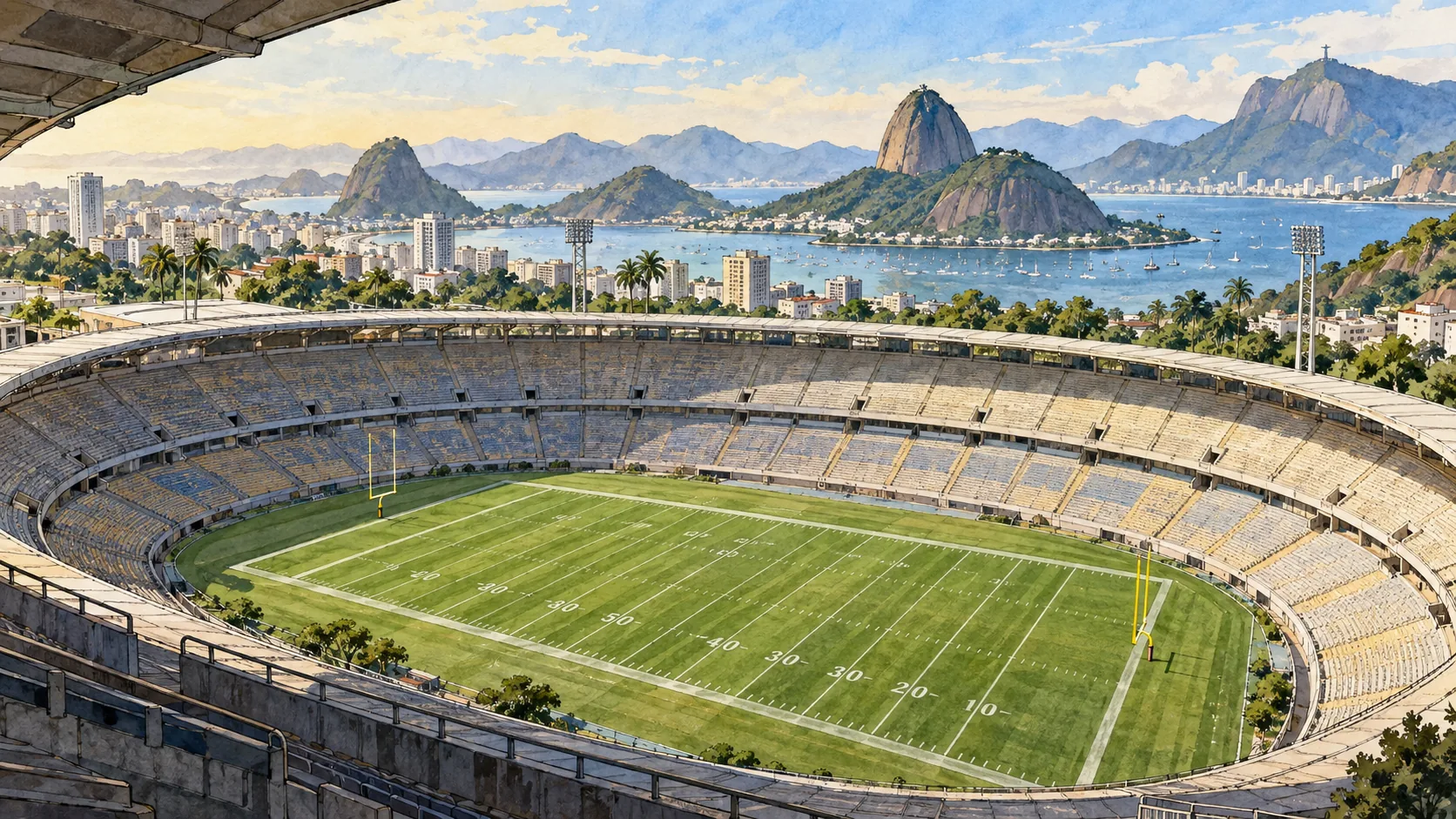
As of September 26, 2026, the Baltimore Ravens–Dallas Cowboys game in Rio de Janeiro remains scheduled for Sunday, September 27, at 4:25 p.m. ET (5:25 p.m. local time). The NFL lists Maracanã Stadium as the venue and CBS as the U.S. television network. The players' union has raised a specific concern about how firmly the grass holds underfoot and says experts will keep checking it through kickoff. That is a live field-preparation issue, not an announced cancellation, venue move, or finding that the surface presents a major injury hazard. Here is what the league, union, and Ravens have actually said, what remains unsettled, and how to follow the status without mistaking an early-week comment or a viral photo for a final game-day assessment.
Is the Ravens–Cowboys game in Rio still on?
Yes, according to the NFL's current Week 3 schedule. Baltimore is listed as the visiting team against Dallas on September 27 at Maracanã Stadium. Kickoff is scheduled for 4:25 p.m. Eastern / 5:25 p.m. in Rio, and the league lists CBS for U.S. television coverage. The NFL's separate international-games schedule gives the same matchup, venue, and time. Neither listing is an advance promise about how every blade of grass will behave at kickoff; each establishes where and when the league intends to play.
That distinction is useful because several different questions have been compressed into a single headline. The official schedule answers whether the game has been moved. A field specialist's assessment answers what the surface looked like when inspected. The players' union can then ask whether the surface is meeting the standard players need for footing and performance. Those statements can change as work continues. A fan trying to decide whether to travel, tune in, or change plans should start with the league's live listing and then read any newer official field updates in date order.
This is the NFL's Rio stop in a broader 2026 international program. Our 2026 international-games schedule covers the other overseas dates, but the question here is narrower: whether this particular grass field is ready for Ravens–Cowboys. The most recent detailed primary statement located for this guide is the NFL Players Association's September 25 release. It describes continued monitoring and improvement work, not a venue change.
What the NFL had said earlier in the week
On September 21, the Ravens' official site reported that NFL field director Nick Pappas had said the league had “no concerns” at that time. Asked about a possible move back to Dallas, Pappas said that was not a conversation. Ravens coach Jesse Minter likewise placed the assessment in the league's hands and said the people on site felt good about the situation. Those are meaningful statements: as of that day, the people preparing the game were proceeding with Rio, and the team was planning its trip around the scheduled kickoff.
They are also dated statements. Grass can be inspected, worked on, and inspected again during game week. It would be inaccurate to use a Monday reassurance to dismiss a Friday assessment, just as it would be inaccurate to recast Friday's concern as proof that the Monday officials knew the game would be canceled. The responsible reading is a timeline: the league saw no reason to discuss relocation early in the week; the union later identified a more specific traction issue that it wanted addressed before players took the field.
What the NFLPA said on September 25
In a September 25 statement, NFLPA executive director JC Tretter said the concern heading into the week was loose, patchy grass that could lead to excessive slipping. The union's experts judged that the surface needed better traction and stability. They recommended reinforcing the grass and planned to remain involved through kickoff. The union also said its specialists and the league's specialists had been on the ground in Brazil and in regular contact.
Tretter was careful about the type of risk he described. He characterized the anticipated conditions as generally more a playability and performance problem than a significant injury concern. That does not make footing irrelevant: a player should be able to plant, cut, accelerate, and cover a receiver without wondering whether the field will break away. But it is different from a union declaration that the game is unsafe or must be canceled. As of this guide's September 26 status check, the most supportable answer is straightforward: the game is on the schedule, the field is being monitored, and the result of the final checks has not been publicly established by these sources.
Why does traction matter on this grass field?
A football play asks players to change speed and direction repeatedly. A receiver sells one route and breaks another way; a defensive back plants to stay close; a ball carrier tries to accelerate out of a cut. If the surface gives way under a cleat, that movement may be slower or less predictable. This is a practical explanation of why the NFLPA cares about traction, not a claim that a named player has already slipped or been hurt in Rio. No regular-season NFL snap has been played on this field at this game as of September 26.
The union described the expected problem as a surface that could be loose and patchy, with excessive slipping. Its experts said the field needed greater traction and stability. That points to the ground itself holding together under repeated football movements. The phrase is more precise than a sweeping allegation that “the turf is unsafe.” Maracanã's playing surface for this matchup is grass; comparing it to an indoor artificial-turf stadium without explaining that difference would confuse the issue. Our broader NFL stadium-surface guide covers the league's surface types, while this story concerns the actual condition of one field during one particular game week.
What could viewers notice if traction proves imperfect? Repeated loss of footing in ordinary cuts, players taking shorter steps before changing direction, or a visible patch lifting under traffic would be relevant observations. Yet a televised angle has limits. One stumble may result from a player being bumped, taking an awkward step, or making a difficult athletic move. A muddy or visually imperfect patch may not behave the way it looks. Patterns across the game and comments from those inspecting or playing on the field offer more context than one slow-motion replay.

Playability, performance, and safety are different questions
The NFLPA's September 25 message makes an unusually important distinction. It says the type of thin, slick surface it feared is generally more likely to interfere with playability and performance than to create a significant injury concern. The union still wants a better field because football's standard should include the ability to play at full speed and execute normally. A game can proceed without a formally identified major injury hazard and still fall short of what athletes and viewers reasonably expect.
There are three separate decisions here. First, can the event be staged at the scheduled venue? The league's listing says that remains the plan. Second, can the field support professional football movement well enough? That is the union's traction question, and experts are still assessing it. Third, can anyone prove that a later injury, if one occurs, was caused by this surface? That would demand specific evidence, not merely the coincidence of a player being hurt in this game. It is sensible to watch footing closely while resisting a pregame conclusion that any injury risk has been established.
Players have expressed different degrees of comfort without contradicting the union's central point. In the Ravens' own account, Lamar Jackson said he trusted the league's specialists to evaluate the field and wanted to focus on winning. Kyle Hamilton said he would judge what he saw during warmups. Neither statement establishes that the field has passed a final test; each explains how an individual player plans to handle uncertainty while the specialists continue their work.
What repair and inspection work is confirmed?
The NFLPA has been specific about the proposed remedy and careful about its status. Its September 25 release says experts recommended reinforced stitching to help the grass surface hold together. It also says equipment was brought to Rio to reinforce as much of the field as possible before the game. The statement does not provide a map of treated areas, a completed-work certificate, a traction reading, or a declaration that all repairs are finished. Saying “equipment was brought in” is stronger than saying nobody is working on the problem, but weaker than saying the problem has been solved.
The union says both its own specialists and NFL specialists had been on site for days, communicating regularly and watching conditions. It planned to keep its experts involved through kickoff. This matters because the last assessment before a game can incorporate work done after an earlier public statement. It also explains why a Monday assurance and Friday request for improvement should not be frozen into two permanently opposing positions. The condition being evaluated can evolve while workers reinforce the field and teams begin using it.
The NFL has described its wider partnership with the players' association on field standards. A joint group of engineers and specialists works on consistency across natural grass and synthetic surfaces, and the league says it uses field-measurement tools as part of its broader practices. That general policy provides context for why specialists, rather than social-media polls, are involved. It does not supply a Rio-specific result. We have not found a public number for traction at Maracanã or an official field-test report saying this particular surface has passed a specific threshold. Any article that inserts a precise Rio score or a blanket “certified safe” verdict without a dated document would be going beyond the evidence.
What fans can verify before kickoff
Use a simple source order. First, check the NFL's Week 3 game listing for the venue and start time; that is the clearest signal of a formal schedule change. Second, look for new statements from the league, the NFLPA, the Ravens, or the Cowboys that address the field itself. Third, treat video of warmups as an observation that may support questions, not as a substitute for a technical inspection. If a post says “the game is being moved,” ask for the league announcement and its date before sharing it or changing plans.
Timing is especially important here. A photo of bare spots from an earlier match, a Monday quotation, and a Friday union statement do not describe the same moment. A picture can be real yet stale. A player can look comfortable during a few warmup steps yet encounter different conditions after a full game of traffic. Conversely, a single awkward warmup cut does not prove the whole field failed. The useful question is what the latest accountable source says about the present surface and what, if anything, changed on the official schedule.
The NFL's Week 3 listing identifies CBS as the U.S. television network. That detail is useful for finding the game, yet it says nothing by itself about the state of the grass. Keep the broadcast listing separate from field updates: an unchanged channel is not a field-inspection report, just as a rumor about the surface is not a schedule-change notice.
How are the teams approaching the trip and surface?
Baltimore and Dallas are preparing to play in Rio. That preparation is a fact distinct from a final field verdict. The Ravens said they planned a Thursday-night flight from Baltimore, a Friday arrival, and time for players to recover from the long journey before normal game preparation. Rio is only one hour ahead of Baltimore in this part of the year, so the team emphasized the length of the flight more than a large time-zone shift. The Cowboys' official site reported that the team landed Friday morning and then practiced at Flamengo's training facilities.
Jackson has tried to keep his attention on the opponent. The Ravens' September 23 report says he trusts the NFL's specialists to look over the surface and intends to focus on the game. Ravens safety Kyle Hamilton took a more wait-and-see view: he said he would assess the field when he saw it during warmups. Those are two reasonable player responses to information they cannot personally settle days in advance. Neither is a substitute for the experts' work the union described on September 25.
Dallas has voiced confidence while acknowledging the discussion. In a September 25 team account, Cowboys coach Brian Schottenheimer called the trip a working trip, said he had no doubt the field would be in good shape, and said the team had other plans if needed. The report did not identify those plans as a confirmed venue move. Treating the words “other plans” as evidence that the NFL has secretly selected another stadium would be speculation. Cowboys quarterback Dak Prescott said he trusted his equipment and cleats and would play on the surface presented to him if the game was allowed to proceed.
Confidence from players and coaches matters because they are the people who must compete on the field. It does not erase the NFLPA's request for greater traction. A team has to install a game plan, travel, practice, and get ready unless the league changes the event. A union has to press for conditions that let players execute that plan. Those responsibilities can coexist. If the pregame inspection yields a better surface, their views may converge; if it does not, the official assessment will matter more than a quote made two days earlier.
There is a broader debate about overseas games: lost home dates, long trips, rest, and whether competitive conditions remain fair. We cover those issues in our international-games fairness analysis. The Rio field dispute belongs within that larger conversation, but it should not be reduced to “both teams play on it, so it does not matter.” Sharing a surface might reduce one type of competitive asymmetry; it does not guarantee that either team can perform as it would on a stable one. The sensible standard is a field that works for both teams, not a field that inconveniences them equally.
What should fans watch during the game and afterward?
The best test of this story is a combination of official assessment and actual play, considered in sequence. Before kickoff, see whether the league and union issue a newer field update. During warmups, note whether players appear to be adjusting their footwear or testing cuts, but do not turn a camera glimpse into a technical verdict. During the game, repeated slipping in similar parts of the field would be more informative than one isolated fall. Afterward, listen for specific comments from players, coaches, and field officials about how the surface held up. If nobody provides a measured assessment, say that rather than inventing one.
A fan can follow the live matchup through our this-week schedule, which is designed for changing game information. If you are writing or sharing a reaction, use a timestamp: “the NFLPA said on September 25” or “a player said after the September 27 game.” That keeps a pregame concern from being repeated as a postgame result. It also protects against the opposite mistake, using a good-looking opening quarter to declare every earlier concern baseless. Conditions can vary by area and as the surface takes traffic.
Could the game be moved or delayed?
No move or delay had been announced in the official sources reviewed as of September 26. The NFL still lists Rio, and the earlier league field director told Ravens reporters that relocation was not under discussion on September 21. Dallas coach Schottenheimer has since said contingency plans exist if needed, but he did not name another venue or announce a change. Planning for contingencies is ordinary event management; it is not evidence that a contingency has been activated. If the league makes a formal decision, the dated announcement and updated game listing should replace this pregame status. Until then, fans should plan around Sunday at 4:25 p.m. ET in Rio, while checking for updates close to kickoff.
Does this prove international games are unsafe?
No. The union's criticism is substantial, but it is specific. Tretter said two of the three NFL games previously played in Brazil had field-related issues and argued that this time of year makes the desired grass condition difficult to maintain there. That is a reason to scrutinize field preparation and future venue choices in Brazil. It is not evidence that every game in London, Melbourne, Madrid, Paris, Munich, Mexico City, or any other international market has the same surface problem. The NFL's international schedule spans different venues, climates, and dates.
The fair conclusion is a demanding one: expansion should include a field standard that covers performance as well as safety, and that standard needs to be tested at each venue. Fans can support a Rio game and still expect the league to answer the union's traction concern with observable work and a credible final assessment. For this matchup, the verified story before kickoff is a scheduled game, an identified grass-stability concern, ongoing reinforcement and monitoring, and a final on-field outcome that has yet to happen.
Comments