The Indianapolis Colts fired Chris Ballard on October 19, 2026, with owner and CEO Carlie Irsay-Gordon saying a leadership change was necessary to meet the organization’s championship standard. She described the midseason timing as deliberate and said the team’s goals for the season had not changed. Reporting subsequently identified assistant general manager Ed Dodds as the person overseeing the personnel department during the transition. That is a leadership change, not confirmation that every veteran is available for trade.
The timing makes this more than an offseason search story. Indianapolis still has games to prepare for and roster decisions to make before the trade deadline. The right way to follow it is to separate the official reason for the dismissal, the reported interim structure, and the evidence that might reveal the club’s next direction.
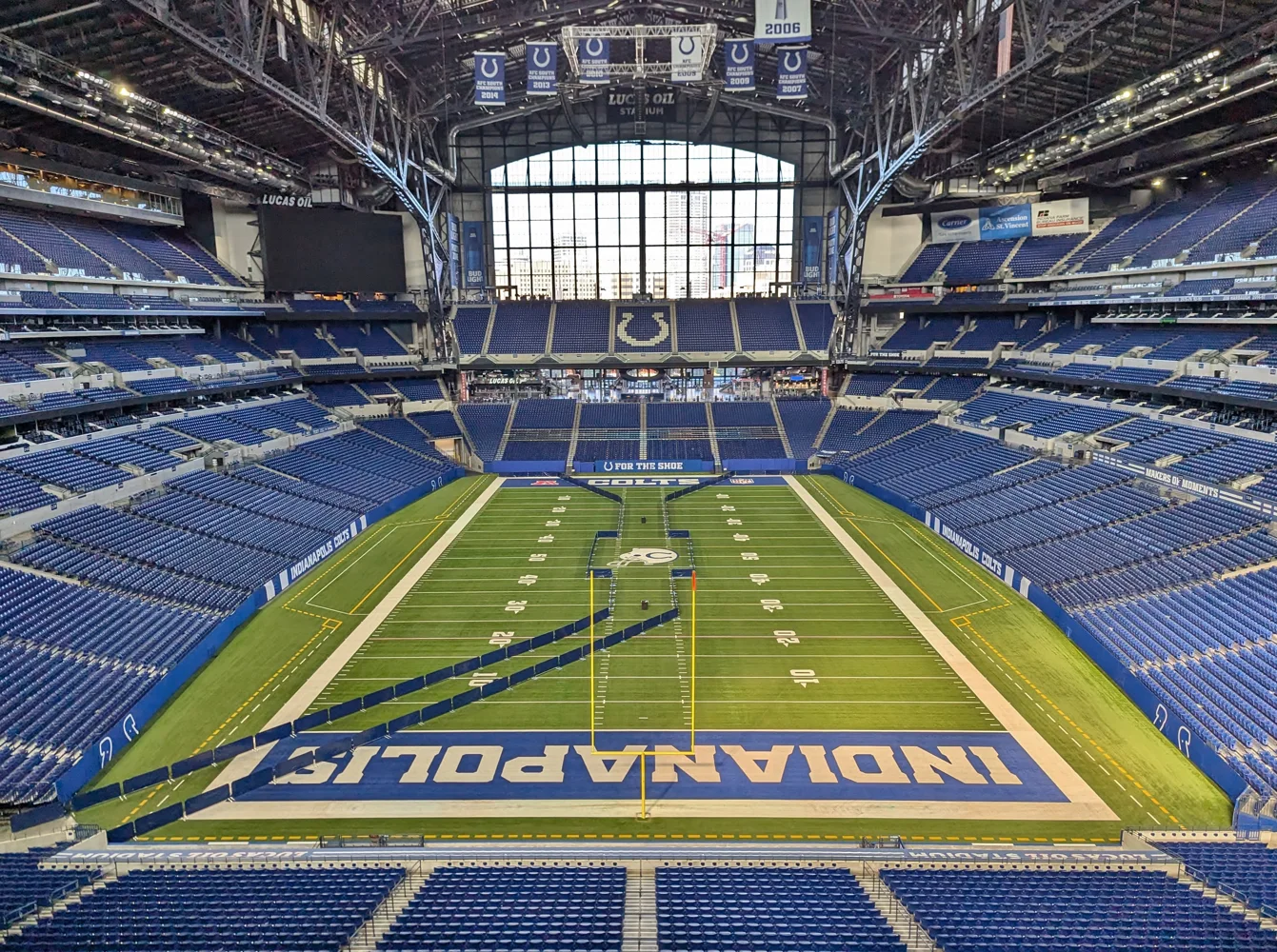
Cover: Lucas Oil Stadium, the Colts’ home, photographed in October 2024 during a stadium tour. SounderBruce, CC BY-SA 4.0; resized and converted to WebP under the same license. This is not a photograph of the 2026 dismissal or Titans game.

Why did Indianapolis fire Ballard during the season?
The Colts’ announcement is the clearest statement of ownership’s position. It confirmed Ballard’s dismissal and a planned search for the next general manager. Irsay-Gordon connected the decision to urgency and the standard of competing for championships. The statement did not present a detailed list of transactions or identify one private disagreement as the cause.
Ownership said waiting would delay necessary work
The key point about the timing was that ownership wanted work on the organization’s future to begin now. That supports a direct answer to the question of why the club did not wait until January: the owner concluded that delay would postpone necessary change. It does not establish that a permanent replacement has already been selected or that the search is a formality.
There is a practical reason the timing attracts attention. A general manager’s influence is not limited to draft weekend. The personnel department evaluates the roster, considers additions and departures, and develops information for future decisions while the season is underway. Changing who leads that work can matter even when the coaching staff and the immediate playing schedule remain in place. That is an explanation of the role, rather than a report of a specific unpublished instruction from ownership.
It is also possible to interpret the dismissal more narrowly than the loudest reaction to it. Ownership decided that the current leadership should change. The announcement did not promise an immediate winning streak, specify a new roster-building philosophy or guarantee the identity of the next decision-maker. Those outcomes will depend on later choices.
For fans following the remaining season, the Indianapolis Colts schedule provides the next competitive checkpoints. The firing changes the context in which those games are evaluated. It does not replace the need to judge the actual performance that follows.
What does the team’s recent record add to the explanation?
Two games help distinguish the circumstances surrounding the dismissal from developments after it. The Tennessee loss happened before Ballard was fired. The Minnesota loss happened afterward. Combining them into one undated description can obscure what ownership knew when it made the change and what has since intensified the discussion.
The Titans loss was the immediate backdrop
Indianapolis lost 26–20 to Tennessee on October 18 after leading 13–0 at halftime. That left the Colts 2–4. The team’s own account described a second half filled with mistakes and missed chances. Tennessee’s official postgame notes recorded three takeaways, six sacks and a blocked-punt touchdown in its first win of the season.
Those details make the defeat more revealing than the six-point final margin alone. Indianapolis had control at halftime, then lost ground through different phases of the game. The front office assembles the roster, while coaches and players have responsibility for how it performs. A collapse involving offense, protection and special teams is not easily reduced to a single player or one draft choice.
The timing makes the Titans defeat the immediate backdrop to Monday’s announcement. It still does not prove that one afternoon alone explains a decision about a general manager’s tenure. Ownership’s stated rationale was broader, and outside analysis should not quietly replace that explanation with a claim about a single decisive play.
The Vikings result sharpened the deadline debate
The Colts then lost 16–10 at Minnesota on October 25, falling to 2–5. The official follow-up described a low-scoring game in which the running backs combined for 141 rushing yards, but the passing attack and missed field goals limited the result. That performance supplied fresh material for the argument about what the roster can achieve this season.
A subsequent defeat can strengthen calls for a different deadline strategy, but it cannot be the cause of a firing that occurred six days earlier. It also cannot tell fans the exact return available in a trade. The current record changes the competitive context; the market and the club’s valuation of each player determine whether a proposed move makes sense.
Who handles personnel decisions after Ballard?
Reporting identifies Ed Dodds as the interim leader of the personnel department. Stampede Blue’s October 19 account, attributing the information to ESPN’s Stephen Holder, described that transition and said Steichen and the coaching staff would report directly to ownership. Those details should be labeled as reporting rather than silently converted into the text of the official dismissal announcement.
| Question | Current distinction |
|---|---|
| Who leads personnel during the transition? | Dodds, according to reporting |
| Has the next permanent GM been announced? | The dismissal statement announced a search |
| Did the firing itself remove the head coach? | No; Steichen continued coaching the team |
The word interim matters. Running a department during a transition gives a person current responsibility. It does not, by itself, award the permanent position. Conversely, a promised search does not mean the club is unable to process everyday roster business in the meantime. Those are different timescales: operating the team now and selecting its long-term leadership.
Continuity also has more than one meaning. A remaining executive can know the scouts, the roster and the information already gathered. That institutional knowledge may help the department function while ownership evaluates its next structure. It does not prove that every prior preference will survive unchanged. A different assignment, a different instruction from ownership or a new offer from another team can produce a different decision without requiring the entire staff to be replaced first.
At the same time, describing Dodds as the person overseeing personnel does not reveal every approval required for a major transaction. Fans should not invent a private chain of authorization from a short report. The useful question is what decision the organization ultimately makes and who publicly explains it. Until a permanent appointment is announced, keep current operating responsibility separate from assumptions about who will control next spring’s draft.
Does firing the general manager mean the Colts are selling?
No automatic conclusion follows. A club can replace an executive because it wants a different long-term direction while continuing to compete with the current roster. It can also conclude that a particular trade improves its future without deciding to dismantle everything. The dismissal itself does not reveal which offers exist or the price at which ownership would approve a departure.
Ownership’s stated goal and a trade strategy are different things
Irsay-Gordon’s statement explicitly maintained the season’s competitive goals. That is a meaningful statement of intent. It is not a contractual promise that no player will be traded. A transaction can be justified as improving the organization even when it reduces strength at one position in the short term. Equally, declining a poor offer does not prove that the team is ignoring the future.
Much of the early debate is interpretation. An On SI column argued against expecting a fire sale by pointing to ownership’s message. Other commentary has favored selling. These are competing readings of the situation, rather than two contradictory announcements from the club. The distinction matters when an opinion headline begins circulating as evidence that a named player definitely will or will not move.
How to evaluate a proposed deal without assuming a fire sale
A useful evaluation starts with the specific exchange. Here are four questions that make the debate more concrete:
- What is actually being offered? A list of interested teams is not a proposed return. Draft selections, players and conditions need to be identified before anyone can assess value.
- What future control does Indianapolis give up? The value of keeping a player depends on the time and terms under which the club can retain him. Do not assume every recognizable veteran is an expiring asset.
- Who would take over the role? Removing a starter changes the work assigned to remaining players. A younger replacement getting snaps can have developmental value, but those snaps also have a competitive cost.
- What obligations remain? Salary and cap consequences can differ from the simplest version of a fan proposal. Evaluate verified terms instead of assuming that a trade removes every associated cost.
Those questions are an analytical framework, not a report that the Colts have received an offer for a particular player. They also explain why buying and selling need not be mutually exclusive labels. A team might address an immediate weakness while moving someone whose future role is less clear. Judge the combination of decisions, the return and the reasoning. The new leadership structure creates the opportunity to change course; it does not make every conceivable trade sensible.
What does the change mean for Shane Steichen?

Steichen continued as head coach after Ballard’s dismissal. In the Colts’ account of his October 19 media session, he emphasized shared responsibility and preparing the team for Minnesota. He did not frame the record as a problem belonging only to the departed general manager.
That response points to the next useful evaluation. The front office supplies players, but the coaching staff determines how to prepare and deploy them. When a team loses a halftime lead or struggles to produce a functional passing game, both roster construction and execution deserve examination. Replacing one executive cannot establish which portion of each problem belongs to which level of the organization.
The Minnesota game gave that distinction a concrete form. Daniel Jones threw for 108 yards and was sacked four times, according to the official recap. Steichen nevertheless continued to back him as the starter. That is an observable coaching decision in the new context. Fans can evaluate the plan, the protection and the alternatives without pretending that the GM firing automatically mandates a quarterback change.
Keeping Steichen in place also allows ownership to observe how the current staff responds to pressure. Does the team correct recurring errors? Does it give its available players roles they can execute? Does it turn respectable stretches of play into complete games? Those questions are more specific than treating every postgame news conference as a prediction about who will be employed next year.
At the same time, remaining in the job today is not a public guarantee about the eventual relationship with the next permanent general manager. The owner announced a search for that executive. Until the club explains its chosen structure, the authority and preferences of the future hire remain unresolved. A claim that Steichen is certain to leave, or certain to remain for another season, would require evidence beyond the fact that Ballard was dismissed.
The fairest reading is that the staff still has a season to coach and results to improve. The leadership change raises the stakes of its response, while the actual decisions on the field provide evidence that a future evaluation can use.
What should Colts fans watch before and after the deadline?
The NFL’s official calendar sets the 2026 trade deadline at 4 p.m. New York time on November 10. The firing does not extend that deadline for Indianapolis. As of this October 27 assessment, the next scheduled games against Jacksonville and Dallas provide additional competitive evidence before that decision point. Use the current weekly schedule for updated kickoff and television information.
Separate completed transactions from reports and suggestions
The Colts’ official transaction log is a good place to begin. It records the October 20 practice-squad additions of Mecole Hardman and Thomas Morstead, followed by later practice-squad and elevation activity. Those moves show that routine roster operations continued after the dismissal. A practice-squad signing is not a trade, and an elevation is not evidence that a star player is leaving.
For larger developments, keep three levels of information separate. An announced transaction records something the club has done. A sourced report can describe discussions, interest or expectations that may never produce a completed deal. A column recommending a move tells you what the writer thinks should happen. All three can be useful, but they answer different questions. A suggested trade package should never become an accepted offer merely through repetition.
Watch the return and the timing if a transaction is completed. Does it supply immediate help, future assets or both? Does the club explain how the move fits its competitive goals? How does it change the opportunity for players remaining on the roster? Those details reveal more about the new direction than applying a seller label before any particular choice is made.
The permanent general-manager search is a separate milestone. November 10 ends the trading window; it does not automatically select the next executive or finish ownership’s evaluation of the staff. A search update, a completed transaction and a coaching decision should each be assessed on their own evidence.
Ballard’s dismissal answers who ownership decided should no longer lead the department. The remaining weeks will answer a more consequential question: whether Indianapolis can translate a different leadership arrangement into coherent personnel choices and better football. Until those choices arrive, the clear facts are the October 19 firing, the reported interim role for Dodds, continued responsibility for Steichen, and a trade deadline that gives the transition an immediate test.
Comments