
The Minnesota Vikings are the NFL’s last unbeaten team through October 27, 2026, after beating Indianapolis 16–10 to reach 6–0. San Francisco and Kansas City also lost on October 25, leaving Minnesota alone without a defeat. The record reflects repeated defensive resistance and an ability to finish close games. It also leaves a live question: can an offense that has scored fewer than 17 points in three victories provide enough support when the opposition raises the scoring requirement?
The useful response is to examine how the wins happened. Minnesota has earned its position, but being the last unbeaten team does not automatically make it the most complete team. Here is what the six results establish, what the latest win exposed, and what to watch as the schedule turns toward Detroit and a demanding November.
How Minnesota became the last unbeaten team
Minnesota returned from its Week 6 bye and won its sixth game in Week 7. That distinction matters when comparing records: six wins are not seven, and the league’s calendar does not give every team the same number of games before the byes even out. The Vikings’ October 26 account confirmed that they stood alone after the 49ers lost in Atlanta and the Chiefs lost in Seattle. This was Minnesota’s first 6–0 opening since 2009.
“Last unbeaten” is a description of the standings at a particular moment. It is not a playoff seed, a championship forecast or proof that the next opponent should be dismissed. It does, however, identify something valuable: Minnesota has collected the maximum number of wins available in its six opportunities. Those banked wins continue to count even if the team later experiences the kind of difficult afternoon that every contender plans for.
Six wins, with very different margins
The official results show both scoring range and a consistent limit on the other side of the scoreboard:
| Week | Opponent | Minnesota result | Winning margin |
|---|---|---|---|
| 1 | Green Bay | 39–22 | 17 |
| 2 | at Chicago | 9–3 | 6 |
| 3 | at Tampa Bay | 23–16 | 7 |
| 4 | Miami | 15–10 | 5 |
| 5 | at New Orleans | 23–13 | 10 |
| 7 | Indianapolis | 16–10 | 6 |
Adding those scores gives Minnesota 125 points and its opponents 74, a differential of plus 51. That is approximately 20.8 points scored and 12.3 allowed per game. These are scoreboard figures; they do not isolate offensive efficiency or assign responsibility for every point to one unit. Four victories came by eight points or fewer. The unbeaten opening therefore contains more tight finishes than comfortable margins, even though the cumulative differential is clearly positive.
That combination supports two conclusions at once. Minnesota has repeatedly kept games within reach, and its position has often depended on executing late. It would be misleading to turn all six wins into one generic story about dominance. Follow the Vikings team schedule for the current results as the sample expands; an evaluation made after six games should develop with the evidence.
The defense has made narrow leads valuable
The Colts game supplies a useful distinction between letting an opponent hang around and letting it finish. Indianapolis stayed close, but Minnesota conceded no second-half points. According to the team’s game observations, the Colts managed 48 net yards in the fourth quarter. A six-point lead was therefore enough despite leaving the result theoretically vulnerable to a touchdown.
A fourth-quarter record worth separating from the final score
Minnesota has allowed just three fourth-quarter points across its six games. That is a striking closing record. Its significance is practical: an offense can leave points available and still win if the opponent cannot turn a final opportunity into a scoring drive. The pattern helps explain why a modest scoring day has not yet translated into a defeat.
It would still be a mistake to budget for another shutout every fourth quarter. Scoring in one period depends on how many possessions exist, where they begin and whether the opponent is chasing a lead. The number establishes what Minnesota has achieved, rather than a fixed allowance future opponents must obey. Fans should enjoy it while watching whether the underlying work continues: forcing difficult downs, tackling before the sticks and denying quick progress when the opponent needs urgency.
Cashman and Smith supplied different kinds of stops
Blake Cashman’s production showed why defensive impact cannot be reduced to interceptions. The official feature on his performance recorded 12 tackles, two sacks, three quarterback hits and four passes defended. Those categories describe several ways to damage a possession: remove yardage, hurry the next decision, contest a completion or finish the play after the ball arrives. They do not, by themselves, establish a particular coverage call or blitz frequency.
Harrison Smith delivered the final change of possession with his 40th career interception, a milestone documented in the team’s account of the play. The difference matters when forecasting. A defense can work toward repeated disruption; it cannot simply schedule an interception for its next closing series. Minnesota’s strongest case rests on making opponents struggle before a takeaway arrives, while treating the takeaway as an additional reward.
Why the offense remains the central concern
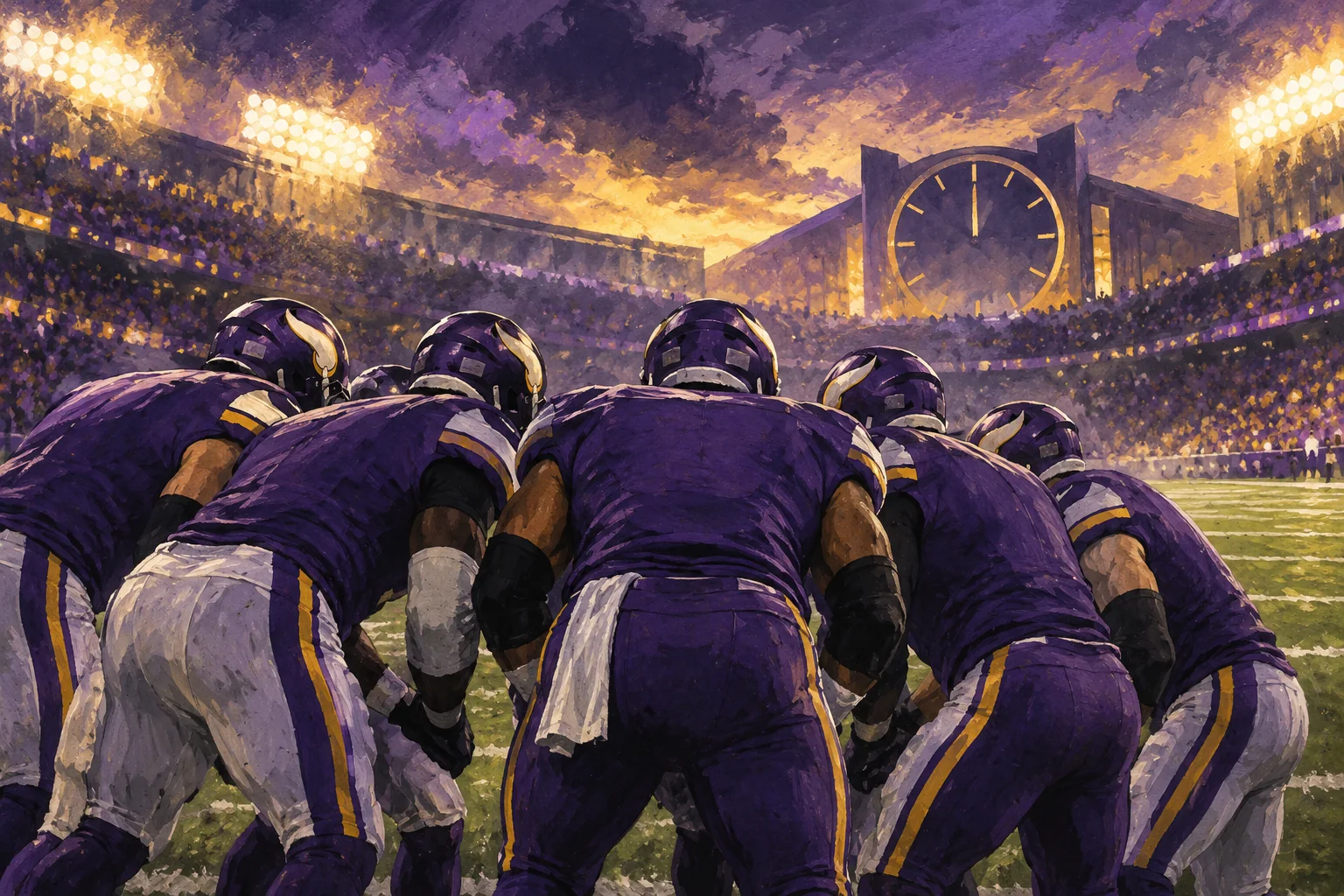
The offensive question is not whether Minnesota has talented players or whether a low-scoring win should count. It is whether the team can create scoring opportunities often enough to avoid requiring an exceptional defensive finish. The Colts game supplied concrete examples, and Kevin O’Connell’s Monday assessment acknowledged that improvement involves several connected parts rather than one simple fault.
Third downs and short yardage tell a clearer story than 6–0
Minnesota converted three of 11 third downs against Indianapolis, approximately 27.3 percent. The Colts converted eight of 15, approximately 53.3 percent. Those are one-game figures, not season rates. They reveal an imbalance in possession extension that the final score alone conceals. A team can win the scoreboard while repeatedly giving its defense more work.
The opening offensive series made the issue especially visible. After reaching third-and-one, Minnesota gained nothing, then lost a yard on fourth-and-one. A promising position became an empty possession. The opportunity cost was larger than the yardage suggests: another first down could have created several more chances to gain field position or reach the end zone. Instead, the defense returned to work without a scoring cushion.
O’Connell discussed the offense’s system of calling two plays and choosing according to the defensive look. That makes a useful caution against assigning every failed run to a single decision made on the sideline. The call, the adjustment and the blocking still have to fit together. For a viewer, the practical question is whether Minnesota can reliably get the required yard, whichever option it chooses.
Murray’s mobility helps, but cannot be the entire plan
Kyler Murray provided the decisive offensive burst by turning third-and-eight into a 35-yard scramble to the Indianapolis five, then throwing a five-yard touchdown to T.J. Hockenson. The official account of that sequence is a reminder that quarterback rushing belongs in the evaluation. An improvised gain is still an earned gain, and a defense must account for it.
Yet a rescue play and a consistent passing attack solve different problems. Minnesota needs routine completions and manageable downs so that mobility adds another answer instead of repeatedly repairing a stalled series. When evaluating the next game, separate the explosive escape from the snaps that made an escape necessary. That distinction gives Murray appropriate credit while preserving the question facing the whole offense.
It also points toward a more useful discussion than demanding one personnel change. Protection, timing, ball placement and the receiver’s opportunity all interact. One missed connection does not prove which component failed. The stronger evidence of progress would be several possessions in which those pieces work together and produce touchdowns before the game becomes another late defensive examination.
The next four games ask different questions
Minnesota’s announced schedule moves from Detroit on November 1 to Buffalo at home on November 9, Green Bay away on November 15 and San Francisco in Mexico City on November 22. That sequence offers several kinds of examination. Describing it as important does not require assuming any opponent’s final record or pretending a future result is already known.
Detroit first tests whether Minnesota can operate efficiently in a divisional road setting. The offense’s short-yardage decisions and communication become particularly useful things to watch away from home. If a drive starts well, can the Vikings convert the manageable down that keeps it alive? If the defense gives up a scoring drive, can the offense answer before the contest becomes dependent on another late stop?
Buffalo brings a Monday night home game. That is an opportunity to assess whether the offense can establish momentum in familiar surroundings while the whole team handles a different weekly rhythm. Green Bay then provides a rematch: Minnesota already won the first meeting 39–22. Repeating the outcome is not automatic because both staffs now have evidence from the first meeting as well as the games played since.
The San Francisco fixture is listed as a Vikings home game but takes place in Mexico City. That distinction matters to anyone reading the schedule as a simple home-and-away sequence. It also makes travel and routine part of the practical test. The football question remains whether Minnesota can win possessions consistently enough that one mistake does not become a demand for a defensive rescue.
These are evaluation questions, not predictions of four wins or four defeats. One opponent may expose a problem while another allows Minnesota to show that it has corrected it. Use the current week’s schedule and NFL television guide for live viewing arrangements rather than treating an October analysis as a permanent listing. Matchup analysis lasts longer when it identifies what to watch instead of guessing a score.
How to judge the Vikings without chasing a perfect season
A perfect record can distort the conversation by making every future mistake seem like a referendum on the entire team. Minnesota’s next loss, whenever it comes, will not remove the six victories already earned. Equally, another victory will not automatically resolve the offensive questions visible against Indianapolis. Results and the quality of the work behind them need to be considered together.
Health belongs in that assessment. O’Connell described Aaron Jones, Sr., as day to day after a knee injury, while Jordan Mason had returned to action. The official update did not establish a guaranteed return date for Jones. A viewer should check the later injury reports rather than assume that a Monday description settles Sunday’s workload. Availability can change the options without excusing every unsuccessful play.
A practical watchlist for the next kickoff
Start with manageable situations. If Minnesota has second-and-short or third-and-one, does it secure the next first down without turning the series into an escape exercise? Then look at scoring opportunities. The meaningful improvement would be drives that end with touchdowns through a sequence of successful snaps, rather than simply another spectacular play that leaves the larger pattern unchanged.
On defense, watch what happens before the takeaway. Are receivers contested? Are gains limited after the catch? Does pressure remove the quarterback’s comfortable options? Those questions do not require inventing a pressure percentage from the broadcast. They encourage watching the ordinary snaps that make an interception or sack more likely to matter.
Finally, track how the units respond to one another. An offensive first down after a defensive stop can give the team breathing room even if the possession does not immediately score. A defensive stop after an empty offensive series can keep a bad stretch from becoming decisive. The best evidence of a more complete contender would be Minnesota needing fewer extraordinary contributions from one unit to cover the other’s ordinary difficulties.
What the 6–0 start means for fans now
The appeal of this Vikings team is easy to understand. Six games have produced six victories, and the defense has repeatedly made a difficult final possession feel survivable. The frustration is equally understandable: close wins can leave supporters wanting more reliable offense before the opposition demands it. Those reactions can coexist without reducing the team to either an inevitable champion or an undeserving unbeaten.
The team’s postgame mailbag captured both celebration of the defensive playmakers and concern over offensive finishing. Those letters are examples of fan questions, not a survey of the entire fan base. They identify the right tension to follow: Minnesota’s strengths have delivered real results, while the next improvement remains visible.
There is no need to predict an undefeated season to make the next month compelling. Detroit offers the immediate test; Buffalo, Green Bay and San Francisco follow. A useful progression would be an offense that turns favorable situations into sustained drives while the defense continues to contest possessions. If that happens, the team’s case grows stronger even if the spotless record eventually ends.
For now, the conclusion is specific: Minnesota has earned a 6–0 start through excellent resistance and successful late-game execution, with offensive consistency still the main question. Keep the record, the process and the next matchup in view together. That provides a much clearer measure of the Vikings than asking each Sunday whether perfection can last forever.
Comments