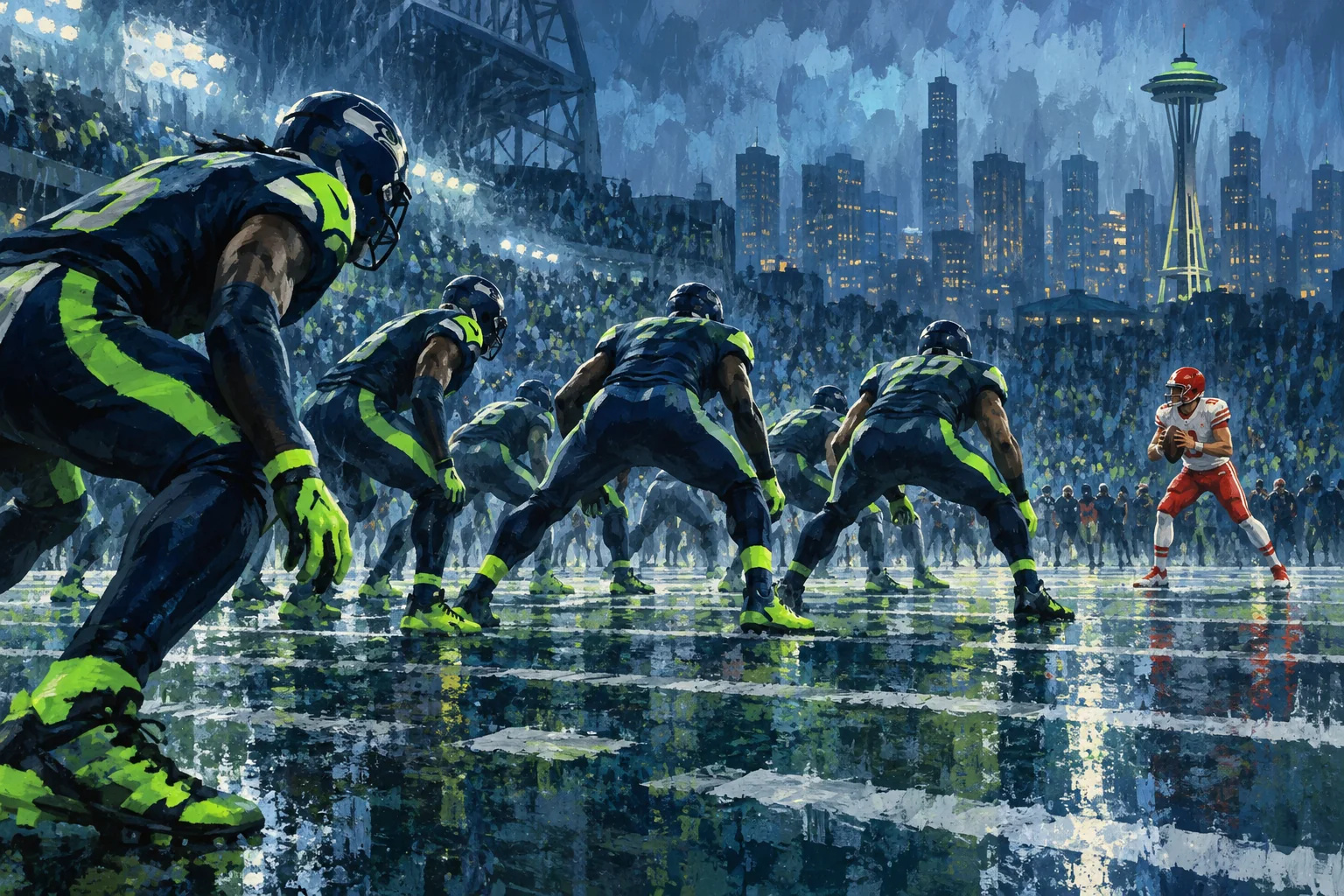
The Seahawks held the Chiefs to three points on October 25, 2026, by combining strong run defense with successful coverage, while Seattle’s offense repeatedly extended third downs and kept Kansas City waiting for another possession. The Chiefs then wasted the opportunities they did have: promising field position did not become a red-zone visit, and two missed field goals left points unclaimed. The 20–3 result came from those problems reinforcing one another.
This was Kansas City’s first defeat after a 5–0 opening. It deserves a closer explanation than saying Patrick Mahomes had a bad night. Both offenses, both defenses and the kicking game helped determine how many chances existed and what happened to them. Here is the chain of events behind the score, what Seattle can reasonably build on, and what Kansas City needs to show next.
The score was surprising because the Chiefs arrived at 5–0
Seattle did not merely finish ahead of an offense already struggling to score. The Seahawks’ postgame defensive assessment noted that Kansas City entered averaging 414 yards and 28 points per game. On this night it produced 213 yards and one field goal. That contrast explains the attention around the result without requiring a speculative claim about what the Chiefs will become.
The official game center and the teams’ reports provide the central comparison:
| October 25 statistic | Chiefs | Seahawks |
|---|---|---|
| Points | 3 | 20 |
| Total net yards | 213 | 410 |
| Third-down conversions | 3 of 11 | 11 of 16 |
| Time of possession | 24:09 | 35:51 |
These categories describe related aspects of the same game, so they should not be treated as independent explanations that can simply be added together. Converting third downs helps produce more plays, more yardage and more possession time. Failing them limits the chances to recover from a mistake. The table becomes useful when read as a sequence rather than a collection of impressive numbers.
Kansas City left Seattle at 5–1, while the Seahawks improved to 4–3 after ending a two-game losing streak. Those records establish the immediate context. They do not erase either team’s earlier work. Seattle demonstrated that it could beat this opponent decisively; Kansas City now has specific failures to correct. A single night can supply convincing evidence about a matchup without proving that every subsequent game will follow the same pattern.
Seattle took away the easy rushing foundation
Kenneth Walker III’s return to Seattle attracted attention because he arrived as the Chiefs’ productive lead runner. The relevant outcome was straightforward: Seattle held him to 36 yards on 14 carries, an average rounded to 2.6 yards. The official defensive report identified stopping the run as a central part of the performance.
Why Walker’s 36 yards mattered beyond the rushing total
A rushing game affects an offense’s choices before it affects the final yardage column. Regular gains can leave second down with several workable options and make a later third down less demanding. When the rushing contribution shrinks, the passing game has to supply more of the necessary progress. That is a general football consequence, not proof that every Kansas City third down had the same distance or that every unsuccessful play began with a failed run.
Seattle’s achievement was to make a major part of the Chiefs’ offense contribute much less than expected. That made it harder for Kansas City to establish a comfortable sequence of plays. The important distinction is between limiting one runner and eliminating every possible rushing answer. Walker’s line tells us what happened to his opportunities; it does not justify claiming that the Chiefs had no tactical alternatives.
For future opponents, the result suggests a question rather than a ready-made instruction manual: can their defenders finish tackles and maintain the necessary discipline against the same rushing attack? Copying an idea is easier than reproducing execution. Seattle’s personnel and collective pursuit were part of the result, so another team cannot assume that choosing similar calls will deliver the same numbers.
Pressure and coverage still had to finish the job
Stopping the run does not, by itself, stop Mahomes from converting through the air. Seattle still had to contest the next play. One concrete example came when Nick Emmanwori pursued Mahomes as he moved left and hit him while he threw; Ty Okada intercepted the resulting pass. The team’s rapid reactions described that sequence and Emmanwori’s work covering Xavier Worthy.
That example connects pursuit with the passing outcome without inventing a coverage diagram. A box score cannot establish how often Seattle disguised a look, which defender carried every route or how frequently pressure was simulated. The defensible conclusion is narrower and strong enough: Seattle reduced the rushing contribution, then supplied effective answers when Kansas City tried to progress through the passing game.
Third downs cut Kansas City’s opportunities from both directions
The third-down comparison is the clearest explanation of why the Chiefs struggled to change the game. Their offense converted three of 11 attempts, while their defense allowed Seattle to convert 11 of 16. Expressed as percentages, that is roughly 27.3 percent against 68.8 percent. One figure describes Kansas City failing to extend its own possessions; the other describes its inability to end Seattle’s.
Seattle extended drives that looked close to ending
The Chiefs’ official recap identified five Seattle conversions on third-and-nine or longer. Long-yardage situations usually look like a defense’s chance to get off the field. Giving up the required gain repeatedly changes the practical meaning of the earlier successful snaps. A defense can create a difficult third down and still lose the possession if it fails on that down.
Seattle’s opening scoring possession illustrates the cost. The game center lists a 15-play, 86-yard drive lasting 8:26 that ended in a field goal. Three points did not look overwhelming on the scoreboard, but Kansas City had spent more than eight minutes without its offense getting the ball. The value of an extended drive therefore exceeds the points it immediately produces.
This does not make the clock an independent weapon that always guarantees victory. A long empty possession can still be a missed opportunity. Here, the repeated conversions allowed Seattle to retain control while its defense kept Kansas City’s scoring return unusually low. The interaction matters more than treating possession time as a universal measure of superiority.
Eight possessions made empty trips expensive
Kansas City recorded eight drives, including the short two-snap possession after Nohl Williams’ interception near halftime. That qualification matters: the total was not eight full drives with normal time available. When chances are limited, an empty trip cannot be dismissed on the assumption that several more are certain to follow.
Seattle held the ball for 35:51 against Kansas City’s 24:09, a difference of 11:42. The Chiefs needed both halves of the problem to improve: their offense had to keep its own series alive, and their defense had to return the ball sooner. Blaming only the quarterback leaves out how the available opportunities were distributed.
The Chiefs had chances and failed to turn them into points
Seattle’s dominance should not become a claim that Kansas City never threatened to score. The Chiefs reached Seattle territory on each of their first three possessions, according to the team’s recap. That gave the offense openings, but getting past midfield and completing a scoring drive are different accomplishments. The Chiefs repeatedly managed the first without the second.
Crossing midfield was not the same as reaching the red zone
Seattle’s defensive report recorded that Kansas City never reached the red zone, the area inside the opponent’s 20-yard line. That is a more precise diagnosis than saying the Chiefs were bad in the red zone. They did not establish the opportunities required to measure red-zone finishing in this game.
The distinction changes the corrective question. An offense that reaches the 10 repeatedly but settles for field goals needs to examine how it finishes in a compressed space. An offense that stalls farther out first needs to examine how it advances into that space. Both can produce a disappointing point total, but they describe different stages of a drive and should not be treated as interchangeable failures.
For Kansas City, early progress was therefore real but insufficient. It showed that Seattle did not prevent every completion or first down. It also showed how much field remained after those gains. The Seahawks continued to defend the next set of downs instead of allowing a promising start to become an inevitable touchdown.
Missed kicks explain part of the score, not the entire defeat
Nohl Williams supplied a major opening by intercepting Sam Darnold in the end zone and returning the ball to Seattle’s 44 before halftime. Harrison Butker’s ensuing 58-yard attempt fell short. Later, an 11-play, 60-yard Kansas City drive reached Seattle’s 27, but the 45-yard field-goal attempt went wide right. These details are documented in the Chiefs’ account of the missed chances.
The kicking misses mattered. They left two possessions without the three-point return the Chiefs sought, while Butker’s successful 50-yarder in the third quarter supplied the entire scoring total. They also should not absorb responsibility for everything that preceded them. A 58-yard attempt is a different proposition from an easy short kick, and settling for attempts from distance reflects where the offense’s progress ended.
Simply adding six points for two hypothetical makes would still leave Kansas City below Seattle’s 20. Even that arithmetic is not a reconstruction of what would actually have happened: a changed score could alter later decisions by both teams. The useful conclusion is that more reliable kicking would have helped, while the offense still needed better drive progression and the defense still needed more timely stops.
Seattle’s offense deserves credit for the defensive result
A defensive achievement this dramatic naturally becomes the headline, but Seattle’s offense helped create the conditions around it. The team’s broader postgame assessment highlighted an offense that gained 410 yards and sustained possessions. Kansas City’s difficulties did not occur in isolation while Seattle repeatedly gave the ball straight back.
Jaxon Smith-Njigba finished with nine catches for 150 yards and a touchdown. His production supplied more than a single highlight: it repeatedly moved the ball and forced the Chiefs to keep defending the passing game. Emanuel Wilson then provided the fourth-quarter finish with a 21-yard touchdown run, completing a night of 100 rushing yards on 24 carries. Those were different contributions to the same objective, keeping the offense productive enough that the defense’s work remained valuable.
That does not make Seattle’s offensive performance flawless. Three trips inside Kansas City’s 20 produced only six points, with an end-zone interception ending one opportunity. The contrast is revealing: Seattle had a red-zone finishing issue, while Kansas City had a red-zone access issue. Both teams left scoring potential unrealized, but Seattle established far more opportunities and did enough with them.
For Seahawks supporters, that is a reason to see room for improvement within a convincing victory. Better finishing could make the same territorial control produce a larger scoreboard return. It would also give the defense more margin on an afternoon when the other quarterback finds an extra completion or a runner escapes a tackle. A team should not need the opponent to score just three for its possession advantage to matter.
The broader lesson is that complementary football runs in both directions. Defensive stops create offensive chances; offensive first downs reduce how often the defense must return immediately. Seattle succeeded at connecting those jobs against the Chiefs. The Seahawks schedule provides the next opportunities to judge whether that connection continues against different opponents and different game situations.
What carries into the next game, and what remains unproven
Kansas City’s next opponent is Denver, as shown on the official Chiefs schedule. The response will be more informative than an immediate claim that Seattle exposed a permanent weakness. A difficult performance establishes problems that occurred; determining whether those problems persist requires seeing the offense and defense react to another opponent’s execution.
The distinction also protects Seattle’s achievement. Calling the result a universal instruction manual can make the performance sound easy to copy. The Seahawks had to stop the run, contest passing opportunities, extend their own drives and finish the decisive moments. Another team may recognize those objectives and still lack the ability to accomplish them against Kansas City.
Three things to watch before calling it a lasting weakness
First, watch what Kansas City produces before third down. A healthier sequence of first- and second-down gains can give Mahomes and the rest of the offense more choices. Another low rushing total would matter, but it should be examined alongside the passing opportunities created and the actual distances the team faces. One number cannot describe the entire decision set.
Second, watch both sides of third down. A better Chiefs offensive percentage is only half of the response if their defense keeps allowing the opponent to extend difficult situations. Note the distance required, the gain allowed and the effect on the next possession. A conversion on third-and-one and one on third-and-12 both move the chains, but they ask different questions of the defense.
Third, track the stages of scoring rather than only the final total. Can Kansas City move from midfield into the red zone? Can it then turn those visits into touchdowns? Are the kicking opportunities shorter and more manageable? Those questions separate offensive progression, finishing and special teams execution instead of allowing the most visible miss to stand for the whole game.
For Seattle, the corresponding test is continuity: keep generating difficult possessions for opponents while improving its own scoring return near the goal line. For Kansas City, it is correction across the units. Check the Chiefs team schedule and this week’s NFL games for the next viewing opportunity. The October 25 lesson is clear enough: Seattle controlled the available chances, and Kansas City did too little with the chances that remained.
Comments