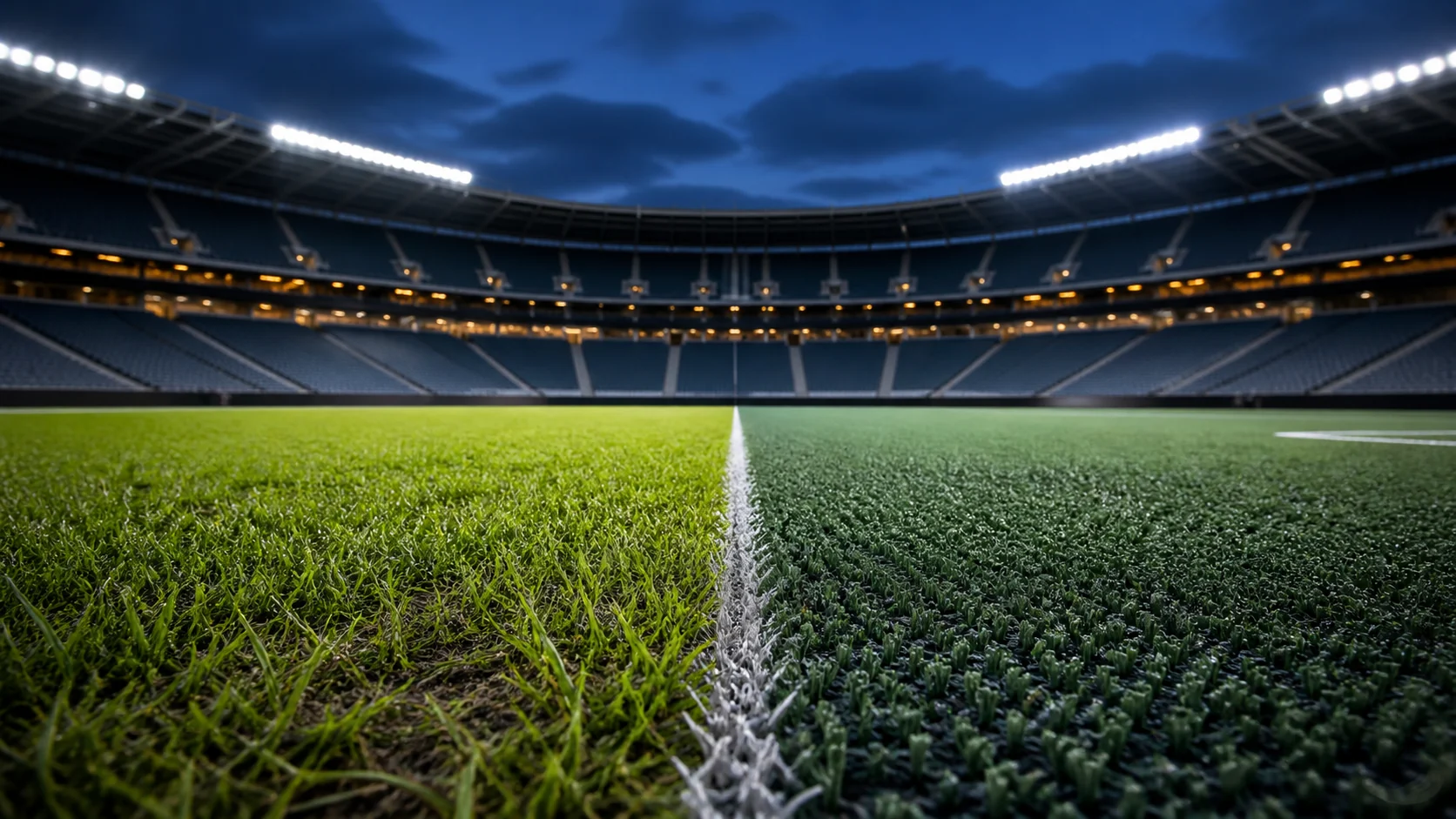
Fourteen NFL stadiums use artificial turf for their normal 2026 NFL configuration, serving 16 teams. The team count is higher because the Giants and Jets share MetLife Stadium, while the Rams and Chargers share SoFi Stadium. This is a September 4, 2026 snapshot: seven turf venues temporarily installed grass for the World Cup, then returned to synthetic surfaces for football.
Buffalo is the important change from older lists. The Bills moved into the new Highmark Stadium with natural Kentucky bluegrass, so they no longer belong in the turf column. Josh Allen's recent comments brought the debate back into focus, but his personal experience, union injury arguments and the NFL's current data position are different kinds of evidence. Start with the complete list below, then use our NFL team schedule directory to confirm where a particular game is being played.
The complete 2026 artificial-turf stadium list
The table uses each team's normal home surface for the 2026 NFL season, not a temporary soccer configuration or a practice facility. It intentionally says “artificial turf” rather than freezing every proprietary product name: a venue can replace its system while remaining in the synthetic category.
| Stadium | NFL home team(s) | Market | 2026 context |
|---|---|---|---|
| Mercedes-Benz Stadium | Atlanta Falcons | Atlanta | Returned to turf after temporary World Cup grass |
| Bank of America Stadium | Carolina Panthers | Charlotte | Synthetic field installed for multi-sport use |
| Paycor Stadium | Cincinnati Bengals | Cincinnati | Artificial turf |
| AT&T Stadium | Dallas Cowboys | Arlington | Returned to turf after temporary World Cup grass |
| Ford Field | Detroit Lions | Detroit | Artificial turf |
| NRG Stadium | Houston Texans | Houston | Returned to turf after temporary World Cup grass |
| Lucas Oil Stadium | Indianapolis Colts | Indianapolis | Artificial turf |
| SoFi Stadium | Los Angeles Rams; Los Angeles Chargers | Inglewood | Shared venue; returned to turf after World Cup grass |
| U.S. Bank Stadium | Minnesota Vikings | Minneapolis | Artificial turf |
| Gillette Stadium | New England Patriots | Foxborough | Returned to turf after temporary World Cup grass |
| Caesars Superdome | New Orleans Saints | New Orleans | Artificial turf |
| MetLife Stadium | New York Giants; New York Jets | East Rutherford | Shared venue; returned to turf after World Cup grass |
| Lumen Field | Seattle Seahawks | Seattle | Turf returned in August after World Cup grass |
| Nissan Stadium | Tennessee Titans | Nashville | Current stadium uses artificial turf |
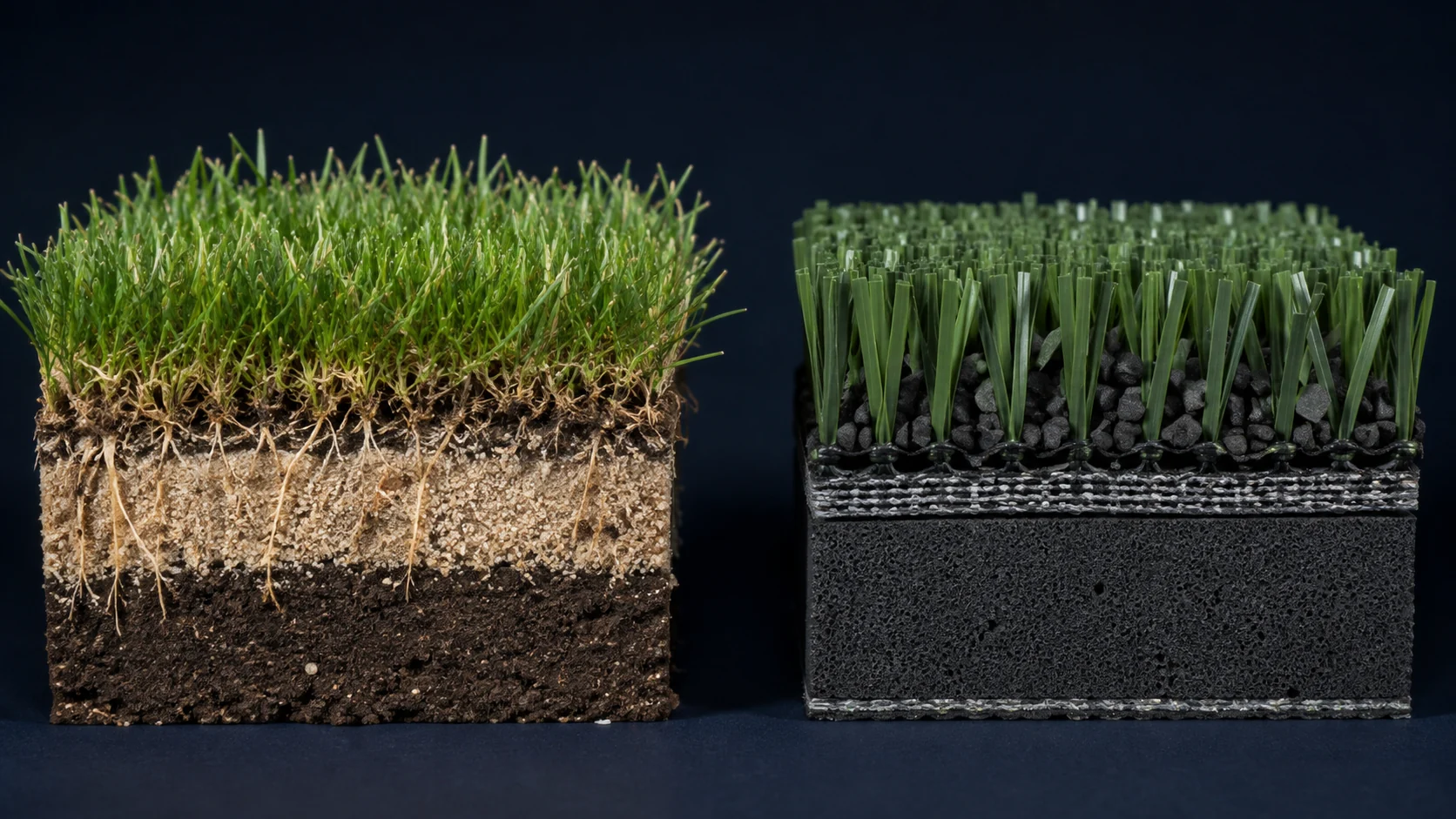
Count venues and teams separately. MetLife houses two New York clubs and SoFi houses both Los Angeles clubs, so 14 fields affect 16 home teams. The league still has 30 primary stadiums because those two pairs share buildings.
The World Cup note prevents another common error. Seven venues on this list hosted soccer on temporary natural grass during summer 2026. That did not permanently move them into the NFL grass column. Current reporting says their normal synthetic fields returned for football; Seattle's turf replacement was specifically reported back in place in August. A photo taken during the tournament can therefore be accurate for that event and wrong for an NFL game weeks later.
What changed in 2026: Buffalo moved to grass
Older surface lists often place Buffalo among the turf teams because the Bills' former home used an artificial field. The new Highmark Stadium changes that answer. The club says its 2026 venue has natural Kentucky bluegrass, first laid in October 2025. That makes Buffalo the clearest reason to demand a date on any NFL grass-versus-turf list.
The transition also produced a more nuanced story than “grass good, turf bad.” During preseason use, parts of the first sod thinned and could push or lift under players. Buffalo brought in an NFL consultant and an independent consultant. According to the team's September 3 account, the surface was judged safe and playable, but the club was not satisfied with how it performed and chose to re-sod before its September 17 regular-season home opener.
Grounds director Aaron Ramella explained that roots were growing downward without knitting laterally as well as hoped. The replacement used sod from the same farm but with a thicker cut. Team officials also said future replacement had always been expected; the surprise was needing it sooner. In other words, “natural grass” describes the material, not a permanent quality grade. Root depth, moisture, sunlight, wear, establishment time and maintenance decisions all affect the field players actually encounter.
That distinction matters when readers use the table. Buffalo belongs in the grass category even though its initial field required corrective work. Conversely, a synthetic venue cannot be judged only by a decades-old image of hard carpet: products, infill, age and maintenance differ. Classification is the first fact; current condition is the second.
For the Bills' actual home dates and opponents, use the Buffalo Bills schedule. A game at another venue inherits that venue's surface, so even a grass-home team can play multiple road dates on artificial turf.
Josh Allen's grass complaint, in context
Allen's late-August comments contained two related but distinct claims. First, he described his own experience. He said indoor work on an artificial surface was something he could feel in his body the next day, while he felt better after practicing outside on grass. He also described repeated turf burns severe enough to blister and disrupt his sleep. That is a concrete account of abrasion and recovery from the person experiencing it.
Second, he offered a broader judgment: he believes grass is healthier for players and would choose grass in every stadium if he could. That is a player-safety opinion informed by his career, not a controlled comparison of injury rates. Reporting it accurately does not require downgrading the pain he described, but it also does not turn one quarterback's experience into proof about every synthetic system.
The abrasion point is especially easy to understand. Sliding skin across synthetic fibers and infill can produce friction burns regardless of whether the play generates a reportable ligament or muscle injury. A database focused on missed-time injuries might not capture nights of skin pain. Allen's story therefore helps explain why player preference can remain intense even when league officials discuss statistical significance for a narrower injury category.
His home context amplified the comment. Buffalo had just moved from its old artificial surface to a new grass stadium, while the grass itself was still being refined. Allen could celebrate fewer home dates on turf and still expect the grounds crew to improve a natural field that had torn in spots. Those positions are consistent: preferring a material does not mean accepting every installation or maintenance outcome.
The responsible takeaway is neither “Allen proved turf causes all injuries” nor “his complaint is only anecdotal, so it does not matter.” It is direct worker feedback about comfort, skin injury and recovery. League-wide causal claims require broader data, which is where the NFLPA and NFL positions enter—and where the debate becomes less tidy.
What injury evidence does and does not say
The NFL Players Association's public case for grass relies on more than individual stories. The union says NFL injury data from 2012 through 2018 showed higher lower-extremity injury rates on artificial turf, including a consistently higher non-contact rate. It has argued that high-quality natural grass should be the league standard and that a later single-season result should not erase a longer pattern.
The league's current public position is different. When the NFL announced enhanced field standards in December 2025, Associated Press reported chief medical officer Dr. Allen Sills saying the recent data did not show statistically significant differences in lower-extremity injuries or concussions attributable to surface type or a specific surface. The league's policy response is to test and improve both natural and synthetic fields, not to prohibit one category.
Those statements sound mutually exclusive until the questions underneath them are made explicit:
- Time window: a 2012-2018 comparison and a recent-season analysis do not contain the same fields, products or players.
- Outcome: non-contact lower-extremity injuries, all lower-extremity injuries, concussions and skin abrasions are different endpoints.
- Unit of comparison: grouping every surface as grass or synthetic can hide field age, condition, weather and maintenance.
- Statistical threshold: “not statistically significant” means an analysis did not clear its chosen evidence threshold; it does not establish perfect equality.
- Access: AP has noted that the underlying league/union injury dataset is not publicly available, limiting independent reproduction.
This is observational safety evidence, not a randomized experiment. Teams do not randomly assign identical athletes and plays to two surfaces. Weather, footwear, opponent, stadium, speed, contact and field condition can move together with surface choice. Researchers can adjust for measured differences, but unmeasured factors remain possible.
It is therefore too strong to say a particular ACL tear was “caused by turf” merely because it occurred on turf. It is also too strong to say surface type cannot matter because one recent comparison missed statistical significance. The most defensible reading as of September 2026 is narrower: players overwhelmingly express a grass preference, the NFLPA cites an older multi-year injury disparity, the league says recent aggregate differences are not statistically significant, and both parties now participate in stronger field testing.
The 2026 field standards and 2028 deadline
The policy change for 2026 is a quality-control program, not an artificial-turf ban. The NFL and NFLPA's Joint Field Surface Safety and Performance Committee developed mandatory practices that apply to natural and synthetic fields. Beginning this season, clubs selecting a new playing surface must choose from systems that meet approved metrics and styles. New synthetic installations require advance product approval.
The program turns “the field looked bad” into measurements and documented checks:
- Pre-approval: a new system is tested against specified performance ranges before installation.
- Mechanical testing: the BEAST device simulates elite-athlete cleat interactions, including forces relevant to traction and release.
- Impact testing: the STRIKE device measures how the field absorbs energy when loaded.
- Routine monitoring: synthetic game fields receive recurring testing during the season, while all surfaces receive game-day visual inspections for hazards.
- Maintenance response: clubs document and address conditions, including procedures around re-sodding or turf replacement.
The phase-in matters. The official NFL overview says every domestic and international stadium must comply with the enhanced standards by 2028. That does not mean all 14 synthetic venues disappear after 2027. It means the field systems used across the league must fall within the approved performance framework. Natural, hybrid and synthetic options remain contemplated.
Nor does certification mean a field can never degrade. A test captures specified properties at a point in time; games, weather, events and maintenance continue afterward. Buffalo's grass replacement shows the practical loop: inspect, measure, observe performance and intervene. Synthetic fields likewise require checks for hardness, depth, evenness and cleat interaction rather than relying on their category label.
For fans, the important correction is precise: the NFL did take a significant field-safety action for 2026, but it chose tighter performance standards and a multi-year compliance program. Claims that the league “banned turf by 2028” misread the announcement.
Why indoor and multipurpose venues often choose turf
Most venues in the artificial group are enclosed, roofed, heavily programmed or shared. Synthetic systems offer operators a predictable surface that can be covered, uncovered or replaced around concerts, soccer, college football and other events. They do not need sunlight, irrigation or a rootzone to recover between uses. Those are operational advantages, not proof that players should prefer the result.
Natural grass inside a building is an engineering system of its own. Plants need suitable light, air movement, moisture, temperature and time to establish roots. The 2026 World Cup conversions required years of research, artificial lighting, special growing plans and, at some venues, substantial geometry changes to create a wider soccer pitch. Houston also had to schedule installation after its stadium's annual rodeo and dirt-floor conversion.
The tournament demonstrated that high-level grass can be installed temporarily in buildings designed around turf. It did not run the experiment people sometimes imagine: maintaining that same field through an entire NFL season plus every scheduled stadium event. Seven U.S. NFL venues returned to artificial turf after their World Cup matches. That choice reflects their owners' operating model; it does not settle the injury debate.
The NFL's own best-practices guide treats shared venues and multi-sport use as factors requiring extra diligence. A good decision has to consider expected hours of play, changeovers, environmental control, drainage, replacement logistics and the ability to keep the field within performance limits. “It has a roof” is not a complete argument for turf—Arizona and Las Vegas use movable natural-grass trays—but each solution depends on how the stadium was built.
Player preference belongs in that calculation alongside operations. Allen and the NFLPA are effectively arguing that the worker experience and potential health cost deserve more weight, even when grass is harder to maintain. The league's 2026 framework answers by measuring both categories more tightly. Whether that compromise changes the number of turf venues is a future ownership decision, not an announced requirement.
How fans should read surface information each week
A stadium list is useful context, not a player projection. Before discussing a matchup, answer five narrower questions:
- Where is the game? A grass-home team may be visiting a turf venue, and neutral or international games use a different building.
- What configuration is active? Separate the normal NFL field from a temporary soccer overlay or a practice surface.
- How current is the source? Buffalo changed stadiums, seven World Cup hosts changed back, and individual fields can be re-sodded or replaced.
- What is actually known about condition? “Grass” or “turf” does not report hardness, traction, moisture, seams or recent wear.
- What claim are you making? Venue classification is factual; predicting a particular player's injury is speculative.
Use the NFL games this week page to identify the venue, then confirm any unusual field change through the host club or league. This matters most after concerts, severe weather, a re-sod, a new installation or an international conversion. A current official note is stronger evidence than a search snippet or an old stadium photograph.
For fantasy and lineup decisions, do not downgrade a player solely because the game is on artificial turf. Availability reports, workload, role and matchup are direct inputs; a broad surface category does not provide an individual medical forecast. If a club announces a field problem or a player reports a specific concern, treat that as new context and wait for football or medical staff to describe its practical effect.
The same discipline improves the public debate. Ask whether a claim concerns comfort, abrasions, non-contact injury rates, all injuries or field performance. Those questions can have different answers without anyone changing the subject.
Frequently asked questions
How many NFL stadiums have artificial turf in 2026?
Fourteen of the league's 30 primary stadiums use artificial turf in their normal 2026 NFL configuration. They serve 16 teams because MetLife Stadium and SoFi Stadium each have two NFL tenants. This count is current through September 4, 2026.
Which teams share an artificial-turf stadium?
The New York Giants and New York Jets share MetLife Stadium in East Rutherford. The Los Angeles Rams and Los Angeles Chargers share SoFi Stadium in Inglewood. Count each venue once when answering how many stadiums use turf, but count both tenants when asking how many teams play home games on it.
Does Buffalo still play home games on turf?
No. The Bills' new Highmark Stadium uses natural Kentucky bluegrass. The club replaced the initial sod before its 2026 regular-season home opener after it thinned in places, even though consultants judged the preseason field safe and playable. Older lists describing Buffalo's former artificial field are stale.
Did the World Cup grass stay for the NFL season?
Not at the seven turf-first U.S. NFL venues in this list. Atlanta, Arlington, Foxborough, Houston, Inglewood, East Rutherford and Seattle installed natural grass for World Cup soccer and returned to artificial turf for their normal NFL configuration. The temporary grass photographs are not evidence of the later football surface.
Is artificial turf proven to cause more NFL injuries?
The public record does not support a one-sentence verdict. The NFLPA cites league data from 2012-2018 showing higher lower-extremity rates on turf. The NFL says recent data did not find statistically significant differences attributable to surface type. The underlying league dataset is not fully public, the windows differ and neither position proves what caused one player's injury.
Is the NFL banning artificial turf by 2028?
No. The league is phasing in enhanced performance standards for natural, hybrid and synthetic fields. New-field approval began in 2026, and all domestic and international NFL venues are scheduled to comply by 2028. The policy sets testing and quality requirements; it does not require every stadium to install grass.
Bottom line: use the 14-stadium table as a dated baseline, then verify the venue and any late surface work for the game you care about. The NFL teams page is the quickest route from a club to its current schedule.
Comments