Eagles–Commanders stayed on Sunday Night Football because the NFL chose to retain the Week 8 matchup, despite considering a replacement. The October 20 decision left Philadelphia’s visit to Washington scheduled for Sunday, November 1, 2026, at 8:20 p.m. ET on NBC. Week 8 was eligible for a flex; eligibility simply did not require the league to use one.
Reporting identified two considerations beyond whether viewers liked the matchup: the availability of a replacement within broadcast constraints, and the possibility that the NFC East game could still have meaningful division stakes. Those are reported factors, not a public formula revealing every part of the league’s decision. Understanding the distinction helps answer the broader complaint: why does an apparently disappointing prime-time game sometimes stay exactly where it was scheduled?
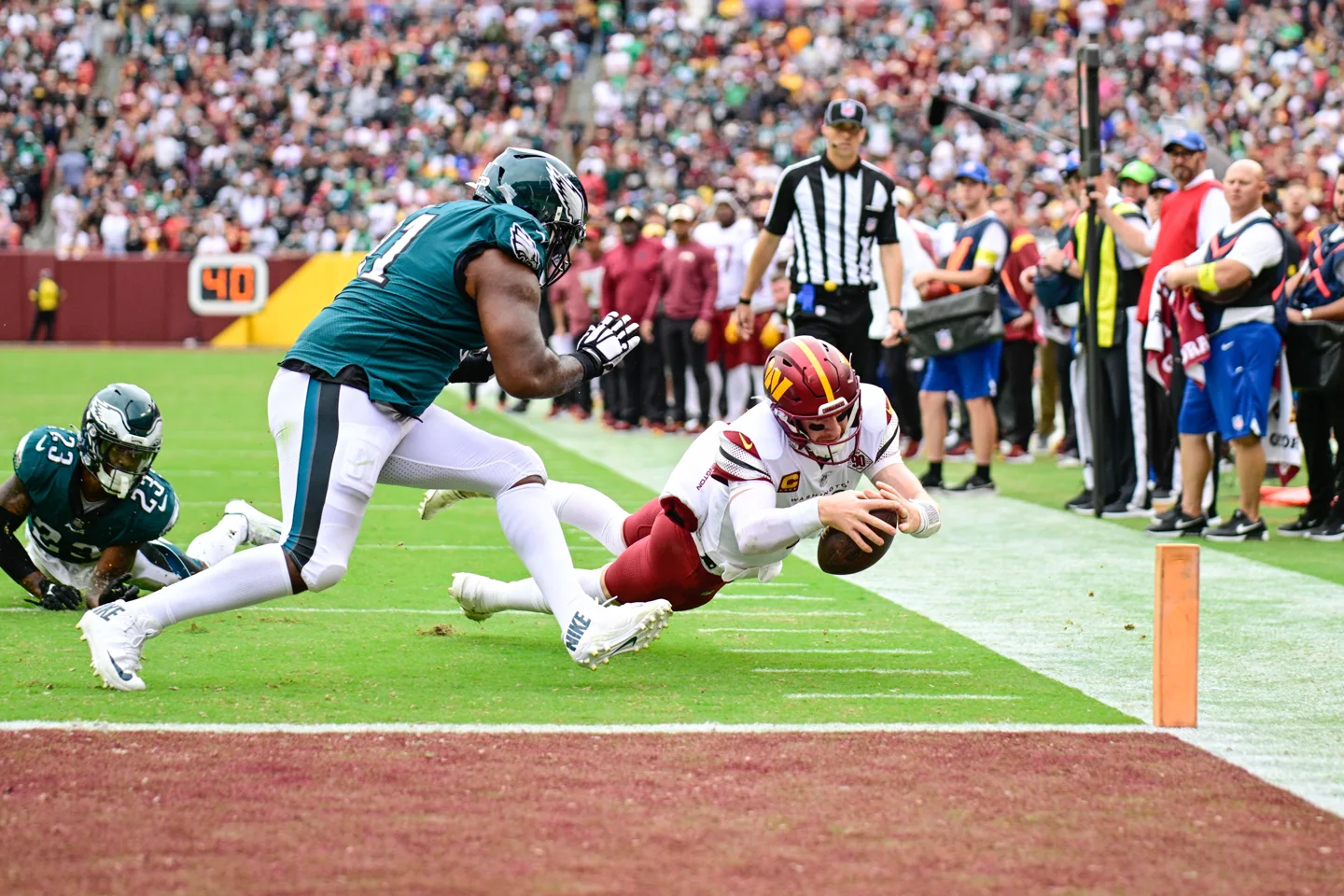
Cover: Eagles–Washington in September 2022 at the stadium then called FedEx Field; this is an archival rivalry photo, not the 2026 game. All-Pro Reels / Joe Glorioso, CC BY-SA 2.0; resized and converted to WebP under the same license.

What happened to the Eagles–Commanders Week 8 slot?
The Philadelphia Inquirer reported on October 20 that the league decided against moving the game out of NBC’s Sunday night window. Its account said the NFL seriously considered Cleveland at Pittsburgh as an alternative. That proposed change did not happen. Reporting that a replacement was considered should not be confused with an announcement that the replacement had been selected.
The game stayed on Sunday night
The practical listing, checked October 27, is straightforward: Philadelphia at Washington, November 1, 8:20 p.m. Eastern Time, NBC, at Northwest Stadium. Washington’s official regular-season schedule retains that Week 8 assignment. For the current listing alongside future Sunday night games, use the Sunday Night Football schedule.
This is also a useful example of how a scheduling story develops. First there can be discussion about whether a change is possible. Then reporters may identify candidates. Finally the league either makes a selection or leaves the existing assignment in place. A fan who sees only the middle stage may reasonably think a switch is imminent, even though consideration creates no commitment.
Keep the dates separate when reading older reports. October 20 was the decision date described in the news. November 1 is the date of the game. The fact that another week of football happened between those dates does not automatically reopen the normal flex process. Notice periods mean the league must evaluate some games before the latest possible information about team form becomes available.
The result can feel unsatisfying to viewers looking for the most compelling matchup on the day. For ticket holders, however, the retained slot provides something useful: the originally advertised evening plan survived the ordinary Week 8 flex decision. The next question is why another game could not simply take its place.
Why did the league keep this matchup?
The public reporting describes a constrained choice. It does not establish that the NFL concluded Eagles–Commanders would be the best game of the entire week. Those are different propositions. A schedule change requires a workable alternative, and every alternative has a broadcaster, an existing audience and a place in the wider season’s arrangements.
A replacement had to be available, not merely attractive
Awful Announcing’s account of the decision, crediting the Inquirer, highlighted a divisional-rivalry constraint: CBS and Fox retain at least one meeting in the relevant AFC and NFC rivalry pairings. A popular proposal can therefore raise a second question beyond the teams’ records: what happened to the other meeting, and would moving this one deprive an afternoon partner of the rivalry?
The Browns–Steelers matchup illustrates the problem without proving that it was absolutely impossible to move. The reporting says it was seriously considered, then retained on CBS at 1 p.m. ET. Describing it as automatically forbidden would go beyond that account. A more defensible conclusion is that broadcast commitments narrowed and complicated the available choices.
There is also a difference between a fan’s preferred game and a complete swap. Moving one contest into NBC’s window displaces the existing Sunday night game into an afternoon slot. The league has to consider the resulting arrangement, rather than select a prime-time game in isolation. That is why a list of attractive matchups is only a starting point for the decision.
Division stakes were part of the reported calculation
The Inquirer’s reporting also identified possible NFC East significance as a factor. A game between struggling clubs can still matter within a closely grouped division. That does not guarantee high-quality football, but it gives a broadcaster a competition story that differs from a matchup involving teams already far removed from a race.
These considerations explain why retaining the game was plausible. They do not reveal the precise weight assigned to audience size, team popularity or any private discussion with television partners. Claims that one factor alone decided the outcome require stronger evidence. Fans can dislike the result while recognizing that the league was choosing among arrangements with obligations attached, rather than freely selecting any two teams to appear on Sunday night.
Was Week 8 actually eligible for a Sunday night flex?
Yes. Week 8 falls within the early Sunday night flex window. NBC’s official 2026 schedule release says Sunday night flexible scheduling may be used up to twice between Weeks 5 and 10, and at the NFL’s discretion during Weeks 11 through 17. That early allocation is permission with a limit, rather than a requirement to replace two games.
Think of the decision as three questions asked in order. Is this week within a permitted window? Is there an eligible alternative that works within the schedule and broadcast arrangements? Does the league choose to make the change? A yes to the first question does not settle the other two. That is the missing step in many complaints that a matchup must be removed because the flex window has opened.
The early-season limit also matters conceptually. The league does not have an unlimited supply of early Sunday night changes under the published policy. A discretionary system can preserve an existing game even when a replacement looks appealing. That observation does not prove the league was saving an unused change in this case; the reporting does not identify that as the decisive reason. It explains why the policy’s wording should not be read as a promise to move every disappointing contest.
There is no published automatic trigger based on a particular losing streak in these procedures. A team’s form can strengthen the case for reconsidering a slot without creating a mandatory switch. Likewise, an injury can change the anticipated appeal of a matchup while leaving other scheduling constraints in place. Fans should therefore treat proposals built around team records as arguments for a decision, rather than evidence that the league violated a rule by keeping the game.
The seasonal boundary is another reason to check the current year’s policy. An older explainer can describe a different window or notice period and still appear prominently in search results. For this game, the relevant policy is the 2026 procedure, and the relevant early window includes Week 8. The remaining timing question is when that eligible change had to be announced.
What was the deadline, and could the NFL change its mind later?
The ordinary Week 8 Sunday night flex decision had to be made with at least 12 days’ notice. That is why October 20 mattered. This was not a situation in which the league could wait until the last game before November 1, compare the newest results and then casually substitute a different matchup.
Working backward from November 1
| Date | Why it mattered |
|---|---|
| October 20 | Twelve days before the game; the reported retention decision |
| October 27 | This article’s schedule check; the normal deadline had passed |
| November 1 | Eagles at Commanders, 8:20 p.m. ET |
The date calculation is simple calendar subtraction: twelve days before November 1 is October 20. The Inquirer’s earlier explanation of the possible change identified the same deadline before the league reached its decision. This helps distinguish an actual scheduling window from general speculation about whether the game deserves a national audience.
The NFL’s current procedures give early Sunday night decisions a different notice period from late-season ones. The shorter late-season period is not a general option that the league can apply to any week merely because a new injury or result makes a matchup less appealing. Week 8 must be evaluated under its own applicable window.
That creates an unavoidable tradeoff. More notice helps broadcasters, stadium workers, traveling fans and the clubs themselves organize the game. Less notice would allow the decision to reflect fresher competitive information. The ordinary process chooses a balance between those goals. A disappointing game can survive because the decision must be made before the final evidence of how the teams will look is available.
Passing the normal flex deadline should therefore increase confidence in the retained assignment. It should not be described as an absolute guarantee against every conceivable emergency. Weather, safety or other extraordinary disruptions are separate questions from the routine process for improving a television matchup. There is no basis here to expect such a disruption; the distinction simply prevents an ordinary scheduling rule from becoming a promise it does not make.
Why do Monday and Thursday games follow different rules?


The word flex covers several scheduling windows. It does not create one universal power to move any prime-time game at any point in the season. The 2026 procedures, also summarized in the Titans’ official schedule announcement, give Sunday, Monday and Thursday distinct eligibility periods.
The eligible windows are different
| Package | 2026 flex window | Usual notice requirement |
|---|---|---|
| Sunday night | Up to twice, Weeks 5–10; any week, Weeks 11–17 | 12 days through Week 13; generally 6 days in Weeks 14–17 |
| Monday night | Weeks 12–17 | 12 days |
| Thursday night | Up to twice, Weeks 13–17 | Generally 21 days |
For a concrete comparison, a Week 8 Sunday night game can be within a flex window while a Week 8 Monday night game is outside the ordinary Monday window. Asking why both disappointing games cannot be removed in the same way overlooks that basic difference. The policy does not promise identical flexibility across the packages.
Moving between days also has different practical effects from moving within Sunday. A Sunday afternoon-to-evening change alters a fan’s day. A move to Monday or Thursday can alter work arrangements, hotel nights and the timing of a team’s preparation. That is a practical explanation for why viewers should pay attention to package-specific rules, rather than a claim that any one logistical concern decided this particular matchup.
A flex is a swap with an eligible afternoon game
The published procedure identifies Sunday afternoon games, or games listed as TBD, as the pool eligible to move into the affected night window. The original night game then moves to Sunday afternoon. It does not describe a free exchange between two existing prime-time assignments. That distinction removes some seemingly obvious fan proposals before there is even a debate about which matchup would attract the larger audience.
Week 18 is another separate situation. Its final weekend times are assigned after Week 17 under the league’s published process, rather than treating every initial matchup as a permanently fixed afternoon game. An unassigned final-week slot and an announced Week 8 game are therefore different planning problems. Use the appropriate week and package when checking what can still change.
How should fans plan around the decision?
For Eagles–Commanders, plan around the retained Sunday evening assignment. The ordinary flex deadline has passed, and both the official team schedule and the current listing show the same date and time. Before finalizing the rest of a trip, check the actual game entry rather than a months-old graphic or a social post discussing a possible change that never occurred.
- Confirm the date, time zone and venue. November 1 at 8:20 p.m. ET is the U.S. Eastern listing; an overseas viewer may watch on a different local calendar date. Do not assume a time displayed by a friend’s calendar uses your own time zone.
- Check the broadcaster separately. The NFL TV schedule keeps the channel attached to the game. NBC’s official season announcement also identifies Peacock as a streaming home for its NFL games. Confirm the service available where you live before kickoff.
- Recheck your digital ticket and transportation plan. An evening assignment affects arrival and departure differently from an afternoon game. Check the stadium’s current event information and the transport provider’s timetable for the actual date.
- Read the booking terms you accepted. A schedule change and a refund entitlement are separate issues. The relevant ticket, hotel or transport terms determine the options; a flex discussion does not create one universal refund policy.
For later games, an updating calendar subscription can reduce manual work. The NFL calendar page offers subscription feeds as well as one-time ICS downloads. A subscription can receive later changes when the calendar application refreshes; an imported static file is simply a copy of the schedule at the time it was downloaded. Keep that difference in mind if a future prime-time game moves and your personal calendar still shows its original slot.
The frustration about this matchup is understandable: viewers want the national window to showcase compelling football. The specific answer, however, is procedural as well as editorial. Week 8 could be flexed, the league considered alternatives, and the reported decision was to keep Eagles–Commanders. Its ordinary deadline then passed. Future games require a fresh check of their own week, broadcast package and notice period, rather than assuming the same outcome or the same flexibility applies to every night on the schedule.
Comments