The original NFL season in 1920 included fourteen teams in the American Professional Football Association, or APFA. Only two of those franchises still compete today: the Decatur Staleys became the Chicago Bears, and Chicago's Racine Cardinals became the Arizona Cardinals. The complete list also includes clubs from Akron, Buffalo, Canton, Cleveland, Columbus, Dayton, Detroit, Hammond, Muncie, Rochester and Rock Island, plus the Chicago Tigers. Ten founding clubs and fourteen first-season members are compatible counts, because additional teams joined during the year. The difference matters when comparing lists. This guide separates meeting attendance, season membership and franchise continuity, then explains how the inaugural competition worked and why several familiar modern clubs do not belong on its founding roster.
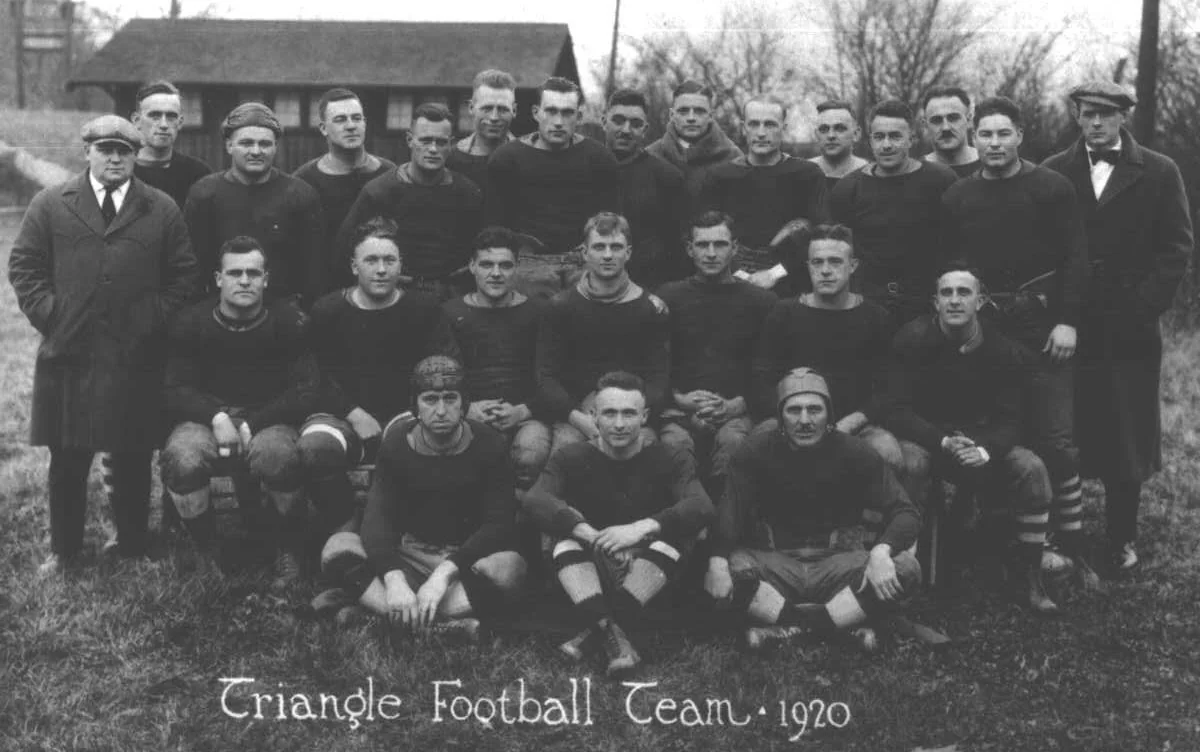
Cover: the 1920 Dayton Triangles, Unknown photographer; public domain in the United States. Converted to WebP.

What counts as an original NFL team?
An original team, in the broad first-season sense, is one of the fourteen clubs that belonged to the American Professional Football Association in 1920. APFA was the league's name before it became the National Football League in 1922. Calling those clubs original NFL teams is a convenient historical description; it does not mean NFL appeared on their original league paperwork.
The count changes when the question is about a particular organizational meeting. The Hall of Fame's chronology describes an August 20 meeting involving four Ohio clubs, followed by the September 17 gathering in Canton that organized the APFA. It identifies ten clubs at the latter stage and four additional members during the year. A list of the September group and a list of the entire inaugural season therefore answer different questions.
Massillon creates another apparent discrepancy. The Hall's account of the founding meeting includes the Massillon Tigers among eleven represented organizations, then explains that Massillon withdrew and never joined the league. Count the ten participating founding clubs after that withdrawal, then add Buffalo, the Chicago Tigers, Columbus and Detroit for the fourteen-member first season. Do not add Massillon as a fifteenth playing member.
It also helps to separate a club's own origins from its admission to the league. A team could already exist before 1920 and still become a charter member that year. Another could begin outside the association and join later. Neither a familiar city nor a very old football tradition establishes first-season membership by itself. Keep four labels apart when reading a history: when the team began, when it entered the league, what it was called at the time, and whether the modern franchise is the same organization.
The complete list of 14 teams in the 1920 APFA
This table uses each club's 1920 identity. Founding group means the ten clubs in the September organizational group after Massillon's withdrawal. Additional member means one of the four clubs the Hall of Fame identifies as joining during that inaugural year. It does not assign an unsupported exact admission date.
| 1920 club | State | Membership group | Later identity or league endpoint |
|---|---|---|---|
| Akron Pros | Ohio | Founding group | Later Indians; last season 1926 |
| Buffalo All-Americans | New York | Additional member | Later Bisons/Rangers; last season 1929 |
| Canton Bulldogs | Ohio | Founding group | Last season 1926 |
| Chicago (Racine) Cardinals | Illinois | Founding group | Today's Arizona Cardinals |
| Chicago Tigers | Illinois | Additional member | Only league season 1920 |
| Cleveland Tigers | Ohio | Founding group | Indians in 1921; then departed |
| Columbus Panhandles | Ohio | Additional member | Later Tigers; last season 1926 |
| Dayton Triangles | Ohio | Founding group | Last Dayton season 1929; Brooklyn purchase |
| Decatur Staleys | Illinois | Founding group | Today's Chicago Bears |
| Detroit Heralds | Michigan | Additional member | Only league season 1920 |
| Hammond Pros | Indiana | Founding group | Last season 1926 |
| Muncie Flyers | Indiana | Founding group | Last league season 1921 |
| Rochester Jeffersons | New York | Founding group | Last season 1925 |
| Rock Island Independents | Illinois | Founding group | Last NFL season 1925 |
The names and league periods follow the Hall of Fame's franchise register. An endpoint here means the club's last APFA or NFL season, unless the row expressly identifies a surviving franchise. It should not be read as a claim that every organization immediately stopped playing all forms of football on that date.
Cleveland is an easy place to make a one-year naming error. The register distinguishes the Tigers in 1920 from the Indians in 1921. Using the latter name throughout a founding-team list can hide that change. Likewise, Chicago's Cardinals can appear as Racine Cardinals in early material. The table keeps that alternate label visible so a reader does not accidentally count the same club twice.
The list is also a reminder that a historical league map is not a list of current markets. Several cities have no modern NFL club, while two teams shared Chicago. Start with the organization and season when following an old newspaper report. Beginning with today's team name and working backward can attach an unrelated club to the wrong history.
The two original franchises that still play today
The Bears and Cardinals are the two surviving organizations from the inaugural league. Neither used its present full name in 1920. Following the intermediate identities explains why an old Staleys or Racine reference belongs in the history of a familiar modern team.
Decatur Staleys to Chicago Bears
The Bears' Hall of Fame history begins the league story with the Staley company's team in Decatur, Illinois. George Halas represented the Staleys when they entered the APFA in September 1920. The club moved to Chicago in 1921, with an agreement to retain the Staleys name for that season. The Bears name followed in 1922.
Read that sequence as a single franchise changing its location and identity: Decatur Staleys, Chicago Staleys, Chicago Bears. A 1921 reference to Chicago does not establish a new expansion team, and a 1922 Bears reference does not mean the organization first entered the league that year. The name changed while the competitive history continued. The Staleys' 1921 championship belongs to the same franchise history that modern Bears fans follow.
That distinction is useful when comparing old team photographs, result lists or anniversary material. A date on a picture may describe a particular uniform or city rather than the beginning of the franchise. Identify both the season and the name before deciding that two labels represent different teams. For present-day opponents and game dates, the Chicago Bears schedule carries the modern name; the historical chain explains how that team connects to Decatur.
Racine Cardinals to Arizona Cardinals
The Cardinals' older club history begins before the league. The Hall's team history traces the organization to Chicago's Morgan Athletic Club in 1898 and explains the Racine Street label. Racine here refers to a Chicago location, not an original NFL team based in Racine, Wisconsin. The Chicago Cardinals and Racine Cardinals labels in early accounts should therefore not produce two rows in a founding-team count.
The later moves are a second chain to keep straight. The Cardinals' team facts place the move to St. Louis in 1960, the move to Phoenix in 1988 and the change to the Arizona name in 1994. That last change was a broader geographic identity, not another relocation out of the state.
These dates also answer the common oldest-team question. The Cardinals' pre-league origins and their 1920 admission measure different things. An organization can be older than the competition it later joins. It would be a mistake to move the NFL's foundation back to 1898 merely because the Cardinals trace their club roots there.
A modern Arizona Cardinals schedule thus belongs to an organization with Chicago and St. Louis chapters. The place name alone changes how a fan searches, but does not divide that football history into unrelated expansion clubs. Questions about who controlled these organizations are covered separately in the guide to original NFL owners; the distinction here is the identity of the team itself.
What became of the other twelve clubs?
The other twelve names do not all have the same kind of ending. Some disappear from league competition quickly; others remain through much of the decade. The fourteen-row list above records those different endpoints, rather than treating every vanished identity as an identical business failure. A short league life, a later nickname and a franchise sale require different explanations.
Dayton is the important caution against an overly simple vanished-team list. The Hall's 1930 chronology records the purchase of the Dayton franchise, its move to Brooklyn and its new Dodgers name. The Triangles identity ended, but a transaction carried league rights elsewhere. That is more specific than saying Dayton simply ceased to matter after its final home-city season.
It does not follow that any later club reached through a chain of purchases should be declared a third surviving charter franchise. The Colts' own Hall of Fame history, for example, describes a new Baltimore franchise awarded in 1953. Follow the distinction between an organizational history and the movement of assets or rights. An interesting transaction chain is not permission to discard the league's identification of the Bears and Cardinals as the two surviving originals.
A familiar city does not establish a modern franchise connection
Detroit supplies a particularly clear example. The modern Lions' franchise facts begin with the Portsmouth Spartans in 1930 and record the move to Detroit in 1934. That is a different story from the Detroit Heralds on the 1920 list. Sharing the city does not turn the Heralds into the first name of the Lions.
Buffalo and Rochester demonstrate why the older clubs still deserve attention even without a surviving franchise bearing their names. A Bills feature on the original towns describes the All-Americans and Jeffersons as part of western New York's early league heritage. That is a regional connection: a current club can honor an earlier local team without claiming to be the same organization.
Use the same care with Cleveland's changing nicknames and Chicago's two first-season clubs. The question to ask is whether the record establishes continuity, not whether the spelling, location or mascot feels familiar. This preserves both kinds of history: the modern franchises that continued, and the earlier communities whose league teams did not. It also keeps the contributions of places such as Hammond, Muncie, Columbus and Rock Island visible instead of reducing the founding story to the two names still on today's schedule.
How the first season actually worked
Fourteen members did not mean a balanced schedule in which every club faced the same set of opponents. The association left scheduling to the teams, and their games included opponents outside the league. The number of appearances on a complete team schedule can therefore differ from the number of contests against fellow association members.
That matters when interpreting a record or calling a game official. First establish which games the list includes. A season summary, a membership-only comparison and a contemporary newspaper's claim to a championship may use different boundaries. Applying the assumptions of a modern schedule to all three can make the surviving numbers look more contradictory than they really are.
Why several games can be called the first
On September 26, 1920, Rock Island defeated the St. Paul Ideals 48-0. The distinction was that an APFA member was playing; St. Paul was not another association member. A historical study of Dayton's founding role sets that result alongside the October 3 game in which Dayton beat Columbus 14-0 at Triangle Park.
October 3 also featured Rock Island's 45-0 win over Muncie. The Pro Football Researchers Association's study of the first NFL games examines both meetings and the difficulty of establishing which began earlier. It cautions against simply assuming an earlier kickoff from the cities' different time zones. A shared date does not by itself establish the exact order of two events.
The useful answer depends on the question. For the first game featuring an association team, look to Rock Island on September 26. For the first date of games between teams recognized as members, look to October 3 and acknowledge both results. Dayton-Columbus is the familiar commemorated first league game, but that shorthand should not erase the other contest or invent a verified kickoff time. This is a case where a precise definition gives a better answer than an emphatic single label.
How Akron became the first champion
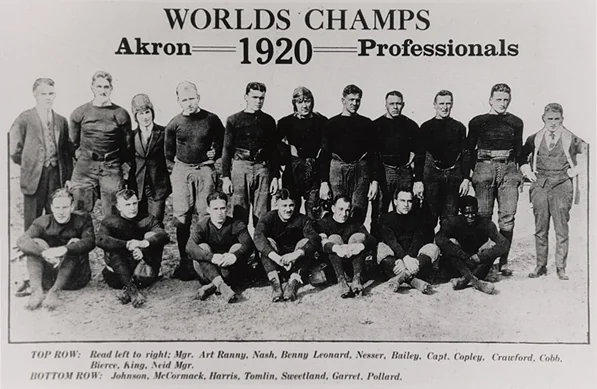

Akron finished 8-0-3 and received the 1920 championship at the league meeting on April 30, 1921. There was no modern postseason bracket ending in a Super Bowl. The title was an association championship settled through the league's early administrative process.
Read the record carefully: eight wins, no losses and three ties. Undefeated does not mean that Akron won every game. A tie remains an important part of the season's story even when the absence of a defeat carries the championship argument. Describing the Pros as eleven-game winners would change the result rather than simplify it.
A physical reminder of that different era survives in the Hall's account of a championship medallion. Akron players received a small gold football-shaped fob. A descendant of Karl “Pike” Johnson donated his example to the museum. The object connects the abstract team list to the people who actually played: these were champions with their own recognition, even though the presentation and competition looked very different from today's league.
Keep that historical setting intact when comparing championships across eras. Akron's title belongs in NFL history, while its route to the title belongs to the APFA's first season. Recognizing both facts respects the achievement without inventing a championship game that the team never had to win.
Were the Packers, Giants or original AFL teams there in 1920?
The Packers existed before the league, but they were not one of its fourteen first-season members. Packers team historian Cliff Christl's account of the club's early names identifies independent seasons in 1919 and 1920 and admission to the APFA on August 27, 1921. That resolves the apparent paradox: Green Bay can have a pre-1920 origin without appearing in a 1920 league-membership table.
The present Giants are another later arrival. The club's history of Tim Mara dates his franchise purchase to 1925. Their long place in the NFL's story does not put them in the founding room or inaugural season. An old franchise and a charter franchise are useful descriptions of different things. Neither label needs to diminish the other team's importance.
The original AFL teams belong to a separate starting point. The league that began play in 1960 was a later competitor, forty years after the APFA's inaugural season. Its opening-year chronology records the Broncos and Patriots playing the first regular-season game that September. Those clubs were not missing from the 1920 list; they belonged to a different founding story.
Buffalo is a useful bridge between the two discussions. The Bills' franchise history begins with admission to the new AFL in 1959, ahead of its first playing season. The Bills were not the All-Americans renamed after four decades. A city can appear in both histories without the two teams being the same franchise. See the separate original AFL teams guide for that later league's clubs and modern identities.
When an original-team list produces a surprising answer, check the season, the league name and the franchise connection. A list about 1920 should use the APFA's fourteen clubs. A list about September's organizational group should explain its smaller count. A list of today's organizations should follow their documented histories rather than match city names. The current NFL team directory is the practical next step for modern schedules; the historical list above explains which two organizations reach all the way back to the league's first season.
Comments