
What the Texans acquired in the Harrison trade
Marvin Harrison Jr. is a Houston Texan. The team's October 12, 2026 transaction announcement confirms his acquisition from Arizona. His reunion with former Ohio State quarterback C.J. Stroud gives Houston an established personal connection to build on, but it does not guarantee immediate NFL production. The useful football question is how Harrison learns the offense, fits with the existing receivers and turns opportunities into dependable plays.
As of October 18, the story is an acquisition and a planned introduction to Houston's offense, rather than a completed evaluation of his Texans career. College highlights explain the excitement. His new role, availability and performance will determine whether that excitement becomes sustained improvement. Keep those two kinds of evidence separate when reading instant trade grades.
The Texans' official transaction notice lists Harrison as a wide receiver acquired from the Cardinals. That is firmer ground than the speculative landing spots that circulated before the announcement. It also means older Arizona-based fantasy advice needs to be read with its publication date in mind.
Read the final pick exchange rather than the first report
Arizona's official transaction record gives the full package:
| Houston receives | Arizona receives |
|---|---|
| WR Marvin Harrison Jr. | 2027 second-round pick |
| 2027 sixth-round pick | 2027 seventh-round pick |
Those late-round selections should not be reversed when summarizing the deal. Arizona's October 12 report specifically noted that the confirmed compensation differed from what had circulated earlier. A saved social-media image can therefore describe the developing story accurately at one moment and still contain terms you should no longer use.
The second-round selection is a meaningful part of Houston's investment, but its exact eventual draft position is not known from the round alone. Calling it a particular overall pick now adds a projection to the confirmed package. Likewise, the trade table does not supply a complete calculation of salary-cap effects or prove either club's private reasoning.
For Houston, the defensible initial description is that it committed future draft capital to another receiving option. Whether that proves worthwhile depends on the player's role and development as well as the alternative uses of those assets. The reunion is part of the appeal; it is not the whole transaction analysis.
Why the Stroud reunion matters, and where familiarity stops
The reunion is more than a shared school listed on two biographies. Stroud and Harrison played together at Ohio State, so the connection comes from actual practices and games. Houston's official introduction of Harrison's first media session centers on that relationship. It is a sound basis for optimism, provided optimism is kept separate from a prediction of instant results.
Ohio State provides evidence of a real connection
Ohio State's Harrison biography records 77 receptions, 1,263 receiving yards and 14 receiving touchdowns in 2022. Those are Harrison's season totals, rather than a claim that every completion came from one passer. They nevertheless give concrete context to the pairing's history during Stroud's final college season.
The relevant advantage is familiarity with the person as well as the position. A quarterback and receiver can develop a sense of each other's pace, preferred communication and reactions when a play changes. A receiver arriving with that foundation may have fewer personal introductions to make than a complete stranger. That is a plausible football benefit, not a measured number of extra yards Houston can enter on its scorecard.
For example, imagine a receiver adjusting his route when the quarterback leaves the pocket. Shared experience might help them anticipate where the other wants to go. Yet the new offense still needs a common rule for that situation. What worked on a college scramble cannot simply override the responsibilities of the other eligible receivers in Houston.
A college connection can also influence confidence: the quarterback has evidence that this receiver can execute difficult plays. Confidence becomes useful when it produces sound, timely decisions. It becomes less useful if the passer forces a covered throw merely because the intended target is an old teammate. The reunion should expand the offense's options rather than narrow every read to one player.
A shared history does not install the Houston playbook
Caley's media discussion focuses on incorporating Harrison into Houston's offense. That is the next layer of the story. Familiar faces do not remove the work of learning calls, formation details and the responsibilities attached to each concept.
A route is more than a line drawn toward open grass. Its starting position, timing and adjustment can affect another receiver's space and the quarterback's progression. A newcomer may know the general concept while still needing Houston's exact instruction for a particular alignment. It would be misleading to declare him fully integrated simply because he recognizes the player throwing the ball.
One sensible possibility is an initial menu of assignments that grows as the staff gains confidence. Another is a broader role immediately if practice shows he is ready. Neither is a confirmed game plan here. Watch the team's actual deployment before deciding which path it chose. The practical value of the reunion is that it may help the learning process; it does not eliminate that process.
How Harrison could fit beside Nico Collins
Harrison joins a receiver room that already includes Nico Collins. The first analytical mistake would be to treat the acquisition as proof that Collins has been replaced. Another would be to assume that every existing receiver will keep exactly the same work. The coaching staff can change formations and assignments without reducing the entire offense to a simple ranking of names.
The Texans' description of Ryans' trade discussion emphasizes adding a playmaker and the possible help of Harrison's relationship with Stroud. That supports an additive reading of the opportunity. It does not reveal the number of snaps, targets or outside alignments Houston will allocate.
One possible benefit is making a defense choose where to spend extra attention. In a hypothetical formation with Collins on one side and Harrison on the other, a safety leaning toward one matchup may leave more space elsewhere. But the coverage still has to respect the routes, protection and situation. Merely placing two recognizable receivers on the field does not force an opponent to abandon its preferred defense.
Another possibility is changing how Houston distributes receivers across formations. Motion, a closer alignment or a different release point can create a different problem for a defender. Those are options to watch, not a claim that Caley has installed a particular Harrison package. Avoid attaching a confident tactical label to the trade before seeing how the Texans actually line up.
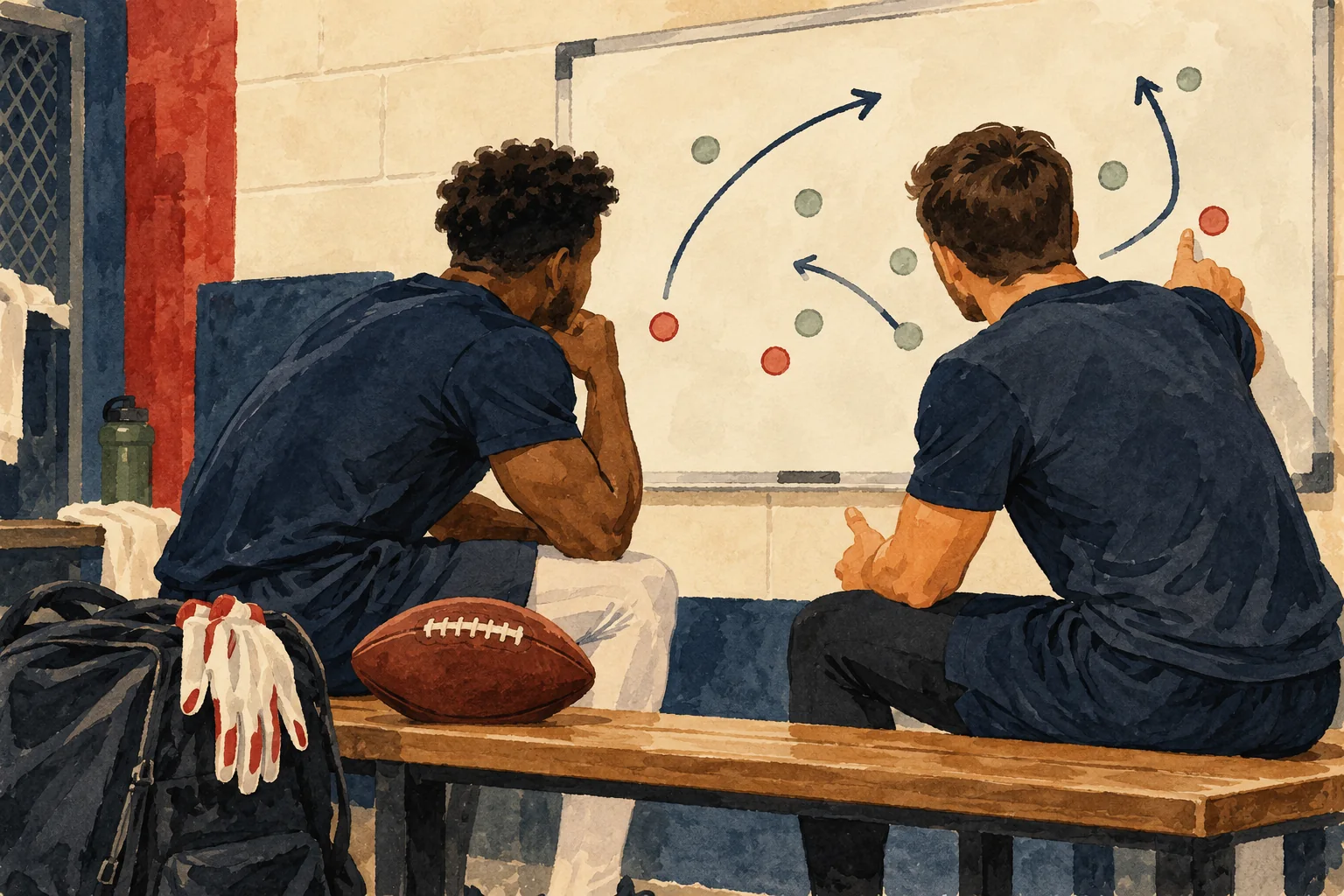
The benefits could also appear on a throw that goes somewhere else. If Harrison's assignment occupies a defender and opens another receiver, that can matter. To credit it fairly, examine the play rather than assuming every successful completion was created by the new arrival. The opposite caution also applies: a low catch total does not establish that a receiver had no useful assignment.
Running plays belong in the evaluation too. A receiver who is trusted to execute his full assignment can be easier to keep on the field across different situations. Watch whether Houston uses Harrison only for selected passing looks or includes him in a wider range of personnel groups. That observation is more informative than guessing the whole depth chart from a transaction announcement.
The best early sign would be a role that makes sense next to Collins and the rest of the offense, with assignments becoming dependable over time. There is room for both individual production and team benefit. Neither should be declared before the evidence appears.
What to watch in his first Houston games
The Texans' official media coverage identifies the London game against Jacksonville as Harrison's planned Houston debut, with Ryans confirming the intention to play him. That is a forward-looking availability statement. It does not supply a catch total, snap count or result. This October 18 analysis is written before that debut and should be read as a guide to evaluating the introduction.
Routes and situations tell more than one catch total
Start by asking how often Harrison participates when Houston throws. A receiver can be on the roster, dress for the game and still have a limited offensive assignment. Snap participation adds context, but passing routes help distinguish meaningful receiving opportunity from a general count of time on the field. Use a reliable chart or the game film rather than inventing a precise rate from a few television shots.
| Observation | What it can help answer | What it cannot establish alone |
|---|---|---|
| Participation in passing situations | How much of the receiving work he is handling | Whether every route made him the first read |
| Starting alignment and motion | How Houston introduces him into formations | The complete play call or private assignment |
| Third-down and red-zone use | Whether his role includes important situations | A guaranteed future touchdown share |
| Targets and catch outcomes | Whether opportunities are becoming production | Who caused every incompletion or coverage change |
Then examine the kind of target. A difficult sideline attempt under pressure and a clean, uncontested opportunity should not be treated as identical tests of the receiver. A target count is useful, but it needs context. If the quarterback cannot set his feet or the defense wins early in the down, a failed connection may say little about whether the college relationship still helps.
Watch repeated situations rather than selecting only the most dramatic play. Does the offense return to a concept? Does Harrison remain involved when the game becomes close? Does his range of assignments expand? These questions can reveal growing trust without requiring an immediate breakout. They can also expose a genuinely narrow role that a single touchdown might otherwise disguise.
Fantasy expectations should follow opportunity and availability
For fantasy managers, the trade changes the setting but does not erase uncertainty. Stroud's familiarity is encouraging; actual passing opportunities determine how much of that relationship can affect a lineup. A player can be an exciting long-term addition while remaining difficult to project for his first week in a new offense.
Check the Texans' official injury report and the final game-day status before assuming that every receiver will be available together. Practice participation and a game designation are different pieces of information. Our roster and depth-chart explanation also distinguishes being on the roster from being available for a particular game.
Do not translate the addition into an automatic downgrade for every teammate. If the offense sustains more drives, several players could benefit; if passing volume stays limited, competition for opportunities could be more noticeable. Both are possibilities. The first games should tell you more about which pattern is emerging.
A measured expectation leaves room for a useful debut without demanding a highlight reel. A few dependable assignments, a clear place in passing situations and signs of coordinated timing can be meaningful beginnings. They are still beginnings. Avoid treating one good game as a complete validation or one quiet game as proof that the trade has already failed.
How to judge the trade after the reunion excitement
The useful standard is whether Houston turns Harrison into a dependable part of its offense at a cost that makes sense. The second-round pick gives the evaluation real stakes. The existing relationship with Stroud supplies an opportunity, rather than an exemption from having to perform. A good story and a good acquisition can coincide, but they are not interchangeable descriptions.
Arizona's official departure report records 108 receptions, 1,578 yards and 13 touchdowns in 33 games with the Cardinals. That history is a baseline, not a diagnosis of why every play succeeded or failed. The change of team does not prove that one coach, quarterback or receiver caused every previous problem. Judge the Houston work directly rather than making the new uniform settle an argument about the old one.
Separate the evaluation into time horizons. In the first games, look for assignment clarity, useful participation and communication with Stroud. Over a longer run, look for consistent production and whether the offense gains a sustainable option alongside its existing players. Only then can you weigh the realized contribution against the draft capital Houston surrendered.
The schedule creates practical checkpoints. Houston's published calendar has the Giants after the London matchup, followed by a Week 8 bye. That gives fans an early stretch to observe and a pause in which to reconsider the initial role. It does not promise that the bye solves every issue. Use the Texans schedule for the current sequence and the NFL TV guide for the appropriate broadcast.
A fair assessment can change. If Harrison begins with selected assignments and later expands his work, the early limitation may look like a sensible introduction. If involvement remains narrow and the offense never finds a dependable use, the concern becomes more substantial. Likewise, an immediate explosive play is encouraging but should be followed by evidence of repeatable execution.
The confirmed conclusion today is straightforward: Houston acquired Harrison, paid a known draft-pick package and reunited him with a quarterback from a productive college chapter. What comes next depends on their work in this offense, with these teammates, against NFL defenses. Follow the role as carefully as the highlights, and the trade will become easier to assess without either dismissing the reunion or asking it to guarantee the outcome.
Comments