
An NFL depth chart shows the listed starters and backups at each position, but it does not guarantee who will play or how many snaps they will receive. The roster, injury report and game-day inactive list supply different parts of that answer. For fans, the useful habit is to read them together: find the likely replacement, confirm that he is available, then watch how the team actually uses him. Here is how those lists fit together and what the familiar roster labels mean.
A roster, a depth chart and a game-day list answer different questions
A roster tells you which players belong to a team's personnel list; a depth chart shows their listed order at each position; the game-day information tells you who can participate in that particular game. Reading one as though it were another is the source of much of the confusion around NFL lineups.
| What you are reading | Question it helps answer | What it does not guarantee |
|---|---|---|
| Roster | Who is listed with the club, and at what position? | That every listed player will dress for the next game |
| Depth chart | Who is listed first, second or farther down at a position? | A fixed number of snaps, carries or targets |
| Game-day availability | Who is active or inactive for this matchup? | That an active player will start or play extensively |
Official club websites usually separate these pages. For example, the Chargers publish a player roster and a separate depth chart. Read the chart as a guide to the listed lineup rather than a promise that the coaching staff will use exactly that arrangement on every down.
Also read the category headings on a roster page. A website may display reserve players or practice squad personnel below its main group. Counting every visible name is not necessarily the same as counting the regular active/inactive roster. A familiar player can still appear somewhere on the website while being unavailable for this week's game.
Consider a hypothetical backup quarterback. His name can be on the roster, second in the quarterback row and active for a game, yet he may never take a snap because the starter plays throughout. Each listing is useful, but none contradicts the others. You need the right list for the question you are asking.
Start with your club on our NFL teams page, then use the club's own personnel pages for current names and roles. This guide explains how to interpret them, so you can follow changes during the week without mistaking a static ordering for the final Sunday lineup.
How to read starters and backups without guessing playing time
Begin with the chart's date, its position labels and the headings over the columns. Then read across a position row. The first name is the player listed first for that role; names farther across show the listed depth behind him. The entire page is not a single ranking from the team's best player to its worst.
Notice who published it. A club chart and a fantasy site's projected chart can differ because they serve different purposes and may be updated at different times. The Patriots explicitly call their chart unofficial. Even a chart hosted by the team should be read alongside news about availability and coaching decisions.
Position rows and the meaning of first team
Multiple receiver rows are normal. They represent places in a listed formation, so several receivers can occupy a first-team column. The chart is not necessarily declaring one universal receiver ranking from first to last. Likewise, a player appearing at more than one position is still one person on the roster, not two roster spots.
Look separately at offense, defense and special teams. A reserve on offense can have an important return or coverage job. A holder, long snapper or returner row answers a different question from the quarterback or running back row. Seeing a player farther down in one section does not establish that he has no significant role elsewhere.
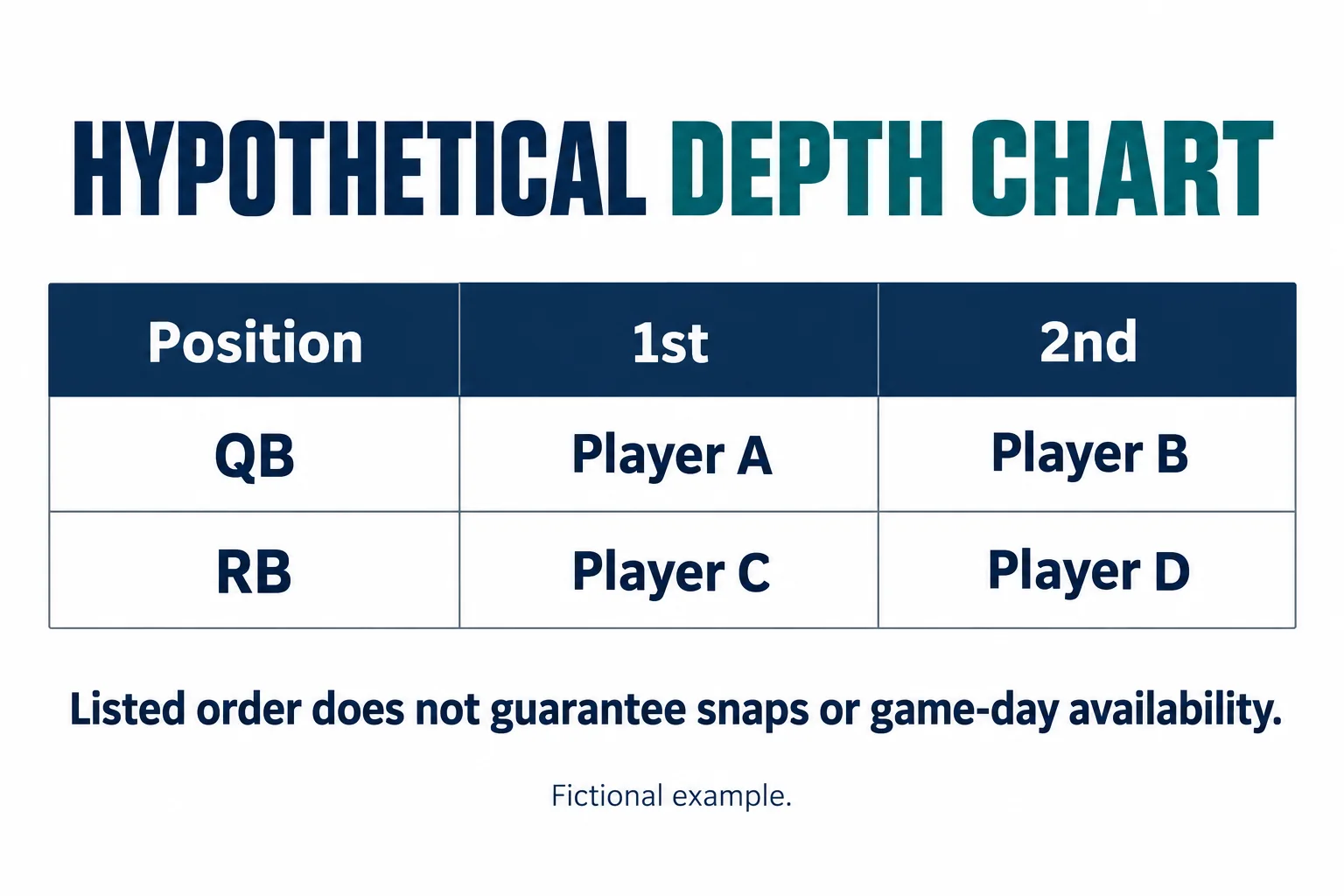
In that fictional example, Player B is the listed quarterback backup to Player A, while Player D sits behind Player C at running back. The chart helps you identify a possible replacement. It supplies no evidence that B will play half the game or that D will receive a particular number of carries.
Why WR1 and RB2 do not promise a fixed workload
Football uses different personnel groupings for different situations. The NFL's formations guide shows why the arrangement can change. A team can bring in a receiving back, use an additional tight end or change its defensive personnel without treating every substitution as a permanent promotion on the depth chart.
WR1 also depends on context. A fan may mean his team's leading receiver, a fantasy writer may mean a high-ranking fantasy option, and a chart may simply show first-team receivers in different rows. Read the surrounding explanation before treating the abbreviation as a guarantee of targets.
For a backup running back, ask which work he is likely to handle: replacing the starter, participating on passing downs or contributing to special teams. Those are different roles. The depth chart helps you begin that investigation; recent snaps, game usage and the team's weekly news help you answer it.
Why a 53-player roster does not mean 53 players dress
The familiar 53-player figure describes the regular-season and postseason active/inactive list. It is not the ordinary game-day active limit. The NFL's roster-size explanation separates those categories and also describes temporary practice squad elevations.
That vocabulary can feel awkward because fans often call the 53-player group the active roster. In conversation, someone can say a player is on the active roster while also reporting that he is inactive for Sunday. Usually they are referring first to membership on the larger list and then to availability for a specific game. Ask which list they mean before concluding that the reports conflict.
A game-day inactive designation also is not automatically an announcement of an injury. A team must decide which personnel to make available for that matchup within the applicable limit. To understand a particular player's absence, read the injury report and the club's game-day information together. Avoid inventing a medical explanation simply because his name appears on an inactive list.
The game-day active limit and offensive linemen
A team can have 48 game-day actives if at least eight are offensive linemen whose primary positions are center, guard or offensive tackle; otherwise the limit is 47. The condition concerns the active group, not merely the number of linemen listed somewhere on the club's website.
Do not confuse that condition with the five offensive line positions in a usual formation. The game-day list includes replacements as well as the likely starting players. It also does not mean eight offensive linemen must line up together on an ordinary down. Roster eligibility and an on-field formation describe different things.
For a fan, the practical result is simple: being listed first on a depth chart does not by itself settle game-day participation. Check whether the player is available for this game, then interpret his listed role. Likewise, an active backup may be ready to substitute without taking many snaps. The number of players who can dress is a limit on availability, not a promise of equal playing time.
These are the rules relevant to the regular-season game you are following. Offseason and preseason personnel lists serve different purposes. When an old article discusses a different season or stage of the year, make sure its roster limit belongs to the game context you have in mind.
Practice squad players and weekly elevations
The practice squad is a separate personnel group, not an automatic extension of the game-day lineup. As described in the NFL's 2026 roster guidance, the usual limit is 16, with a possible 17th qualifying international player. The International Player Pathway explanation describes that conditional extra place.
For fans, the important question is the next roster transaction. A player practicing with the club is not automatically eligible to enter Sunday's game simply because he knows the offense or appears in training photographs. Look for an announced elevation or signing and then confirm his game-day availability.
The standard elevation process allows one or two practice squad players to join the active/inactive group temporarily, taking it to 54 or 55. They return to the practice squad afterward under that process. That does not turn the game-day active limit into 54 or 55, and it does not mean the whole practice squad can dress.
Read the transaction verb carefully. Elevated describes a temporary move for the game. Signed to the active roster describes a different move into that roster. Reverted often appears after an elevation ends. Similar-looking announcements can therefore have different implications for the following week.
Imagine a fictional reserve receiver elevated to provide depth while another player is unavailable. The elevation makes him a candidate for this game's active list; it does not guarantee he will receive passes. If he later reverts, that news alone is not proof that the coaches disliked his performance. It can be the expected completion of the temporary roster process.
Likewise, a player moving from the practice squad to the main roster is not automatically becoming a first-team starter. Roster membership, game availability and workload remain separate questions. A fan following an injury replacement should keep all three in view instead of treating the first transaction as a complete forecast.
Club transaction pages are especially useful late in the week. Read them alongside the roster categories rather than relying on an older screenshot of a depth chart. The screenshot might still show a name in the same place while the announcement explains why the personnel available for the coming game have changed.
What IR, PUP, NFI and injury labels mean for fans
IR refers to injured reserve; PUP means physically unable to perform; NFI refers to non-football injury or illness. Read the complete list name, including an Active or Reserve prefix. The same short abbreviation in a training camp discussion and a regular-season transaction may not describe the same roster situation.
For a fan, these labels mainly tell you to check the player's current roster status and the next announced step. They do not supply a diagnosis, a recovery forecast or a guarantee of a return date. Injured reserve also should not automatically be translated into season over: eligible returns involve additional roster steps, rather than the name disappearing from the list by itself.
For 2026, Reserve/PUP players may begin a 21-day practice period after their club's second regular-season game. A report that someone has returned to practice still deserves careful reading. Practicing, being activated and being available for a particular game are different updates.
Reserve lists are different from questionable or doubtful
A reserve designation is different from a weekly game-status label. Questionable means participation is uncertain; doubtful means it is unlikely; out means the player will not play. Those labels help you follow the coming matchup, while the reserve lists describe a player's broader personnel status.
Also separate practice participation from game status. The Chargers' injury-report page, for example, has daily practice columns and a game-status column. Did not participate, limited participation and full participation describe the reported practice activity. A single practice entry should not be read as the final answer about Sunday's availability.
This is particularly useful when checking a star player midweek. A missed practice can create a reasonable question to follow, but it does not justify inventing a certain absence. Read the report's explanation and later updates. Likewise, returning to full practice is encouraging information to interpret alongside the final game status, not a promise of a particular number of snaps.
Check inactives before kickoff
The final pregame inactive announcement is the practical check for the matchup you are about to watch. Use the club's report for the correct game and date. An inactive list from last Sunday, even with familiar names, cannot settle the next game's lineup.
If a player listed as questionable is absent from the inactive group and available for the game, that resolves one question: he can participate. It does not settle whether he starts, whether his role is reduced or how many touches he receives. Those questions require game usage and the team's explanation.
A healthy reserve can also be inactive, so do not describe every inactive player as injured. Pair the announcement with the injury report and recent transactions. Together, they explain the available personnel much more clearly than a depth-chart screenshot or an isolated social-media headline.
A simple weekly routine for following your team's roster
You do not need to follow every transaction in the league to understand your team's next lineup. Focus on the position that matters to your question and build a short sequence of checks. This works whether you are watching a rookie's progress, following an injury replacement or trying to understand why a familiar reserve suddenly appears in the game.
- Start with the latest chart and roster. Identify the listed starter and possible replacements, and read the category headings. Save the date rather than assuming an old image is current.
- Follow practice and game-status updates. Separate daily participation from the outlook for the matchup. For a Sunday game, the familiar Wednesday-through-Friday reports are useful; other game days have a different reporting rhythm.
- Read the last personnel moves and pregame inactives. Look for an elevation, activation or signing that changes the available group. Confirm that you are reading this game's announcement.
- After the game, check actual usage. A listed backup may have played extensive snaps or mainly special teams. Use what happened to inform your next question rather than treating the old order as a workload forecast.
Keep the kickoff in your local time visible on the NFL games today page. That is especially useful for early international games or a night game that does not fit your usual Sunday routine. If the team is not playing, check the NFL bye-week schedule before looking for a game-day inactive announcement that will not exist for a bye.
A bye does not freeze the personnel list. Transactions and news can still change the group you will see next time. For a specific team, its official transaction page illustrates the kind of record to follow. Match the news to the correct club and date.
Quick answers about NFL depth charts
Does first team mean a player gets every snap? No. It shows the listed order for a role, while personnel packages and substitutions affect usage.
Will the second player always replace an injured starter? The chart identifies a likely option, but availability, the position needed and the team's decision still matter. Read the current announcements.
Can someone on the practice squad simply enter a game? Practice squad membership alone does not make that player a game-day participant. Follow the elevation or roster signing and availability information.
Why is one name listed as both a receiver and a returner? One player can have more than one role. He remains one rostered person, even when several rows describe his assignments.
Is a chart better than an injury report? They answer different questions. Use the chart for the listed depth, the report for weekly availability information and game usage for what the player actually did.
Cover photo: Kansas City Chiefs players walking to the sideline against St. Louis on November 5, 2006. Photo by KellyK, CC BY-SA 2.0; resized and converted to WebP under the same license.

Comments