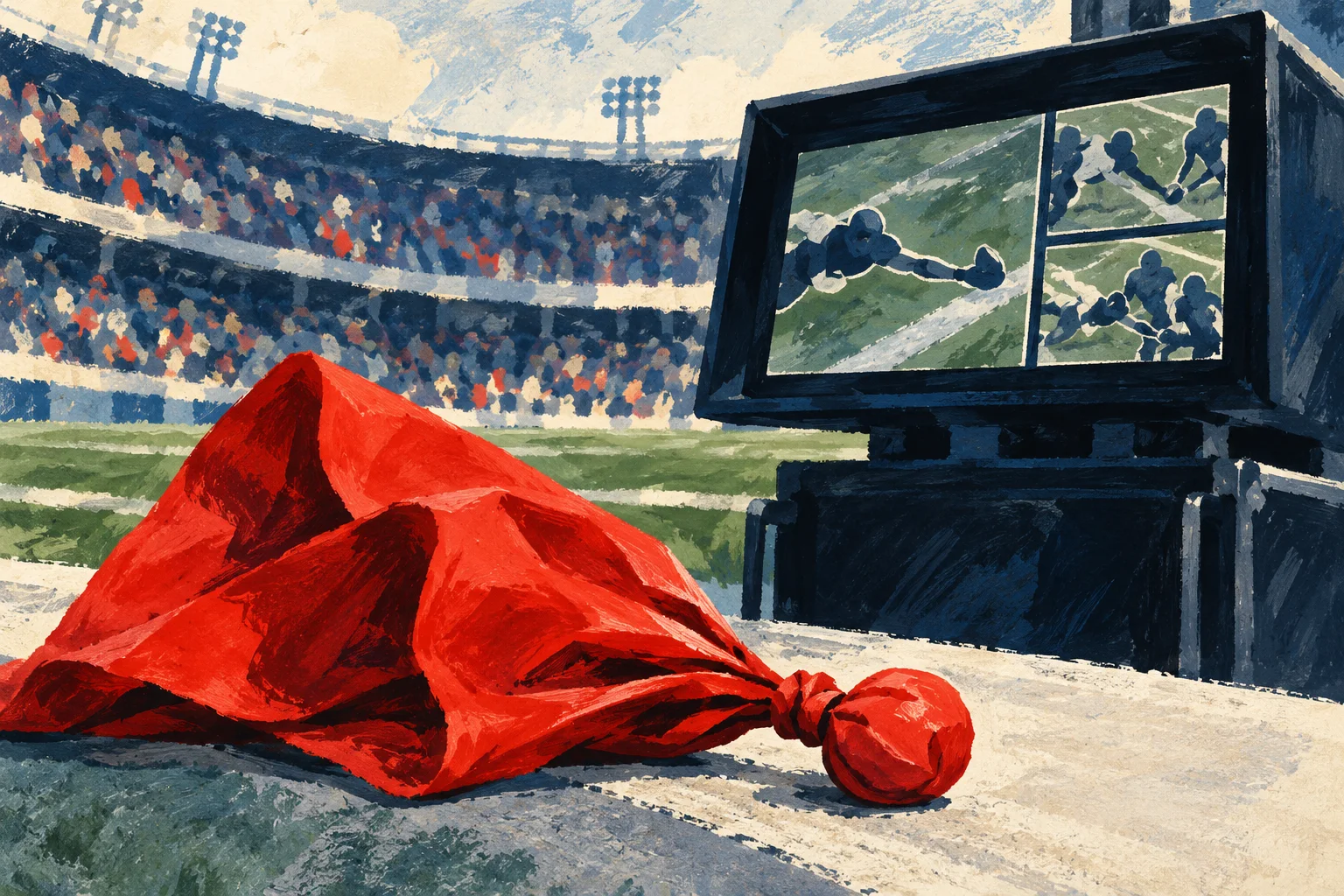
You cannot challenge the contact judgment behind an NFL pass-interference call or no-call in 2026. A coach cannot ask replay to reconsider whether a defender restricted a receiver enough to deserve a flag. However, an objective, reviewable fact on the same play can change the penalty's application. A pass touched noticeably before the interference, for example, is different from a request to judge the contact again.
The distinction also applies late in games. Replay officials taking control after the two-minute warning does not make every penalty reviewable. Understanding the question being reviewed is more useful than simply asking why a coach did not throw a red flag.
The difference between a bad call and a reviewable ruling
A play can contain a questionable decision without containing a ruling that the replay system is allowed to change. That boundary is frustrating when a slow-motion angle seems persuasive. It is still essential to explaining what the officials can do next. Reviewability is a procedural category, not an award for the most controversial play of the afternoon.
The 2026 NFL rulebook identifies reviewable aspects such as possession, touching the ball, field boundaries and certain administrative facts. It does not give a coach a general power to challenge whether ordinary receiver-defender contact amounted to pass interference. A legal challenge must ask a question inside the permitted scope.
For example, “the defender barely touched him” asks for another judgment about contact. “A lineman tipped the pass before that contact” identifies a distinct event that the rules allow video to establish. The second argument can affect a flag without turning the first argument into a challengeable question. Both may concern the same pass, which is why a short television explanation can sound contradictory.
A ruling remaining in place therefore does not prove that every angle supports it. It may remain because the relevant judgment is outside review scope, because no authorized review was initiated in time, or because the evidence does not meet the standard for changing a reviewable ruling. Those explanations should not be blended into a single claim that replay “agreed with the referee.”
Fans can criticize that design while describing it accurately. Allowing review of every receiver's route would be a possible policy choice, with consequences for consistency and delays. It is not the general system currently written into Rule 15. The practical first question is which specific ruling somebody wants changed. Only after answering that can you sensibly discuss the coach's options or the replay official's response.
Why older videos say pass interference can be challenged
Search results can mix a current question with an older rule announcement. An official-looking video can be authentic and still describe a rule that is no longer in force. The date of the competition rule matters more than whether the clip was uploaded by a trusted account or shared again this week.
This is especially confusing for pass interference because the NFL previously tried a different approach. A fan who remembers coaches challenging the contact judgment is not imagining it. The mistake is assuming that the earlier permission applies unchanged to a 2026 game.
The 2019 experiment is historical context
The NFL trialled pass-interference replay in 2019 after the disputed Saints-Rams conference championship no-call. That history explains the old instructional videos.
The trial does not appear as a continuing general contact-review power in the current Rule 15. A historical replay explainer should therefore be read as an explanation of that season's procedure, not as an instruction to throw a challenge flag in every modern dispute. The current list of reviewable rulings is the starting point for the present answer.
Be equally careful with proposed changes. An analyst saying the league should expand review is arguing for a future policy. A headline about a new challenge designee concerns who can initiate an otherwise legal challenge. Neither statement, by itself, reinstates the old pass-interference trial. The subject of a headline and the scope of an actual rule can be very different.
When checking an explanation, look for three labels: the rulebook year, the precise ruling under discussion and whether the statement describes an approved rule or a recommendation. That habit avoids a familiar argument in which one fan cites a genuine old video while another correctly describes the current restriction. Both sources can exist; they simply answer questions about different seasons.
What a coach can actually challenge in 2026
Ask whether the requested review concerns a fact listed in Rule 15, rather than simply noticing that a yellow flag landed nearby. A catch, a boundary ruling or the fact of touching can be reviewed in the proper circumstances. Having a penalty on the same down does not automatically make those separate facts disappear from the replay system.
Tipped passes and the location of a foul
The tipped-pass provision is a useful example because it is precise. Replay can establish whether a player touched a forward pass. That can remove offensive or defensive pass interference when the touch occurred away from, and noticeably before, the interference. A possible fingertip touch at some unrelated moment is not a universal excuse to erase a flag. The sequence and the relationship to the interference are important.
Similarly, reviewing the location used to administer a foul is different from deciding that no illegal contact happened. The spot can have a major effect on the resulting field position. Correcting it does not mean replay has reopened every element of the original judgment. Listen for an announcement about touching or enforcement rather than assuming the officials changed their opinion of the collision itself.
Timing, timeouts and the challenge designee
For a normal coach-initiated challenge, the team needs an available timeout and an available challenge. The red flag must be thrown before the next legal snap or kick. In 2026 the head coach's pregame challenge designee can initiate the challenge, too. That changes the authorized person, not the list of permissible subjects. An assistant holding the flag does not acquire a new power to challenge ordinary pass-interference contact.
A team has at least two challenges and can earn a third by succeeding on at least one. A fourth is not permitted. An unsuccessful challenge costs a timeout. Those limits explain why a coach might decline a marginal but legally reviewable question early in a half: a resource spent there may be unavailable for a clearer mistake later. They do not explain a decision outside review scope, where the resource cannot make the prohibited question valid.
Some situations belong to replay officials rather than the coach, including overtime and plays beginning after a half's two-minute warning. Scoring and specified turnover rulings also have separate initiation rules. Before demanding a flag, check both gates: is the aspect reviewable, and is the coach authorized to initiate a review in this situation? Passing only one of those tests is not enough.
What replay assistance can and cannot fix
Replay assistance is another reason a flag can disappear without the familiar red-flag challenge and long monitor sequence. The rule permits help with specific objective aspects when video is clear. That assistance is a defined tool. It does not create a general second officiating crew empowered to reconsider every contact judgment from a better camera angle.
Removing a flag is different from adding a missed foul
Consider a called roughing-the-passer foul based only on a blow to the head or neck. If video clearly shows there was no contact with that area, the assistance provisions can address that factual premise. A called facemask foul can likewise involve a check of whether the hand actually contacted the facemask or helmet opening. The permission is tied to specified conditions; it is not an invitation to search the entire down for any possible foul.
That explains why viewers may see one flag removed and then see an apparent missed penalty remain untouched. The situations can have different legal routes into review. It would also be too broad to say replay can never create any foul: a changed reviewable ruling can have penalty consequences under Rule 15. The accurate distinction is between those specific authorized consequences and a general power to add a missed pass-interference judgment.
The final two minutes do not make every judgment reviewable
After the two-minute warning of either half, the replay side controls initiation for covered plays. The coach cannot use the red flag as the normal route. That answers who can begin the process; it does not answer what aspects the process can change. Ordinary pass-interference contact does not become challengeable because the scoreboard shows 1:59.
A reception can be changed after review because possession or the boundary is reviewable, while a contested contact judgment on the same drive remains in place. A broadcast showing multiple angles is not proof that officials have formally reviewed every visible foul. Television analysis, replay assistance and a full review are related but distinct activities.
A player disqualification follows its own provisions
The 2026 rulebook also permits consultation about potential player disqualifications for flagrant football and non-football acts, including acts not called on the field. That provision concerns whether a player should be removed under its own authority. It should not be stretched into a claim that any missed receiver contact can now be converted into pass interference.
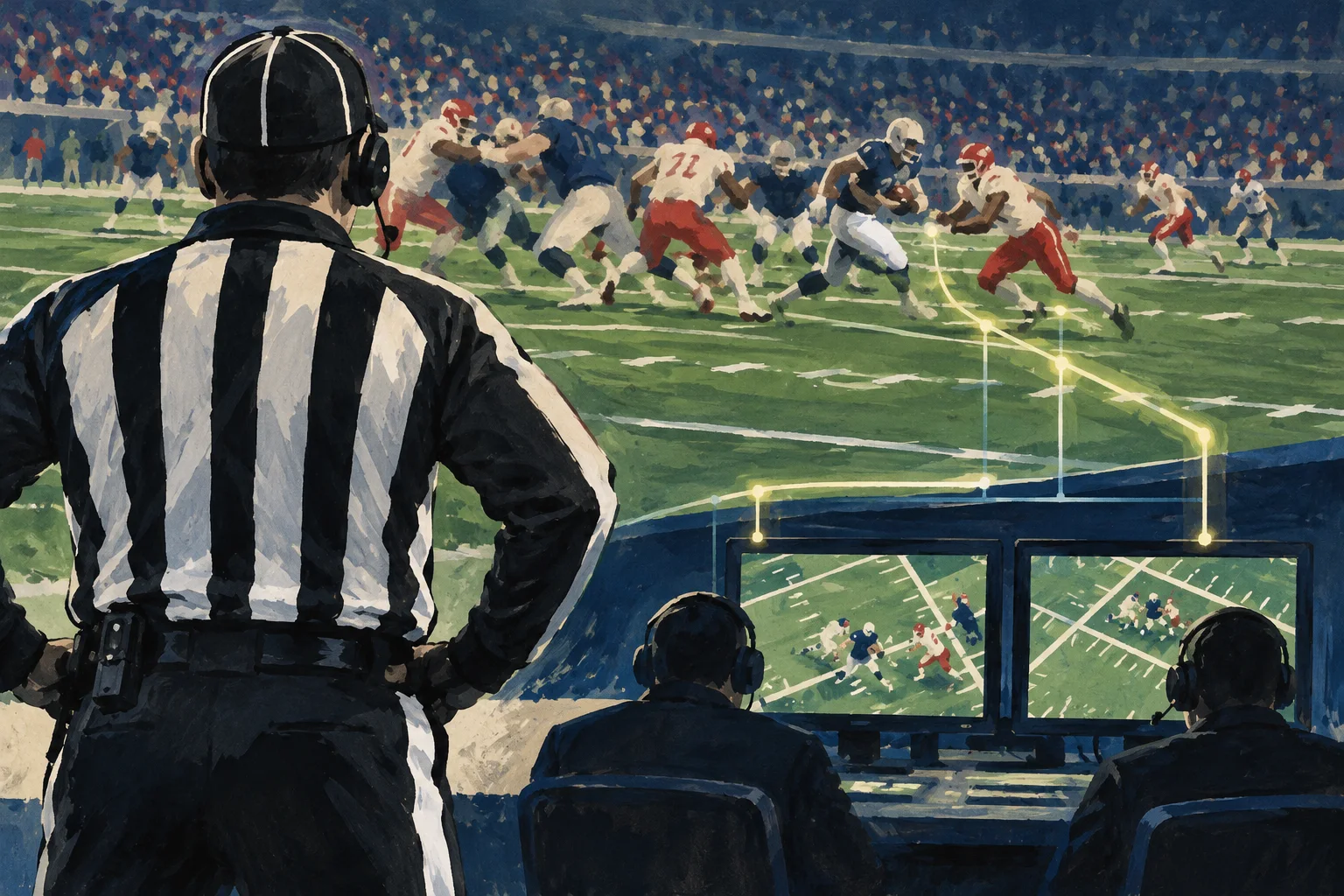
When a new replay headline appears, identify the category it changes. Challenge initiation, objective assistance and disqualification consultation solve different problems. A reform in one category does not automatically change all the others. This is the main reason a simple statement that “replay was expanded” can leave fans with expectations the actual rule does not meet.
Four situations that explain the boundary
The following examples are hypothetical. They describe the question a review might address, not the outcome of a particular controversial game. Assume the necessary timing, timeout and initiation requirements are satisfied unless the example says otherwise.
| What the viewer sees | The relevant distinction |
|---|---|
| A defender appears to arrive early; no flag | A new contact judgment cannot normally be created by coach challenge. |
| A flag follows a pass tipped well before the interference | The fact and sequence of touching can be reviewed. |
| A catch near the sideline occurs on a flagged play | Catch and boundary aspects may be reviewable; the contact judgment is separate. |
| A controversial flag occurs after the two-minute warning | Replay initiation authority changes; review scope remains limited. |
In the first example, showing contact from a clearer angle does not solve the jurisdiction problem. The coach is still asking for the prohibited reassessment. A strongly held view that the call was wrong is not a substitute for a permitted reviewable aspect.
In the second, the argument should focus on the touch and its timing. If a defensive lineman clearly changed the ball's flight well before the receiver-defender interference, that is a different factual premise from the one the official may have assumed. If the video cannot establish the touch clearly, the mere possibility does not require a reversal.
In the third, avoid assuming that an incomplete-pass ruling automatically erases all other conduct on the down. Penalties have their own enforcement consequences. Replay can correct a catch or boundary fact and officials then apply the rules to the resulting situation. The correct final outcome depends on which aspect changed and how it relates to the foul.
In the fourth, the coach may have no authorized flag to throw even if an objective issue deserves attention. The absence of a red flag is not evidence of surrender, secret agreement or a missed opportunity to use a timeout. The useful question is whether the replay official had a reviewable issue to address. That directs the discussion toward the rule rather than a guessed motive.
How to judge a disputed play while watching
Start with the referee's actual announcement, rather than the caption on a clipped social video. Was the ruling pass interference, illegal contact, holding or a catch decision? Similar-looking action can produce different rule questions. A clip beginning after the first contact may also omit the part that explains why the flag was thrown.
- Name the exact ruling you want changed.
- Identify an objective fact that Rule 15 permits officials to review.
- Check whether the coach or replay official controls initiation.
- Check the remaining timeouts, challenges and timing before the next snap.
- Watch the full sequence and wait for enforcement.
For the wider changes surrounding replay and player safety, the 2026 NFL rule-changes guide puts individual announcements in context. Use the weekly game schedule to find the next broadcast, where the same distinction between contact judgment and objective evidence will arise again. Neither resource replaces the actual ruling on a specific play.
When discussing a disputed call afterward, separate three statements: what you think happened, what the official ruled, and what replay was authorized to change. Agreement on one does not require agreement on the others. A supporter can believe a flag was harsh while correctly acknowledging that the coach had no legal challenge to the contact judgment.
This approach also makes criticism more specific. If the complaint is about consistency in judging interference, say so. If the complaint is that clear evidence of an earlier tip was ignored, identify that factual issue. If the complaint is that the rule should permit broader review, describe it as a proposed reform. Each argument can be evaluated on its own terms instead of relying on the misleading premise that every disputed flag already has the same replay remedy.
Comments