The 2026 NFL rulebook makes four changes fans can see: two kickoff adjustments, earlier access to a declared onside kick and expanded league-office consultation on possible ejections. Owners also approved a one-year officiating contingency that matters only if a specified work stoppage occurs, plus three roster-administration bylaws. In August, the NFL and NFLPA separately added stronger repeat-offender consequences for five emphasized safety violations.
The distinctions matter. The ordinary 35-yard kickoff touchback was not newly rewritten for 2026, the ejection rule is not unlimited replay review, and the safety discipline policy does not redefine every underlying foul. This guide starts with the final rulebook, then translates each change into what viewers should watch. Use the NFL Week 1 schedule for the games in which the rules first affect the regular season.
2026 NFL rule changes at a glance
| Change | 2026 effect | Status |
|---|---|---|
| Receiving-team kickoff alignment | Setup-zone alignment requirements are modified | Final Rule 6-1-3 |
| Kickoff from the 50 | Dead-ball placement removes the incentive to deliberately kick out behind the goal line | Final Rule 6-1-5 |
| Declared onside kick | A trailing team may declare one at any time in the game | Final Rule 6-1-6 |
| Potential disqualification | League personnel may consult with on-field officials even when no flag was originally thrown | Final Rule 19-2 |
| Clear-and-obvious correction | Expanded correction authority exists only under the specified officiating-work-stoppage contingency | One-year conditional measure |
| Roster administration | International Week 1 flexibility, Labor Day business days and an earlier PUP practice window | Bylaws, not play rules |
| Repeat safety violations | Five techniques receive stronger cumulative discipline | August NFL-NFLPA policy |
The first four rows are the clean answer to “what changed in the 2026 rulebook?” The remaining rows matter to the season but operate differently. A bylaw changes club procedure, a contingency may never activate, and discipline can occur after a play without changing the yardage enforced during it.
This status column prevents old proposal coverage from becoming fake current law. The adopted rulebook controls. It also prevents a 2025 change from being relabeled as new: the dynamic kickoff structure and ordinary 35-yard touchback were already in place before this season.
Kickoff setup-zone alignment changes
Rule 6-1-3 changes how the receiving team distributes its blockers inside the dynamic kickoff's five-yard setup zone. That zone still runs from the receiving team's 35-yard line back to its 30. At least nine receiving players must occupy it, but the 2026 text now tells clubs more precisely how many must be on the restraining line and how the others can be spread.
At least five setup-zone players must have a front foot on the receiving team's 35. If the return team puts more than nine players in the zone, at least six must be on that line. The rule also requires geographic balance: one on-line player between the hashes, one in each inside-number area and one in each outside-number area. No more than four setup-zone players may align off the restraining line, no more than two may occupy any of the three field-width areas, and at least three receivers must be outside the hashes on each side.
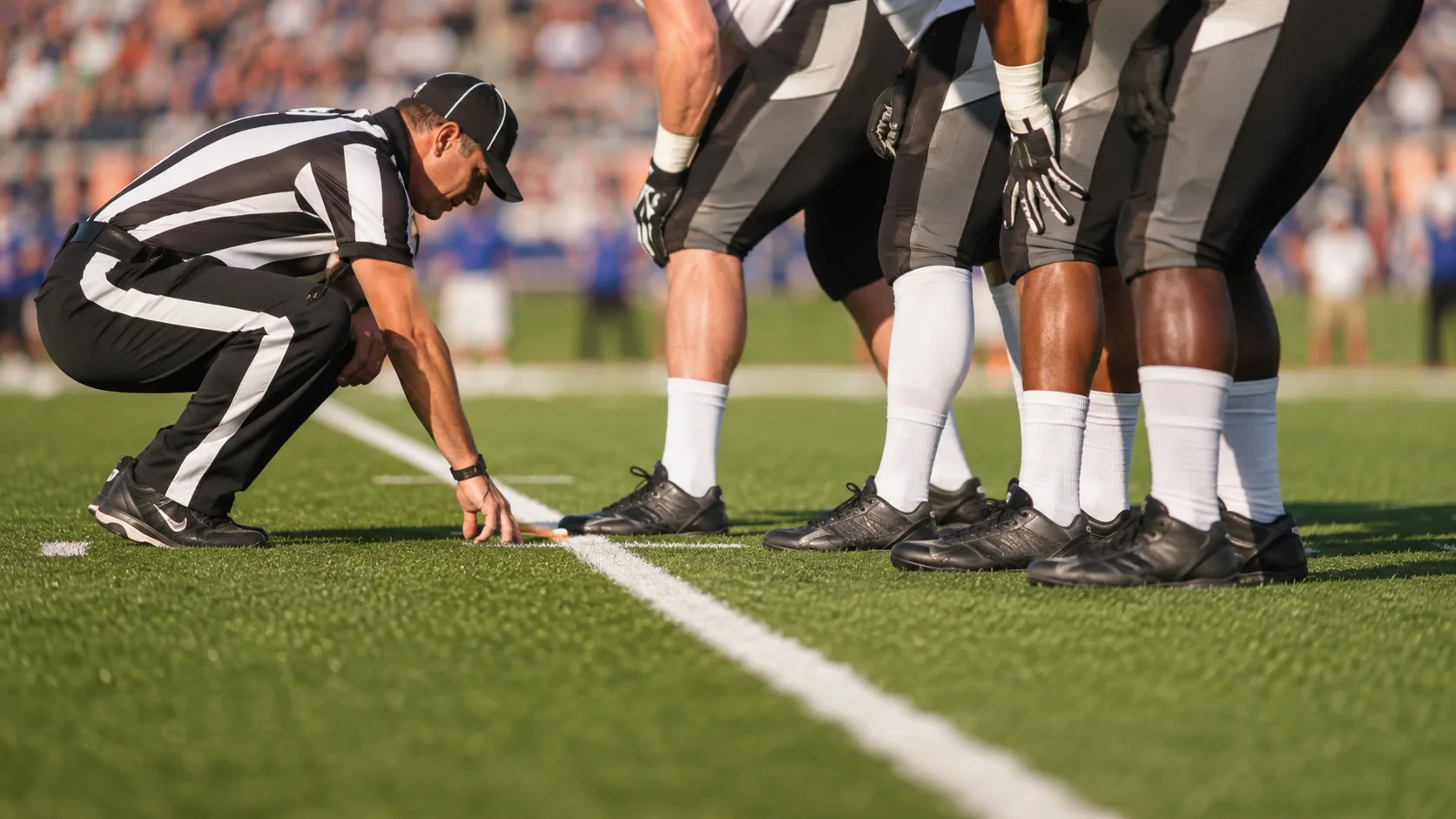
Deep returners are still governed separately. Anyone outside the setup zone must stay behind the 20 until the kick, then behind the 30 until the ball reaches or is touched in the landing zone or end zone. Most viewers will notice the change before the kick, when an official resets a misplaced player or calls illegal formation. The penalty is five yards.
What did not happen is just as important. The league did not abandon the dynamic kickoff or restore the old running-start formation. The kicker, landing zone and near-stationary blocking picture remain. Rule 6-1-3 is a geometry adjustment intended to regulate the initial blocking picture, not a new kickoff system.
The kickoff-from-the-50 loophole is closed
Rule 6-1-5 addresses an unusual kickoff created by penalty enforcement. A normal kickoff begins at the kicking team's 35, but a 15-yard penalty carried to the next free kick can move it to midfield. From there, a kicker has much less field to cover. Under the old incentive, blasting the ball beyond the end line could trade away the possibility of a return while still producing advantageous field position.
In 2026, every touchback on a kickoff from the 50 puts the receiving team at its own 20-yard line. That includes a ball sent directly through or out of the end zone. The lower placement makes deliberate overkicking costly: the return team gets 30 fewer yards than it would under the ordinary untouched-end-zone result.
This is not a general change from the 35 to the 20. On a normal kickoff, a ball that reaches the end zone without first touching the landing zone and becomes dead still produces possession at the 35. A kick that first touches the ground or a receiver in the landing zone before becoming a touchback goes to the 20. The special 2026 sentence applies only when the kickoff itself is from midfield.
For viewers, the practical cue is the preceding penalty. If the broadcast says enforcement will be carried to the kickoff and the tee moves to the 50, the receiving coach now has a stronger reason to accept a deep touchback outcome. The rule removes a tactical reward from the penalized team instead of rewriting the baseline kickoff.
Onside kicks can be declared earlier
The 2026 book removes the old timing restriction from the declared onside option. A kicking team may now declare an onside kick at any time in the game. The final rule does not say it must be losing. That detail is worth emphasizing because proposal summaries and older explainers can leave readers with a trailing-team assumption that is not in the adopted text.
“Declared” means there is still no classic surprise onside kick. The kicking team must notify the referee before the 25-second play clock starts. The referee then tells the receiving team before starting that clock, allowing both sides to enter the special onside formation. The return team places at least eight but no more than nine players in the 15-yard onside setup zone, while the kicking side faces its own balanced-alignment requirements.
The recovery threshold remains familiar. A kicking player may legally touch or recover after the ball touches a receiver or reaches the receiving team's restraining line, normally 10 yards beyond the kicking line. If the ball travels untouched beyond the entire onside setup zone, it is dead, the receiving team gets possession, and the rule specifies a 15-yard unsportsmanlike-conduct penalty from the kicking team's restraining line.
Why use it early? A coach could value an extra possession, exploit a scouting tendency or react to game state before the fourth quarter. But the receiving team gets advance notice, and failure gives it excellent field position. The change expands strategic timing; it does not make recovery easy, conceal the attempt or erase the formation and touching restrictions.
League office can assist on potential ejections
Rule 19-2 gives designated league officiating personnel a narrow way to help remove a player after an exceptionally serious act that the field crew did not flag. If video shows an uncalled football or non-football act that the department determines was flagrant, it may consult with the on-field officials about disqualification. The consultation must happen before the next legal snap or kick.
If the action is found flagrant, the stated result is a 15-yard penalty and ejection. The rule also covers an unpenalized player whose flagrant conduct was directly related to a foul that officials did call—for example, an additional participant in the same confrontation. In that circumstance, the missed participant may be disqualified and a penalty is assessed.
The word “flagrant” sets a deliberately high threshold. The rulebook describes it as an extremely objectionable, conspicuous, unnecessary, avoidable or gratuitous violation; it does not require proof that the player intended to injure someone. This is why the mechanism fits punches, severe football acts and related confrontations, rather than routine debates about whether marginal contact deserved a flag.
It is not a universal missed-penalty review. League personnel cannot use this paragraph to comb through every hold, interference judgment or borderline personal foul and manufacture a normal call. Its subject is potential disqualification, its severity threshold is flagrant, and its window ends at the next legal play. Fans should expect a brief administrative pause when it is used, followed by the referee's announcement of the penalty and removal.
The one-year officiating contingency and roster bylaws
One approved measure sounds broad but has a decisive condition. For one year, the Officiating department may correct clear-and-obvious mistakes by on-field officials that affect the game only in the event of a work stoppage involving game officials represented by the NFL Referees Association. Unless that trigger exists, it should not be described as a blanket 2026 expansion of replay.
The conditional measure also differs from Rule 19-2. The ejection provision is in the final playing rules and addresses flagrant acts. The one-year resolution is emergency coverage for a specified labor circumstance. When reading an in-game report, ask two questions: did the work-stoppage condition activate, and is the intervention an ejection consultation under Rule 19 or a clear-and-obvious correction under the contingency?
Three approved bylaws operate behind the scenes. First, the league office may adjust procedures, dates and deadlines for the final roster reduction when accommodating an international game in Week 1. Second, the Saturday and Sunday of Labor Day weekend count as business days for clubs to deliver personnel notices during the first weekend after roster reduction. Third, a player on Reserve/Physically Unable to Perform may begin his 21-day practice period after his club's second regular-season game.
Those changes can influence when a transaction appears and when a recovering player returns to practice, but none changes whether a catch is complete or a penalty occurred. Fans following cuts should confirm the affected club's actual deadline and use team schedule pages to identify international travel. A PUP player's practice-window opening also does not guarantee immediate activation; it starts a roster decision process.
New repeat-offender emphasis for player-safety violations
In August, the NFL and NFL Players Association announced a shared discipline order for five emphasized violations: the hip-drop tackle, horse-collar tackle, launching, a hit on a defenseless player and a blindside block. These are not five newly invented fouls. Their definitions and on-field penalties remain in the rulebook; the change is how repeated violations accumulate in the accountability system.
A player who commits three offenses across any of those categories during a season receives a one-game suspension. The count is collective, so it does not require three identical techniques. Everyone began 2026 with a clean slate, while offenses after that reset can carry forward to later seasons under the policy.
Accountability also extends beyond the player. A coach must join a player in meetings with the league as that player approaches the suspension threshold. Clubs with excessive health-and-safety violations can face increased financial penalties, and former coach and player Ron Rivera was added to the pool that handles on-field discipline appeals.
The useful viewing distinction is between three layers. Officials decide the foul and yardage during the game. Rule 19-2 can support an immediate ejection when an act is flagrant. The cumulative policy evaluates qualifying violations across games and can produce a later suspension. A play may therefore matter to the repeat-offender count even when the live broadcast focuses only on field position.
The policy's central idea is progressive discipline: distinguish an isolated error from a pattern while creating a firm suspension threshold. That means the season-long context matters. When a qualifying play occurs, viewers should track the player's cumulative category count rather than assume the game-day flag alone reveals the later consequence.
What fans should watch in Week 1
- Count the return team's front line. Before an ordinary kickoff, look for at least nine players in the setup zone and the required distribution across the width of the field.
- Notice where the tee moves after a penalty. A kickoff from midfield activates the special 20-yard touchback placement; an ordinary kickoff does not.
- Listen for an onside declaration. The referee must notify the receiving team, so an early attempt is strategic but not a surprise.
- Watch the next-snap window after a severe act. A pause may signal league-office consultation over a potential disqualification, not a general review of every penalty.
- Separate flags from later discipline. The five emphasized safety categories can accumulate toward a suspension even though the broadcast first explains the on-field enforcement.
Start with the Week 1 game list for the opening slate, or use the current NFL schedule once the season advances. The full 2026 NFL schedule provides the broader calendar. These live pages should control for kickoff times and matchups; this article is the rule companion that explains what the officials are administering.
Frequently asked questions
Is the dynamic kickoff still in effect in 2026?
Yes. The NFL made the dynamic format permanent in 2025. The 2026 alignment adjustment changes the receiving team's distribution inside that existing structure; it does not replace the structure.
Did every kickoff touchback move to the 20?
No. The special new 20-yard result covers a kickoff from the 50. On an ordinary kickoff, a ball that first touches the landing zone before becoming a touchback goes to the 20, while an untouched end-zone touchback goes to the 35.
Must a team be trailing to declare an onside kick?
No. The final 2026 Rule 6-1-6 says a kicking team may declare at any time. Some older coverage described a trailing-team limitation, but that restriction is absent from the adopted rulebook.
Can replay now add any missed penalty?
No. The permanent 2026 addition addresses consultation over a potential disqualification for an uncalled flagrant act before the next legal play. The broader clear-and-obvious correction resolution is conditional on a specified officials' work stoppage.
Did the NFL ban the tush push or require every stadium to use grass?
Neither appears in the final list of adopted 2026 playing-rule changes. Field-surface practices apply league-approved metrics to natural and synthetic fields, but they are not a grass-only mandate. Proposals, debates and operational standards should not be presented as adopted playing rules.
Will these changes automatically remain identical in 2027?
The four provisions printed in the 2026 rulebook govern this season, but clubs can amend rules in a later cycle. The work-stoppage measure is explicitly for one year. Check the next official rulebook before carrying any 2026 language into a future-season guide.
Comments