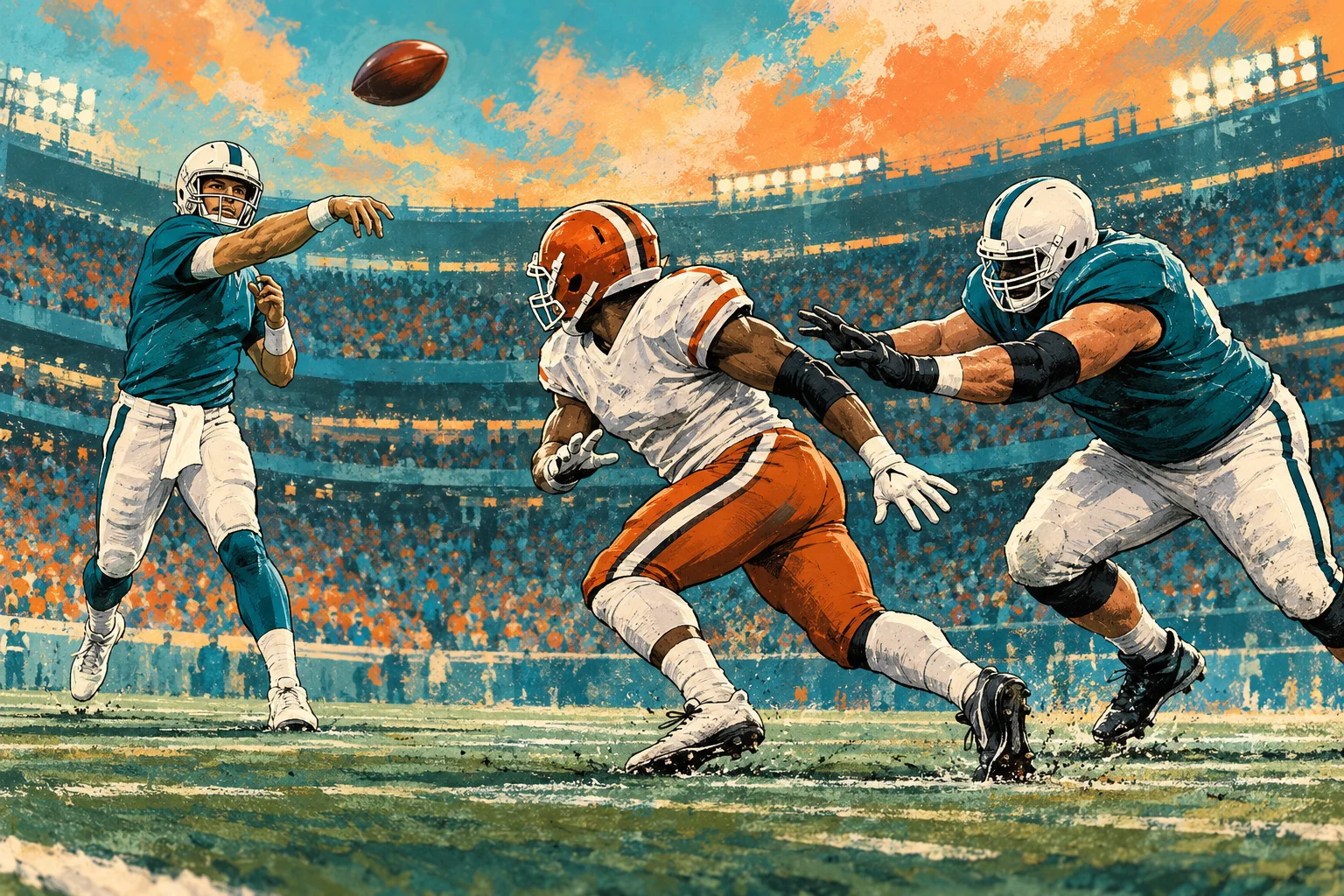
Being blocked into a quarterback does not automatically make contact roughing the passer. The NFL rulebook distinguishes incidental contact, avoidable late force, prohibited hits and particular exceptions. Most roughing judgments cannot be challenged by a coach, although replay assistance can remove a flag based on certain clearly incorrect contact facts.
Green Bay's October 25, 2026 loss at Detroit made both issues urgent again. Fans saw Brenton Cox Jr. contact Jared Goff after being blocked and asked what a defender could reasonably do. Answering that fairly requires more than counting steps or saying a quarterback fell. Here is how the current rules separate the situations.
What counts as roughing the passer in 2026?
Roughing the passer covers prohibited physical acts against a player in a passing posture. It is a collection of protections dealing with timing, force, contact location and the way a passer is brought down. The useful opening question is which protection the official believed was violated.
The 2026 NFL rulebook places those protections in Rule 12, Section 2, Article 11. Its standard penalty is 15 yards and an automatic first down, with disqualification possible for a flagrant act. That first down can make a disputed flag especially costly on an apparent third-down stop.
A quarterback can be protected before the pass leaves his hand
The name can mislead new viewers. A defender does not gain permission to use every kind of contact merely because the quarterback still possesses the ball. The player can be in a protected passing posture before attempting the throw, during the delivery and afterward. Rules against prohibited head contact or unnecessarily driving a passer down are not limited to a late-hit stopwatch.
A normal legal sack remains possible. What matters is how the defender makes the tackle. Wrapping up the passer and using legal technique is a different act from a prohibited strike or a violent extra drive into the turf. A tackle can begin at a legal time but still be completed illegally.
Also identify whether the quarterback is passing, moving outside the pocket or advancing as a runner. The rule adjusts particular protections in those situations. It does not simply make a quarterback either untouchable or completely unprotected. A moving passer outside the pocket loses specified one-step and low-hit protections, while retaining others; clearly reestablishing a passing posture behind the line restores the full set.
For viewers, that means a useful replay starts before the hit. Watch the passer's movement and delivery, not only the moment he reaches the ground. Two impacts with similar final images may fall under different provisions because the preceding action was different.
What if a blocker pushes the defender into the quarterback?
The blocker matters because the defender may no longer control his path in the same way. The late-contact provision expressly recognizes incidental or inadvertent contact by a player who is easing up or being blocked into the passer. It does not treat that contact as significant merely because the quarterback is touched.
There is also an explicit exception within the low-hit provision. A defender blocked or fouled into the passer, with no opportunity to avoid him, does not commit that foul on those facts. But a defender cannot initiate a roll or lunge to make a forcible knee-area hit and claim immunity just because another player was touching him.
Read the exception for the kind of contact being called
The phrases describing these exceptions have a purpose. They address what caused the collision, whether avoidance was possible and whether the defender added a separate prohibited action. They are not a universal rule that any blocker touching a rusher erases everything the rusher subsequently does.
Consider two hypothetical plays. In the first, a blocker changes a defender's direction immediately before contact, and the defender makes an inadvertent glancing collision while trying to pull away. That sequence raises the rule's express recognition of blocked or incidental contact. In the second, a defender regains balance after a block and then launches into the passer's knee. The earlier block does not automatically excuse the later lunge.
Those examples show why a freeze-frame of a hand on the rusher's back is insufficient. Start the video early enough to follow momentum. Did the blocker actually redirect the defender? Was there room or time to avoid contact? Did the defender ease up, or add a new push, roll or drive? The answer has to relate to the specific restriction being enforced.
Equally, a quarterback falling does not establish that the contact was illegal. A light but awkward collision can knock someone off balance; a prohibited hit may leave the passer standing. Injury and theatrics are poor substitutes for evaluating the act. The legal test concerns the contact and circumstances, not how dramatic the finish looked.
This is the strongest way to frame a complaint about a blocked defender: identify the applicable exception, then show the evidence supporting its conditions. It is more precise than arguing that all accidental contact is legal, a claim the broader safety rules do not support.
Late contact, head hits and body weight are separate questions
Many arguments go wrong because viewers test the timing of a hit when the disputed restriction concerns where or how it landed. The following distinctions explain why an apparently timely tackle can still draw a flag, and why a touch after release may not deserve one.
After the release
For the applicable pocket-passer protection, a rushing defender may make direct contact through his first step after release, before the second step hits the ground. Afterward he must try to avoid contact and cannot continue forcibly through the passer. The rule also expects rushers to recognize where the ball is.
This is not a free step during which every form of violence is legal. It describes the timing allowance for direct contact. A prohibited head strike or an unnecessary drive to the ground remains a separate concern. Count steps only after identifying the release and checking whether this particular timing protection applies to the passer's situation.
Head, neck and knee-area contact
Forcible contact to a passer's head or neck can violate the protection even if the defender initially contacts a lower part of the body. The rule distinguishes such acts from incidental mask or helmet contact during a conventional tackle. A replay showing only a brush near the helmet does not settle whether forceful prohibited contact occurred.
The low-hit restriction concerns a forcible hit at the knee area or below against a passer with one or both feet on the ground. Swiping or grabbing to make a tackle is treated differently from driving a helmet, shoulder, chest or forearm into that area. The blocked-defender exception belongs in this analysis when its conditions are met.
Outside the pocket, a passer continuing to move or throwing on the run loses specified one-step and low-hit protections, while retaining other passer protections. If he stops behind the line and clearly establishes a passing posture, the full protection returns. That sequence is another reason the final impact frame is insufficient.
Driving the passer into the ground
A defender cannot unnecessarily wrestle or drive the passer down after release simply because the initial contact was within the allowed step. The rules also address violently throwing a defenseless passer down or landing on him with all or most of the defender's weight. Defenders must strive to fall to the side or brace with their arms.
A photograph of two players overlapping on the turf cannot measure that effort. Watch the descent, the defender's arms and whether he adds force after securing the tackle. Conversely, getting the first shoulder contact right does not excuse an illegal finish. The whole tackle, rather than its most convenient isolated frame, is the relevant evidence.
Why the Packers–Lions calls caused so much frustration
The clearest question from Detroit concerned Cox's contact with Goff. The Packers' official game account described Cox as being blocked into the quarterback. Cox said he was trying to pull up and that his hands contacted Goff's abdomen, putting him off balance. Those reported circumstances explain why the exception for incidental or blocked contact became relevant to the public debate.
They should not be silently transformed into an official finding that every condition of an exception was satisfied. The account is Green Bay's reporting of the sequence and its player's perspective. The accessible pool-report coverage did not provide a specific referee answer explaining the roughing flags. Without that explanation, assigning a precise rationale to the official would be guesswork.
The same game contained multiple disputed decisions, which compounded the reaction. But a dead-ball tackle, intentional grounding and roughing the passer involve different tests. An argument about the whistle on one play cannot establish whether contact to the quarterback on a later down was legal. The clips should be assessed individually.
Green Bay's report also emphasized a season imbalance in roughing penalties called against its defense and drawn by its quarterback. Such a tally explains frustration; it does not establish that equally illegal acts occurred equally often. A fair comparison needs the individual plays, passer posture, timing, contact location and the specific explanation for each flag or non-call.
That distinction lets fans make a stronger argument. Rather than demanding matching numbers, compare truly comparable actions and identify where the same standard appears to have been applied differently. A consistent standard is a reasonable expectation even when exact penalty totals differ.
Keep the event and the lasting rule question separate when following the Packers schedule and Lions schedule. The incident gives the guide its immediate relevance, but the useful lesson is how to evaluate the next blocked-rusher collision without assuming that a team's complaint or a flag alone resolves it.
Can replay overturn roughing the passer?
Sometimes a flag can be removed with replay assistance, but that does not make roughing the passer generally challengeable. The distinction is between correcting a specified objective fact and opening the entire penalty judgment to a new decision.
Rule 15's assistance provision addresses a called roughing foul based only on a hit to the passer's head or neck when clear and obvious video shows the defender made no contact with that area. If the official thought the defender hit the head and the video clearly shows contact somewhere else, the factual foundation can be corrected.
Replay assistance is narrower than a coach's challenge
The word only matters. The provision does not grant a free reconsideration of late force, the body-weight restriction or every collision after a block. Nor does it say that replay may reassess how forceful actual head contact was merely because viewers disagree about it.
Take three hypothetical examples. A flag based solely on a supposed blow to the helmet, with a clear angle showing the defender never touched the head or neck, fits the specified assistance question. A clip showing actual contact near the helmet, followed by debate about whether it was forceful enough, is not the same no-contact fact. A body-weight flag raises another issue entirely.
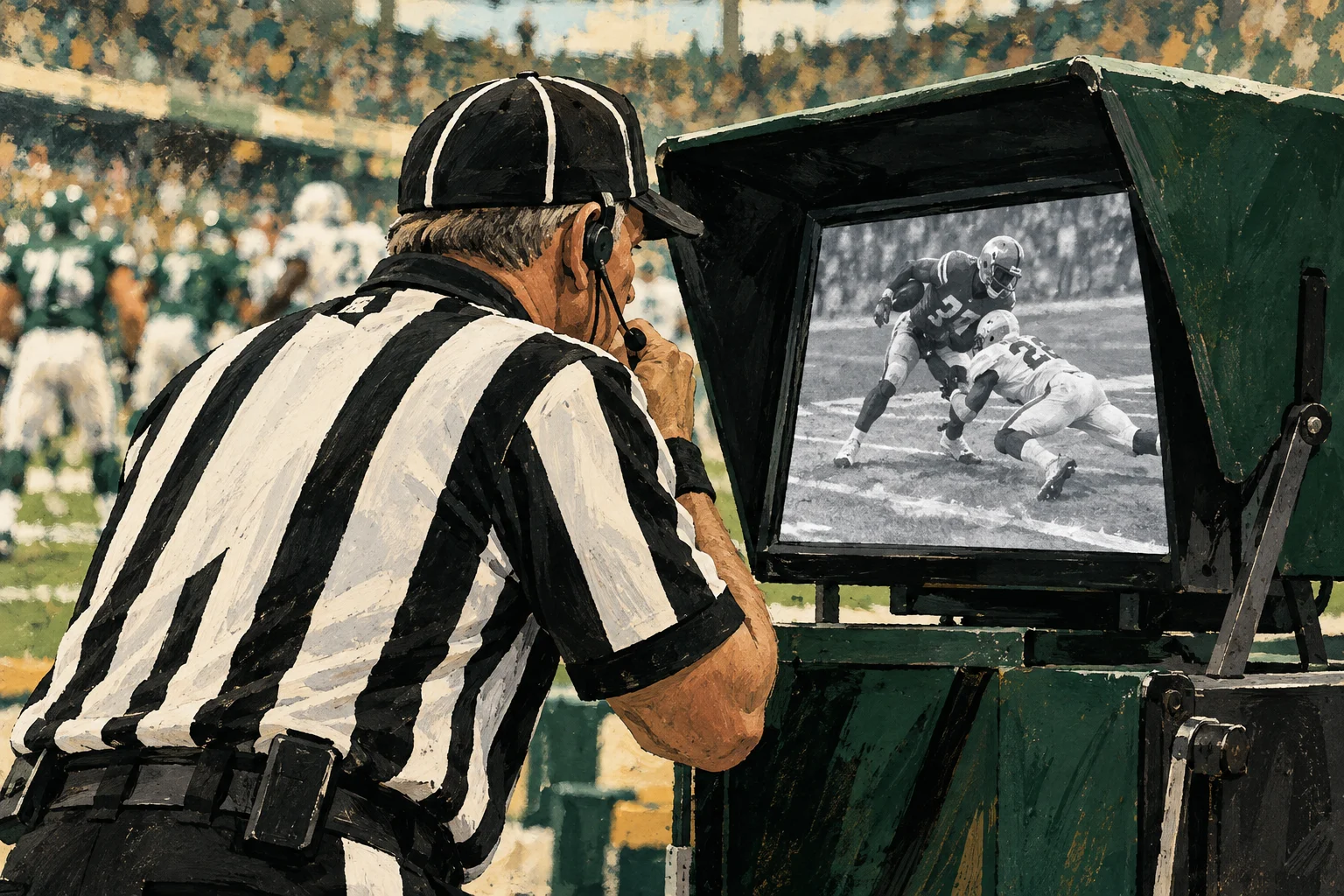
A coach's red flag does not expand the list of reviewable rulings. Fans therefore should not assume a coach declined an available remedy whenever a disputed roughing call stays in place. First identify whether the desired correction falls within the replay rules and whether the evidence meets the applicable standard.
It is equally inaccurate to say a roughing flag can never change. Assistance can address its specific permitted factual situation, and penalty administration has its own review provisions. The accurate answer names the channel and the precise fact being corrected.
Finally, distinguish replay during the game from later disciplinary review or an officiating explanation. A later fine, lack of a fine or public comment is not the same event as removing the live game's penalty. None should be described as changing the final score unless the league actually takes such an action.
How to evaluate a roughing call without guessing the official's motive
Start with the full-speed sequence. A collision that appears avoidable in a succession of paused frames may develop much faster in real time. Then use slow motion to identify facts that normal speed cannot resolve. Both views are useful, provided neither is asked to prove something it cannot show.
- Identify the passer's posture. Was he established in the pocket, moving outside it, throwing on the run or advancing as a runner?
- Locate release and first contact. Count steps only if the relevant timing protection applies.
- Follow the blocker. Determine whether he changed the defender's path and whether the defender had an opportunity to avoid the collision.
- Locate the actual hit. Distinguish head or neck, torso and knee-area contact, including whether contact was incidental or forcible under the applicable provision.
- Watch the finish. Look for a new drive, violent throw or effort to brace and fall away.
- Identify the ruling and permitted correction. A specific replay fact is different from a request to reconsider the entire judgment.
When comparing another game, repeat those steps rather than matching only the final appearance. A moving passer and a planted passer do not necessarily have identical protection. A defender displaced by a blocker and a defender initiating a fresh lunge do not present identical causation. Good comparisons make those differences explicit.
Use the NFL TV schedule to follow the full broadcast and listen for the penalty announcement or later explanation. A caption added to a short clip may call every quarterback personal foul roughing, even when the official announced something more specific. Check the actual category before discussing the standard.
Criticism is strongest when it states what the official appeared to miss: a changed path, absence of head contact, an effort to pull up, or an inconsistent assessment of comparable force. None of those arguments requires claiming knowledge of private motives. The essential distinction remains whether the action meets a defined rule, and whether the NFL's limited correction process can address the particular error alleged.
Comments