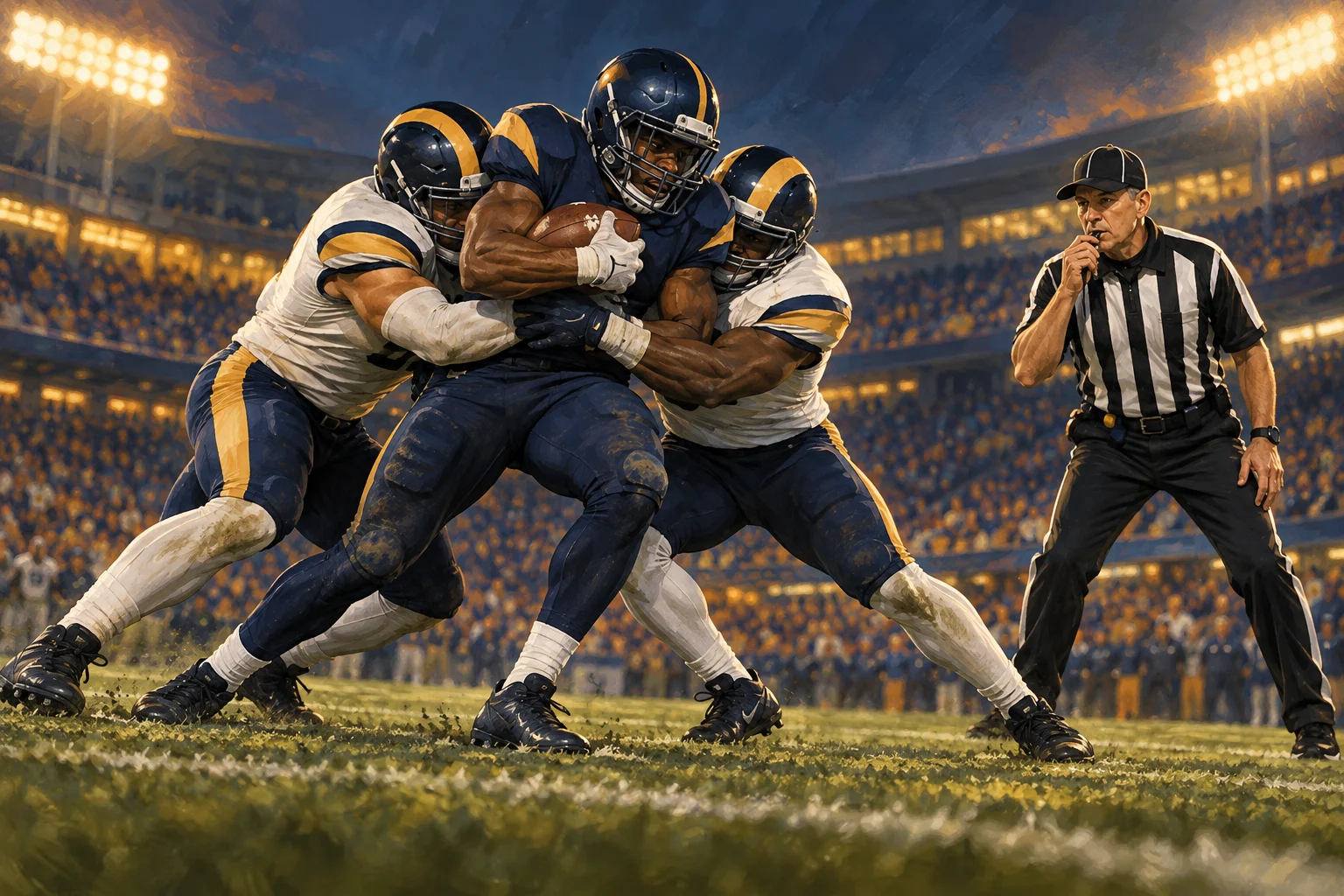
Yes. An NFL play can be over before a player, spectator or television microphone hears a whistle. A runner can already be down by contact or have his forward progress stopped. The separate question is whether a defender's subsequent contact was unnecessary. An unheard whistle does not automatically make every tackle legal, just as a dead ball does not automatically make every unavoidable collision a foul.
That distinction became the central argument after Devonte Wyatt's personal foul against Amon-Ra St. Brown in Green Bay's October 25, 2026 loss at Detroit. Here is how to separate the dead-ball rule from the disputed judgment, and how to watch a similar play without relying on one misleading freeze-frame.
Yes, an NFL play can end before you hear a whistle
Think of a run as a sequence of events: the player advances, something happens that ends the down, and an official communicates that ending. Those moments can be very close together. They do not have to be identical. The rules determine when the ball becomes dead; the sound helps everyone recognize what has happened.
The 2026 NFL rulebook lists several ways a down ends. A runner can go out of bounds, be down after defensive contact, be restrained until his forward movement ends, or give himself up. Waiting to hear a whistle is therefore an incomplete test of whether additional advancement is permitted.
This matters most in a crowded tackle. A receiver may still move his arms or legs after the legally relevant event. A defender may see that movement without seeing a knee touch the turf. Viewers may hear a roar from the crowd and assume nobody has stopped play. Each observation can be sincere while providing only part of the picture.
The whistle communicates a ruling; it is not the only dead-ball trigger
Imagine a runner's knee reaches the ground after an opponent has contacted him. The television whistle arrives a fraction of a second later. Those extra frames do not give the runner a new opportunity to sprint away. The knee and contact establish why the down ended. The later sound announces the ruling.
An erroneous whistle presents a different problem. The rulebook separately addresses a whistle sounded while the ball is still live, with administration depending on whether the ball was possessed, loose or in flight, and on applicable replay provisions. That is not the same situation as an official recognizing a run that has already ended by another rule.
For a viewer, the practical move is to identify the proposed dead-ball event before debating the sound. Was there contact and a knee? Was the runner held with advancement stopped? Did he leave the boundary? If no such event is visible, ask for the official explanation. Audio from a broadcast is useful context, but it cannot replace those questions.
What happened on the Wyatt–St. Brown play?
The argument came from a third-quarter second-and-11 play in Detroit's 20–17 win. Isaiah McDuffie was attempting to bring St. Brown down. St. Brown returned to his feet, Wyatt made another tackle, and umpire Terry Killens Jr. went to the ground during the sequence. Wyatt received a personal-foul flag. The confusing overlap of a receiver rising, a defender arriving and an official entering the action made the play particularly difficult to interpret live.
Those are the essentials in the Packers' official game notes. The account also records Green Bay's frustration. That reaction explains why the play became a talking point; it does not establish that the NFL subsequently overturned the judgment. A team's report is especially valuable for its players' explanation, but its editorial perspective should remain visible.
What the referee explained, and what remains disputed
In the postgame pool report, referee Alex Moore said the crew had ruled the play over and that he could not confirm hearing a whistle. His explanation rested on the preceding tackle having ended the run. It was not a statement that every play remains live until every participant hears a signal.
That answers one part of the controversy: the crew believed Wyatt's contact came after the run had ended. It leaves a separate issue for criticism: whether the defender had a reasonable opportunity to recognize that ending and whether his contact deserved the personal-foul assessment. Knowing the legal stopping point does not, by itself, settle that judgment.
Nor does an official falling establish why he threw a flag. A clip can show when contact occurred, but it cannot prove anger, retaliation or a private motive. The reports checked for this explanation do not establish an NFL admission that the call was wrong. Treat a later league explanation as new information if one is issued, rather than treating online certainty as that explanation.
For the teams' next games, use the Packers schedule and Lions schedule. The lesson from this game travels to either sideline: establish when the run ended, then evaluate the additional contact. Starting with which team benefited makes both questions harder to answer fairly.
Down by contact and forward progress are different ways to end a run
Two familiar explanations can lead to the same dead-ball result, but they describe different events. Down by contact involves an opponent's contact and the runner touching the ground in a qualifying way. Stopped progress can end a run while the runner is still standing. Neither requires a new tackle after the down has ended.
A knee down after contact
A runner is down when, after contact by an opponent, a part of his body other than his hands or feet touches the ground. The rule's hands exception includes the wrist; its feet exception includes the ankle. A knee, elbow or hip is different. A player can brace himself with a hand and continue without that hand alone ending the run.
The contact does not have to be a dramatic final blow. A defender can trip or otherwise contact a runner whose knee subsequently hits the turf. When watching a close replay, follow the earlier contact as well as the eventual fall. Starting the clip only when the player stands up may omit the event that made him down.
A runner held upright with nowhere forward to go
A defender can restrain a runner so that his forward progress ends even when neither knee has touched the ground. Officials must judge whether the advance has genuinely stopped. There is no universal count of seconds that a defender must hold the runner before this can happen.
The forward-progress spot protects a runner who is driven backward by an opponent. It prevents the defense from gaining extra field position simply by carrying an immobilized runner toward his own goal. It also prevents a prolonged struggle from becoming an excuse for additional punishment after the advance has ended.
That protection is not a guarantee of the furthest yard line a runner ever visits. A runner who remains free and voluntarily retreats to seek another lane has chosen a different path. Watching who caused the backward movement is essential. A runner being dragged backward and a runner reversing field can look similar in a still image but present different football questions.
An untouched fall does not always end an NFL run
In the NFL, a player who slips untouched and immediately tries to continue can still have a live run. That is why the advice to check for defensive contact matters. It is also why assumptions imported from college football can produce the wrong conclusion.
But untouched is not a universal permission to restart. A runner can give himself up, and slides, kneeling and other giving-up situations have their own rules. An opponent touching a runner who remains on the ground, or touching the ball in that runner's possession, can also finish the down. Identify the precise event instead of reducing every fall to a single slogan.
Can the receiver get up, and can a defender tackle him again?
A receiver cannot revive a dead ball by standing up. Once the run is legally over, subsequent steps do not become additional yardage. His decision to continue can reveal that he misunderstood the situation, but the runner's understanding does not determine the rule.
For the defender, the hard part is recognizing that ending at full speed. The rules do not solve that difficulty by authorizing unlimited additional force until a whistle becomes audible. They also do not make every touch after a legal ending automatically unnecessary. Evaluate the timing, the type of contact and whether it is part of an already developing tackle.
Three hypothetical plays that look similar on television
Example one: contact, knee, then a restart. A cornerback contacts a receiver, whose knee lands before he regains his feet. The receiver starts running again. The run has already ended by contact and the knee. A second defender cannot make the restart legal by participating in it. Whether that defender commits a foul depends on the additional contact, not on the receiver's wish to keep going.
Example two: an untouched slip. A receiver falls while changing direction, with no defensive contact, and immediately gets up to advance. Assume he has not given himself up and no other dead-ball event applies. His run can continue. A legal defensive tackle can still be needed. Change the fact about earlier contact and the answer may change completely.
Example three: upright but stopped. Two defenders hold a runner, his advance ends and the crew rules progress stopped. He later wriggles free and starts forward. Standing throughout the sequence does not preserve his right to advance after that ending. A fresh hit cannot be justified merely because his knees never touched.
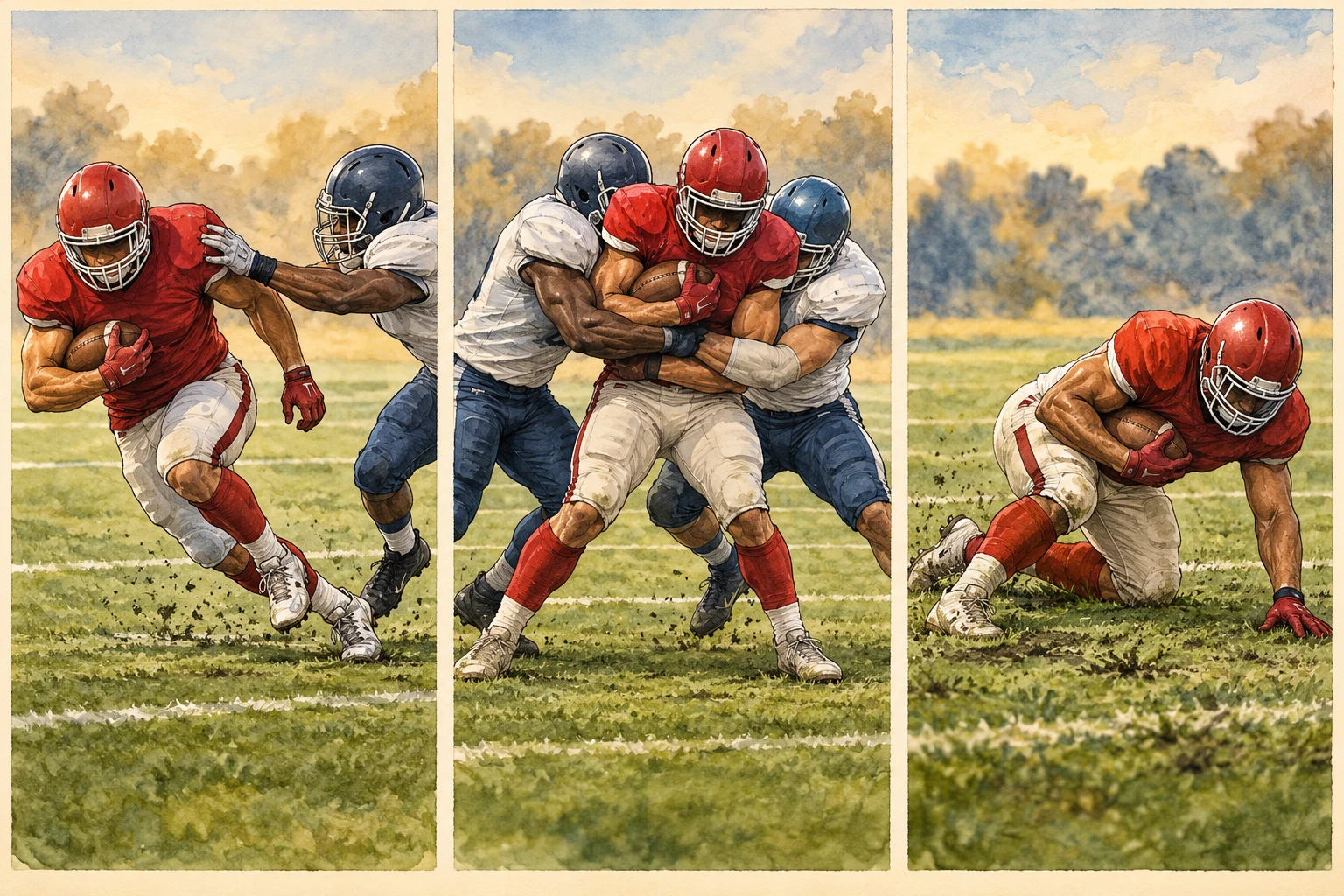
These are teaching examples, not a frame-by-frame verdict on the Detroit play. Their value is that they isolate one changing fact at a time. When a social clip shows only the final collision, ask to see the preceding second. The reason a play ended is often earlier than the moment that made the clip go viral.
Why a dead-ball tackle can draw unnecessary roughness
The unnecessary-roughness rule specifically addresses actions against runners whose progress has stopped and against players already on the ground. It also prohibits throwing a runner to the ground after the ball is dead. Those provisions explain why a tackle that resembles ordinary football contact can become illegal at a different point in the sequence.
The purpose is easy to understand in an upright stop. Once defenders have restrained a runner and ended his advance, a further hit no longer serves the same competitive function. The runner cannot earn more yards from a dead ball, and the defense cannot erase the protected progress by adding force. Continuing punishment adds exposure without advancing the play.
Still, the official must decide what actually occurred. A defender may already be committed to a tackle when another player's contact ends the down. A later arriving defender may instead initiate a distinct forceful action. The speed of the sequence, the runner's posture and the nature of the hit matter. A slow-motion replay can illuminate the order while making the real reaction time feel much longer than it was.
That is why two claims should be kept separate: a defender may have been trying to complete his assignment, and the action may nevertheless violate a safety rule. Intention is relevant to understanding the player's complaint; it does not automatically erase an objectively prohibited act. Conversely, the existence of a dead ball alone does not prove every resulting collision meets the standard for unnecessary roughness.
The standard penalty for unnecessary roughness is 15 yards, with an automatic first down when committed by the defense. Enforcement can be limited by the distance to the goal line, so the actual distance moved need not be 15 yards. Reading the assessed distance as evidence that officials called a different category of foul can therefore mislead.
On the Wyatt play, the defensible debate concerns the crew's recognition and assessment of a second tackle. It does not require pretending the rulebook makes a whistle the only possible ending. Fans can challenge the judgment while accurately describing the rule under which that judgment was made.
What replay can fix, and how to judge the next disputed clip
Replay can examine whether a player was down by contact. It can also address specified possession questions and whether a dead-ball spot reached the line to gain. Those powers do not create a general right for a coach to challenge an unnecessary-roughness judgment simply because the replay looks persuasive.
Be equally careful with the claim that anything involving forward progress is untouchable. The current rulebook includes a narrow fumble question when the field ruling was stopped progress: whether possession was lost before or simultaneously with defensive contact. It also allows a line-to-gain spot review. Those limited inquiries are different from freely replacing the crew's assessment of when an upright runner stopped advancing.
The rules even distinguish the question of whether an erroneous whistle sounded from other reviewable aspects of a play. A controversial sound, a disputed knee and a personal-foul assessment are not one interchangeable challenge. Identify the specific part of the ruling that replay is authorized to examine before demanding a reversal.
A replay checklist for viewers
- Start before the collision. Look for earlier defensive contact and the runner's knee, elbow or hip.
- Check whether the runner was restrained. Upright posture does not prove the advance was continuing.
- Separate ending from punishment. Decide what ended the run, then assess any additional force.
- Read the official explanation. A pool report describes the crew's basis; it is not automatically an independent endorsement of that basis.
- Ask the replay question precisely. Down by contact, possession and line-to-gain rulings have different scopes from a personal foul.
Watch the sequence once at normal speed before using slow motion. Then check the wide angle, where the earlier tackler and approaching official may be visible. A close crop can show the second impact clearly while hiding the contact that ended the run. The NFL TV schedule helps locate the full game broadcast rather than relying only on a circulating excerpt.
The next time a receiver gets up and a flag follows, the first question should be what made the ball dead. The next should be whether the additional hit was unnecessary under the circumstances. An unheard whistle belongs in that discussion, but it cannot answer both questions on its own.
Comments