
Our NFL picks against the spread this week are three conditional Week 5 leans: Seattle, Atlanta and Buffalo at the specific numbers discussed below. This October 11, 2026 preview explains the case for each, the reasons to hesitate and how to grade the result. The quoted spreads come from a dated published snapshot, so check your own current number before making a selection. An ATS pick includes the spread; choosing the winning team alone does not answer the same question.
Which NFL week does this picks guide cover?
This edition covers selected 2026 Week 5 games on October 11–12, with an editorial review date of October 11. It focuses on San Francisco at Seattle, Baltimore at Atlanta and Buffalo at the Rams. Seattle's official schedule and Buffalo's Monday game center confirm the relevant week and dates. These are pregame opinions, rather than results or a promise that the page carries continuously updating odds.
Before reading a pick, match the opponent, venue and date to your game. A search for “NFL picks this week” can surface an older preview with a familiar rivalry in the headline. A different season, home team or week changes the football question. The Week 5 schedule provides kickoff times and a timezone selector if you are following the games outside Eastern Time.
Then check what your competition asks you to select. A straight-up pool asks who wins. An ATS pool asks who covers its assigned spread. A confidence pool may require a ranking as well. Picking the same team in each format can produce different outcomes, even when everyone watched the same final score. Keep the spread printed on your own pool sheet beside the selection.
We offer three leans rather than force a pick on every matchup. Each has a football reason, a concern and a boundary beyond which the recommendation no longer applies. The aim is to make the reasoning understandable before kickoff. A fan who disagrees with the conclusion should still be able to identify the assumption that separates the two views.
Read the published number as part of the recommendation. If the number available to you differs, do not transfer the team name alone. Also distinguish a line quoted in a dated article from a price you can actually obtain. A useful preview explains its limits clearly enough that you can decide whether to use it, modify your opinion or leave the game alone.
How NFL picks against the spread are settled
ATS means against the spread. The useful question is whether the team's final scoring margin beats the assigned number. Keep that number attached to the pick from the moment you choose it through the final whistle.
Minus spreads, plus spreads and the price beside them
For a favorite at -3.5, subtract 3.5 from its score before comparing the teams. It must win by at least four actual points. For an underdog at +3.5, add 3.5; an outright win or a loss by three or fewer covers. DraftKings' spread explanation describes this distinction and why a half-point avoids an equal adjusted score.
The price next to the spread answers a different question: what the wager risks and returns. In a hypothetical -110 example, risking $110 wins $100 in profit if successful; the total returned would be $210, including the original $110. That is an arithmetic illustration, not the price of any Week 5 recommendation here. A displayed -3.5 does not itself tell you the financial return.
Write both fields when comparing two offers. “Team A -3.5 at one price” and “Team A -3.5 at another price” have identical football grading but different returns. Moving from -3.5 to -4 changes the grading as well. Neither the team's name nor the negative sign provides a complete selection.
You can also prefer an underdog against the spread while expecting the favorite to win. Imagine you believe a game will stay within a field goal. Taking the underdog with more than three points expresses that close-game view; it does not require you to predict an upset. This is why copying a straight-up winner into an ATS sheet can misrepresent your own football opinion.
A 28–24 score can produce a win, a push or a loss
Use one fictional result: Favorite 28, Underdog 24. The favorite's margin is four points. Changing only its assigned spread produces these three grades:
| Favorite selection | Adjusted favorite score | Compared with 24 | Grade |
|---|---|---|---|
| -3.5 | 24.5 | Higher | Win |
| -4 | 24 | Equal | Push |
| -4.5 | 23.5 | Lower | Loss |
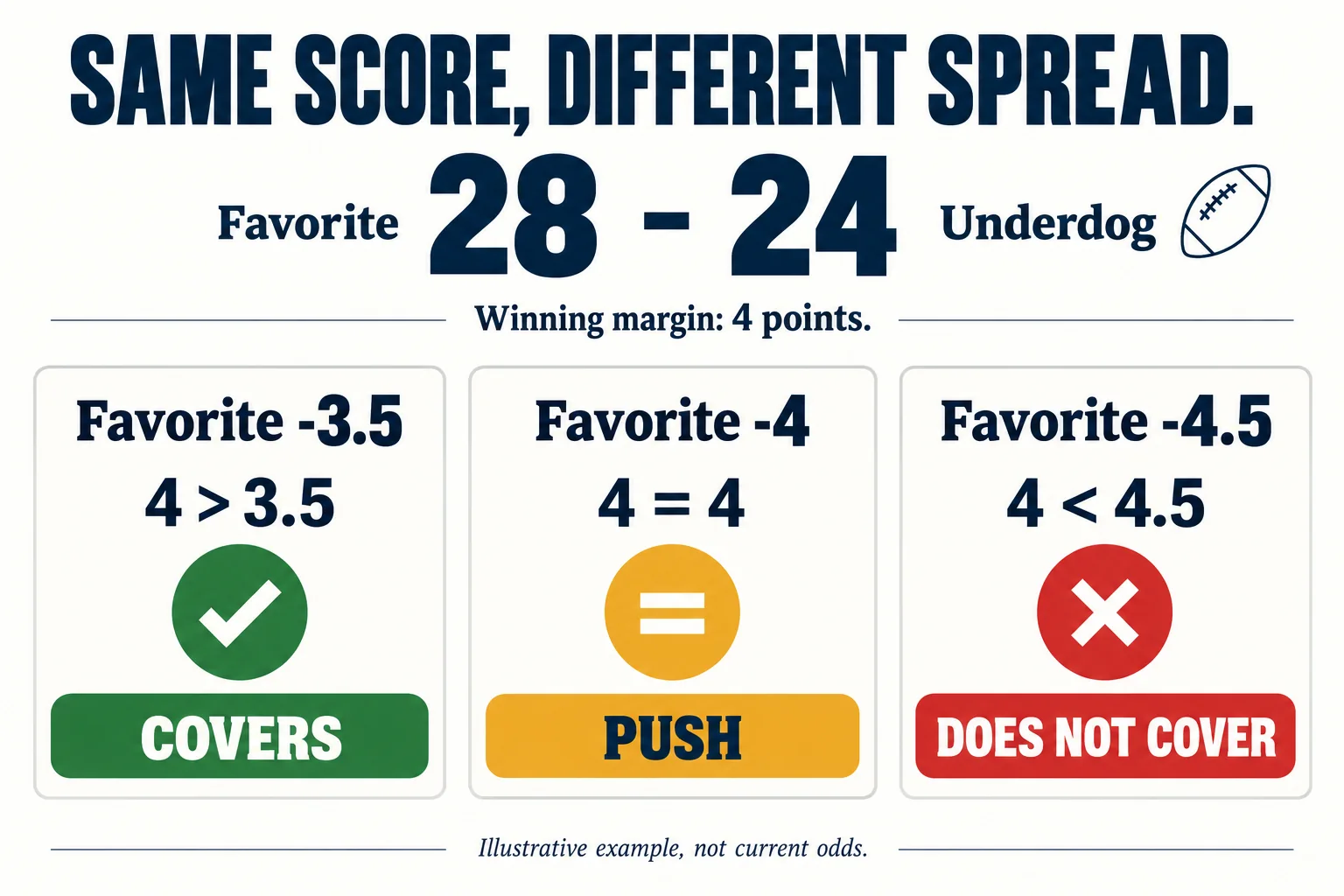
A push is an exact tie after applying the spread. Under bet365's standard two-way rules, a straight wager's stake is returned. An office pool can assign pushes differently, so agree on the pool's rule before kickoff rather than negotiating it after a close finish.
Apply the calculation to the final score for the exact market you selected. A four-point lead with five minutes remaining is only a current game situation. A later touchdown, field goal or overtime score can change the grade. The operator's published full-game rules include overtime unless stated otherwise; a regulation-only or partial-game selection needs its own terms checked.
The diagram also explains why two fans can both select the favorite, watch it win and record different ATS outcomes. Their numbers were different. There is no contradiction to resolve once each selection is graded against the spread that actually belonged to it.
Three Week 5 ATS leans and reasons to be cautious
Bet365 snapshot: FOX, October 10, 11:25 a.m. ET: Seattle -3.5, Atlanta -3.5, Buffalo +3.5. These dated numbers frame our selections; available prices have not been verified here. The football opinions below are editorial judgments, not a computer model or an expert-consensus score.
Seattle minus 3.5 against San Francisco
Lean: Seattle, requiring a win by four or more. The Seahawks' October 9 report clears Leonard Williams without a game designation and lists San Francisco's Nick Bosa and Kyle Juszczyk out. Those personnel differences make Seattle the more appealing side to us at the stated number.
Our football case is about the kinds of drives Seattle could create. If its protection benefits from Bosa's absence, longer-developing opportunities could become easier to attempt. If Williams helps disrupt the interior, San Francisco might have to solve more awkward down-and-distance situations. Those are possible advantages, not measured point adjustments or a claim that either outcome is certain.
The strongest counterargument is a close divisional game in which San Francisco moves the ball quickly enough to reduce the importance of the pass rush. Seattle also has its own availability concerns: Zach Charbonnet is out, while George Holani is questionable. Do not treat this as an entirely healthy home roster facing an entirely depleted opponent.
For the ATS decision, imagine Seattle controls much of the game but wins by only a field goal. The straight-up prediction succeeds while this selection fails. Our lean therefore needs more than “Seattle should win”; it needs enough offensive efficiency to create a margin beyond that close-game outcome.
Pass condition: we would not extend this recommendation to a larger favorite spread. A fan who sees only a narrow win should prefer passing to pretending the favorite selection and a moneyline opinion mean the same thing. Keep late availability information attached to that decision.
Atlanta minus 3.5 against Baltimore
Lean: Atlanta, also requiring a four-point victory. Baltimore's October 9 press conference confirms Lamar Jackson and Trey Hendrickson are out, with Tyler Huntley starting at quarterback. This is confirmed personnel information; it is not a rumor about a starter missing practice.
Our preference is for Atlanta to make the visiting offense repeatedly earn its way out of passing situations. A quarterback change can alter the combinations an offense trusts, but it does not automatically remove every useful play from the game plan. The case must be tested on the field: can Atlanta stop enough early-down gains to avoid letting Baltimore dictate comfortable possessions?
Huntley can still execute a coherent offense. An efficient series, a short field or a turnover could keep the game close without requiring him to reproduce Jackson's usual contribution. That is the main reason to resist turning a headline absence into a confident prediction of a blowout.
Atlanta's own final availability also matters. We would check the home team's offensive protection and defensive personnel before using the lean, rather than only reading Baltimore's report. The next section explains the specific home-team statuses that need attention.
Pass condition: do not chase a bigger favorite number on the strength of Jackson's absence alone. The quoted spread already exists after that announcement; we do not know how much of the information is reflected in it. Our selection expresses a modest preference at one number, not evidence that an injury created an unpriced advantage.
Buffalo plus 3.5 at the Los Angeles Rams
Lean: Buffalo with the three-point losing margin protected. This is the underdog selection of the three. Its case is a competitive game that can remain close through the last meaningful possession; Buffalo does not have to win outright for the recommendation to succeed.
There are clear reasons to hesitate. The Bills' October 10 injury report rules out Ed Oliver and Joshua Palmer, with DJ Moore questionable. Receiving uncertainty can narrow the dependable options on an important third down. Oliver's absence is also a reason to question whether Buffalo can make enough defensive stops.
Our lean depends on Buffalo sustaining enough drives to avoid an expanding deficit. It does not depend on a published projected score or a promised late comeback. If the final personnel leave you unconvinced about that competitive-game assumption, the sensible editorial response is to lower confidence or pass.
The extra half-point beyond a field goal matters to this particular opinion. A fictional Rams victory by three would still fit our close-game case. A comfortable Rams win would not. Those possibilities describe how the prediction can fail; they are not claims about what the teams will actually score.
Pass condition: we would not carry the recommendation over to a spread offering only a field goal or fewer points. Check Monday's game information again before deciding. Use the team directory to keep your chosen clubs and matchup straight when moving between previews.
When to change a pick or pass on a game
A pregame lean remains useful only while its assumptions and number still apply. Make a short list of what could change your view before kickoff, rather than inventing a reason to stick with it after contradictory news appears.
Check the official injury status before kickoff
Atlanta provides a good example of why the latest update matters. The club's October 9 report includes a Saturday editor's note ruling Za'Darius Smith out and placing Yasir Abdullah on injured reserve. The older Friday table still lists Smith as questionable. Reading only the table would miss the later decision.
The same report lists Jake Matthews, Divine Deablo and Samson Ebukam as questionable. Matthews' full practice on Friday is encouraging information, but it does not erase his game designation. Atlanta's protection and defensive depth are therefore genuine questions in our own favorite lean, even with Baltimore's quarterback change already confirmed.
The Bills' official injury legend distinguishes practice participation from game status and defines questionable as uncertain to play. A practice label answers how much a player participated that day. It does not promise a full game, a usual workload or an unchanged role.
- Confirm the report belongs to this opponent and this week.
- Read the latest dated update, including any changes below the headline.
- Check the game-day inactive announcement when available; until then, preserve any unresolved status in your decision.
Ask how the absence affects your actual argument. If your selection relies on reliable protection, an offensive-line decision deserves more attention than an unrelated roster update. If a key assumption remains uncertain, passing is a complete decision. You do not need to invent a precise point adjustment for every injured player.
A different spread means a different decision
Consider another fictional result: a favorite wins by three. At -3, the favorite pushes; at -3.5, it loses against the spread. On the other side, the underdog at +3 pushes while +3.5 wins. That half-point changes the result even though the football game is identical.
For a favorite, a smaller required margin is generally easier to cover; for an underdog, more points provide more scoring-margin protection. The price can change at the same time, so an easier grading number does not automatically mean a better overall offer. Compare the complete selection rather than the half-point in isolation.
Also be precise about what you observed. Different numbers at two sportsbooks at one moment are not, by themselves, evidence that either line moved. To describe movement, you need an earlier and later observation for the same market. We have not supplied that history for these three games.
Before committing to a pick, write your boundary: the biggest favorite margin you would lay or the smallest underdog cushion you would accept. If your available spread falls outside it, reconsider the football case or pass. Changing the boundary simply because you want another selection defeats the reason for having one.
How to record and review your ATS picks
A useful record preserves what you knew and selected before the game. A notebook or spreadsheet is enough. Start a separate row for each selection rather than recording only the team names you liked that weekend.
| Field | What to save |
|---|---|
| Game | Season, week, date, away team and home team |
| Selection | Team, exact spread and full-game or other market |
| Quote | Book or pool, price if relevant, and observation time |
| Reason | Your football argument and the information that could change it |
| Result | Final score, actual margin and win, loss or push |
| Review | Whether the original assumption proved useful |
Grade with the number you actually took, not the last number you saw on television. Preserve pushes as their own category. In a fictional record of two wins, one loss and one push, the winning share of decided picks is two out of three, or about 66.7%. Calling it two wins out of four answers a different question because it includes the undetermined selection in the denominator.
Neither figure alone proves profitability. Prices and amounts would be needed for a financial record, and an office pool may not involve money at all. Likewise, our three editorial leans do not carry an established success rate. A short list of opinions should not be presented as a tested forecasting system.
Review the football argument separately from the result. A pick can win because of an unexpected defensive touchdown even though its offensive assumption failed. It can lose on a late score after the matchup unfolded much as anticipated. Describe what actually happened without changing the pregame reason to make yourself look more accurate.
For the next week, carry forward the questions that helped you understand the game, rather than automatically carrying forward the same team. Was protection as reliable as expected? Did the opponent sustain drives? Was the unresolved player status central to the outcome? Those observations are more useful than a story built around the winning logo alone.
For this edition, the choices remain limited to the three games and numbers already discussed. Keep the dated snapshot, official availability and your own boundary together. When they no longer fit the selection available to you, leave the pick unused and return to the matchup with fresh information.
Cover photograph: Lumen Field exterior by PCN02WPS, July 15, 2023, before Seattle Sounders FC played FC Dallas in soccer. Wikimedia Commons source, CC BY-SA 4.0; resized and converted to WebP. It is an archival venue image, rather than a photograph of the 2026 NFL game. Body graphic: original NFL Schedule illustration generated for this fictional settlement example and converted to WebP.

Comments