
NFL intentional grounding generally concerns a passer avoiding an imminent loss under defensive pressure by throwing a forward pass outside the direction and vicinity of an originally eligible receiver. An important exception allows a passer who is or has been outside the pocket to throw away a ball that reaches the line of scrimmage extended. Significant defensive contact affecting the throwing motion creates additional exceptions.
That means a nearby receiver, an escape from the tackle box and a hit during the throw are distinct questions. Jordan Love's disputed October 25, 2026 penalty against Detroit brought them together, but they should be examined separately. The rule is clearer when you apply its tests in order.
What intentional grounding actually means in the NFL
Start with the full definition rather than the phrase intentional grounding. The 2026 NFL rulebook, Rule 8, Section 2, identifies defensive pressure threatening a loss of yardage, a forward pass and the absence of the required relationship to an originally eligible receiver. A bad-looking pass is not automatically a foul.
Quarterbacks miss targets because of pressure, disrupted timing, poor mechanics or miscommunication. The official must apply the rule to the circumstances rather than penalize every embarrassing incompletion. The definition also says a pass does not have to be incomplete for grounding to apply, so the ball merely touching a player is not a substitute for analyzing the play.
Direction and vicinity both matter
A receiver existing somewhere on the same side of the field does not automatically answer the question. Direction concerns where the throw is aimed; vicinity concerns the area in which the receiver is located. Pointing toward a tight end does not by itself establish that the ball was thrown into his vicinity.
At the same time, this is not a requirement that every legal pass be completed or perfectly placed. A genuine attempt can miss. The judgment is whether the throw satisfies the rule, including its exceptions, rather than whether the receiver could make a spectacular rescue catch. The rulebook does not supply a universal yardage circle that viewers can draw around every target.
Eligibility matters too. An offensive lineman standing near the landing point does not simply become the intended eligible receiver because he is the nearest teammate. When the broadcast identifies a target, distinguish a legally eligible option from a player whose proximity cannot supply that answer.
A useful hypothetical is a pressured passer pointing at a receiver well downfield while dropping the ball close to his own feet. The visible direction may support his stated intention, but the distance still raises a vicinity question. Before concluding it is grounding, however, check whether defensive contact significantly altered the delivery. The definition begins the analysis; it does not eliminate the exceptions.
How the tackle box and line of scrimmage work together
The pocket area, commonly called the tackle box, is the area between the outside edges of the normal tackle positions, extending backward toward the offense's end line. It is a rules-defined area, not a moving outline around whichever blockers happen to remain close to the quarterback.
The line of scrimmage is the line from which the play began, extended across and beyond the sidelines for this exception. It is not the television first-down line. A throwaway does not need to reach the yardage required for a new first down; the relevant question is whether it reaches the scrimmage line.
Leaving the pocket is only part of the exception
A passer who is outside, or has been outside, the pocket can avoid grounding on a throw that lands at or beyond the line of scrimmage extended even when no receiver has a realistic chance to catch it. The rule treats the passer as outside if any part of his body or the ball is outside the pocket area.
The two parts belong together. Escaping the tackle box does not authorize a quarterback to dump every pressured throw anywhere. If he is using the no-receiver throwaway exception, the line requirement remains relevant. Conversely, reaching the line from inside the pocket does not by itself create that exception.
Consider a hypothetical passer rolling outside the pocket and throwing into the stands beyond the extended scrimmage line. That is the familiar legal throwaway situation under this provision. Now move the landing point short of the line with no eligible receiver in the required area. The outside-pocket fact remains, but the throwaway exception has lost its other condition. You still need to check the contact exception before reaching a final conclusion.
A legal receiver-targeted pass can finish behind the line
Not every pass that ends behind the line must qualify as a no-receiver throwaway. Screens and short throws into an eligible receiver's direction and vicinity can be legitimate passing attempts. Their landing point does not turn them into grounding merely because the quarterback escaped the pocket first.
This is the key to a common argument: one fan says the ball was short, another says a receiver was nearby, and both assume their observation automatically wins. They may be applying different routes through the rule. Check the receiver relationship under the basic definition, then the specific throwaway exception, instead of mixing half of each test.
The camera angle can obscure both distances. A sideline view may clarify the scrimmage line but compress the gap between receiver and landing point. A wider view may show the target while hiding whether the passer crossed the pocket boundary. Use the angle that answers each question.
What changes when the quarterback is hit while throwing?
The contact exception is central to evaluating a throw that suddenly loses distance or changes direction. A quarterback can begin a legitimate passing motion and then have a defender alter the delivery. Judging only the landing point would miss why the ball ended up there.
Rule 8 says grounding should not be called when a passer starts his motion toward an eligible receiver and defensive contact then significantly affects him, causing the ball to land outside the receiver's direction and vicinity. It separately addresses an outside-pocket passer whose motion is significantly affected by contact that causes the ball to fall short of the line.
The forward-pass definitions also matter. Rule 3 addresses an opponent materially affecting a passer after the throwing motion begins: the resulting throw is a forward pass regardless of where it lands, and grounding does not apply in that situation. Contact before the throwing motion starts leaves responsibility for the direction with the passer, subject to the applicable rules.
The key is timing and effect, not merely the existence of contact. A defender brushing the passer before he begins a controlled delivery is a different fact pattern from a hit knocking the arm off its path during the throw. Both clips may show a quarterback being touched; only the sequence explains the effect on the ball.
Consider a hypothetical quarterback beginning a throw to a back in the flat. A defender hits the arm during that motion, and the ball dives into the turf well short of the back. The contact provisions are directly relevant. Now suppose the defender already has the passer wrapped up, the passer still controls the ball, and he then begins a deliberate dump with no eligible receiver in the required area. The mere fact of the earlier tackle does not automatically provide the same answer.
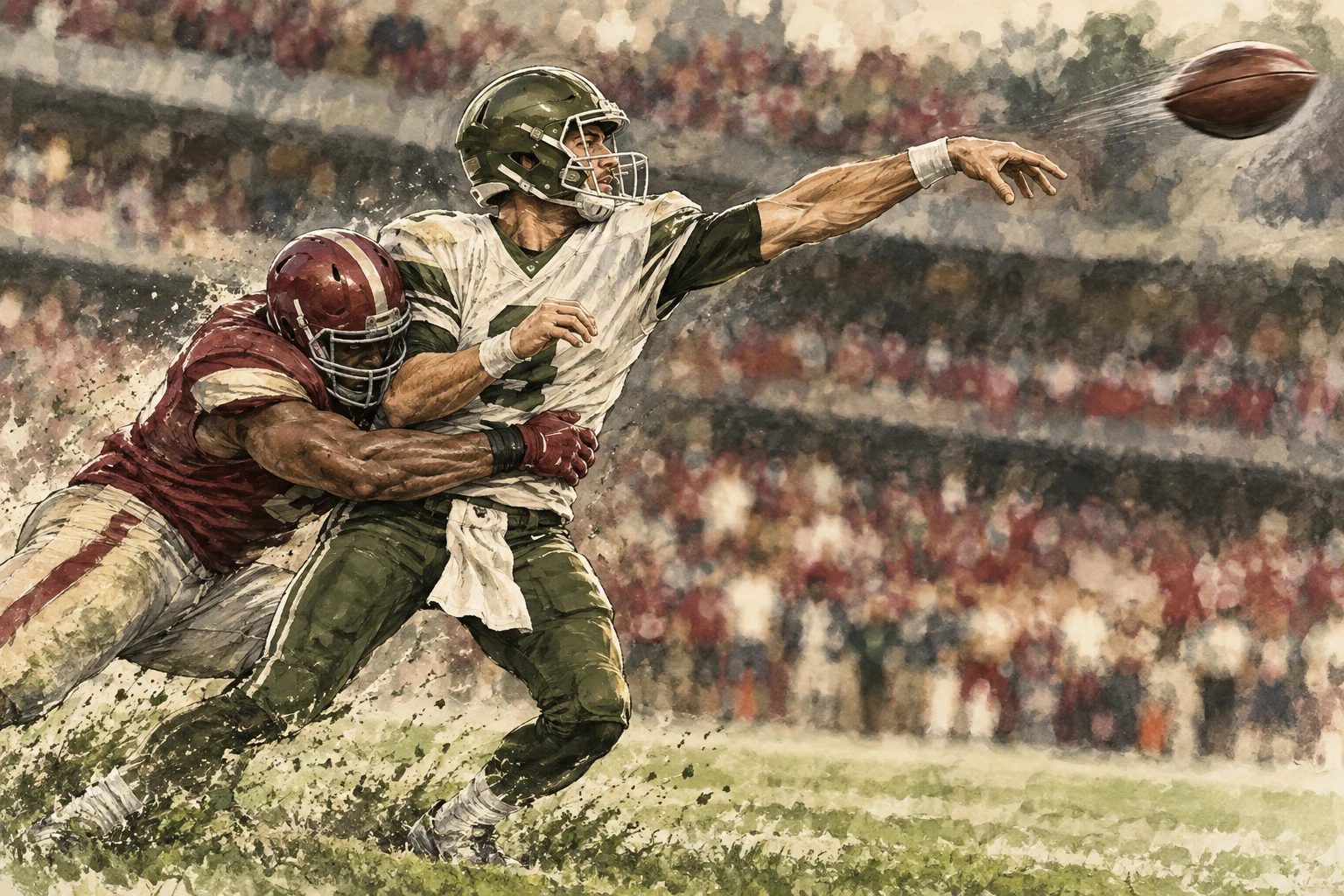
A clear angle of the throwing arm is often more useful here than an overhead picture of the target. Watch when the motion begins, when the defender arrives and whether the delivery visibly changes. Avoid turning a plausible explanation into a proven fact when the necessary frames are missing.
Why Jordan Love's Detroit penalty remains disputed
Love was penalized on a pass toward Tucker Kraft during the Packers' 20–17 loss to the Lions on October 25. The disagreement involved the pocket boundary, the short landing point, the receiver's position and contact affecting the throw. Each is relevant, but each answers a different part of the rule.
Fans supporting the penalty emphasized the distance between the ball's landing point and the receiver, together with the shortfall from the scrimmage line. Critics emphasized the identifiable intended target and contact during the delivery. Those arguments should be tested against the definition and exceptions rather than reduced to which team a viewer supports.
Conflicting accounts of the tackle-box explanation
There is an additional reporting problem. The Packers' game notes summarize referee Alex Moore's explanation as saying Love was not outside the tackle box. A reproduction of the pool report published through Packers Wire quotes Moore as describing Love as outside it and focusing on the pass failing to reach the line or the receiver's area.
Those accounts conflict on a material detail. This guide does not silently treat either summary as a settled resolution of the play. The rule can be explained accurately while the reporting discrepancy remains visible. A clarified original report or a later league explanation would be stronger grounds for resolving that discrepancy.
Even confirmed outside-pocket status would not end the analysis. A short ball can still be a legitimate receiver-targeted pass, or qualify under the contact provisions. Conversely, identifying Kraft as the intended target does not alone establish vicinity or prove that the relevant contact caused the shortfall. The sequence and effect of the hit remain essential.
The checked accounts establish that the penalty was called and explain why it drew criticism. They do not establish an NFL announcement reversing it or admitting an error. Follow the Packers schedule and Lions schedule for the teams' next games, while treating any later official explanation as a separate update.
Why a spike is legal, and what grounding costs
A spike looks like the most deliberate possible throw into the ground, which is why new viewers understandably ask why it is permitted. The answer is an express exception with conditions. Grounding penalties and clock consequences then apply differently when a passer falls outside those conditions.
Immediate spike versus delayed spike
The rule permits a T-formation quarterback to conserve time by immediately beginning a continuous throwing motion after receiving the snap and throwing the ball directly into the ground. T-formation here refers to the defined alignment close behind the snapper. The familiar under-center spike uses this permission.
A delayed spike is different. A passer cannot wait for strategic purposes and then throw the ball into the ground in front of him, even without pressure from a rusher. A quarterback who wants to inspect a possible scoring opportunity before abandoning it cannot simply borrow the immediate-spike exception afterward.
Yardage, loss of down and a possible safety
The ordinary grounding penalty includes loss of down and 10 yards from the previous spot. The rule instead uses the spot of the pass when it is more than 10 yards behind the previous spot or more than half the distance to the goal line. Field position therefore matters; it is inaccurate to describe every grounding flag as exactly the same ten-yard walk.
Loss of down means the offense does not repeat the down on which it committed the foul. If a hypothetical team commits grounding on second down, the next ordinary down is third after enforcement. The team does not receive another second-down attempt simply because a penalty was assessed.
Grounding can also result in a safety when the passer's entire body and the ball are in his own end zone when he throws. The precise positions matter. A passer near the goal line is not enough by itself to establish that safety condition.
When the clock penalty matters
After the two-minute warning of either half, grounding is among the illegal acts that can conserve time. When the offense commits such an act while time is in, the clock rule provides a ten-second runoff. A remaining offensive timeout can be used instead, and the defense has the option to decline the runoff.
This is not an automatic ten-second subtraction for every grounding foul in every quarter. Check the game period, the clock status and the available timeout choice. The yardage and down consequences are one part of the punishment; the late-half clock rule is another. A broadcast discussion that skips those conditions can make a correct administration look inconsistent.
A practical checklist for the next grounding call
Watch the complete play at normal speed first, then separate the questions. Trying to solve everything from the landing point encourages the same confusion that surrounded the Detroit discussion.
- Identify defensive pressure. Was the passer facing the threatened yardage loss described in the definition, or is another provision such as a delayed spike involved?
- Locate the eligible receiver. Check both direction and vicinity, rather than simply naming a target somewhere in the picture.
- Establish pocket status. Determine whether the passer or ball was outside the rules-defined area, including earlier escape during the play.
- Locate the scrimmage line. For the no-receiver throwaway exception, check the landing point against that line extended.
- Watch the contact sequence. Determine whether the motion had begun and whether a defender materially or significantly affected it under the relevant provision.
- Read the administration. Yardage, the charged down, possible safety and any clock consequence answer separate questions.
Replay can correct specific facts without reopening every judgment
The general question of whether a passer intentionally grounded the ball is listed as non-reviewable. That does not mean video assistance has no role. The assistance rules permit specified objective corrections, including a called grounding foul when clear and obvious video establishes outside-pocket status. They also address player location relative to the pocket.
Correcting that fact does not mean every short throw outside the pocket becomes legal. The throwaway exception's other conditions and the relevant contact provisions still matter. Nor does assistance give a coach an unrestricted challenge over whether a receiver was close enough or how the officials assessed the entire play.
There is another narrow replay situation when a fumble ruling is changed to an incomplete forward pass. Grounding can be created in replay only if the referee made the required pre-review announcement that the changed ruling would create the foul. That specific mechanism is different from searching every incomplete pass for an uncalled penalty.
For viewers, the useful response is to ask what fact the video can establish and what correction the rules permit. The NFL TV schedule helps locate the full broadcast, where the original announcement and subsequent explanation may be easier to hear than in a short social clip.
A receiver nearby, a quarterback outside the tackle box and a defender making contact can all be relevant without any one observation settling the play. Apply the definition, test the exceptions and keep uncertainty about a particular sequence separate from the written rule. That approach produces a clearer answer than treating every short pass or every unpopular flag as the same event.
Comments