
For this week's NFL DFS picks, our DraftKings Week 5 afternoon player pool starts with Jacoby Brissett, Jahmyr Gibbs, Amon-Ra St. Brown, Michael Wilson and Trey McBride. This October 11, 2026 guide explains their published salaries, the tradeoffs between them and what to check before lock. They are candidates to compare, rather than a complete nine-player lineup or promised points. Confirm the exact contest's eligible games and current availability before using any name.
Which NFL DFS slate do these picks cover?
This is a DraftKings Classic guide for the Week 5 Sunday afternoon main slate on October 11, 2026. DraftKings Network's Week 5 lookahead explicitly identifies an 11-game Sunday afternoon slate. That count belongs to this week; do not carry over the previous week's larger schedule.
The guide covers the afternoon windows beginning at 1 p.m., 4:05 p.m. and 4:25 p.m. Eastern Time. It excludes the Thursday game, the London morning game, Sunday Night Football and Monday Night Football. Those games can have separate contests, but their players do not become eligible for this afternoon selection just because they appear on the same weekly NFL calendar.
Confirm the Sunday afternoon player pool
Start with your chosen contest, then inspect its listed games. DraftKings' Classic overview directs players to the contest's Depth Chart to confirm the slate. A preview's description helps you navigate; the actual contest controls who you can draft.
Check the platform, game style, date and first lock time together. A Sunday afternoon Classic player pool is a different task from a single-game lineup or a season-long start/sit decision. Likewise, a price from another platform is not a usable DraftKings salary. Match all four fields before copying a name into your notes.
The Week 5 schedule helps you compare kickoff windows and display the times in your own timezone. Use the bye-week calendar when reviewing players from outside today's active games. Neither page replaces the contest's own eligibility list, but both make it easier to spot a player who belongs to another window or has no game.
Our five choices below form a candidate pool, not a submitted lineup. They illustrate decisions at quarterback, running back, wide receiver and tight end using dated platform-published salaries. You still need to fill every required position, select a defense and satisfy all the contest's restrictions. Keeping that distinction clear prevents a useful shortlist from becoming an incomplete entry.
How the DraftKings Classic roster and budget work
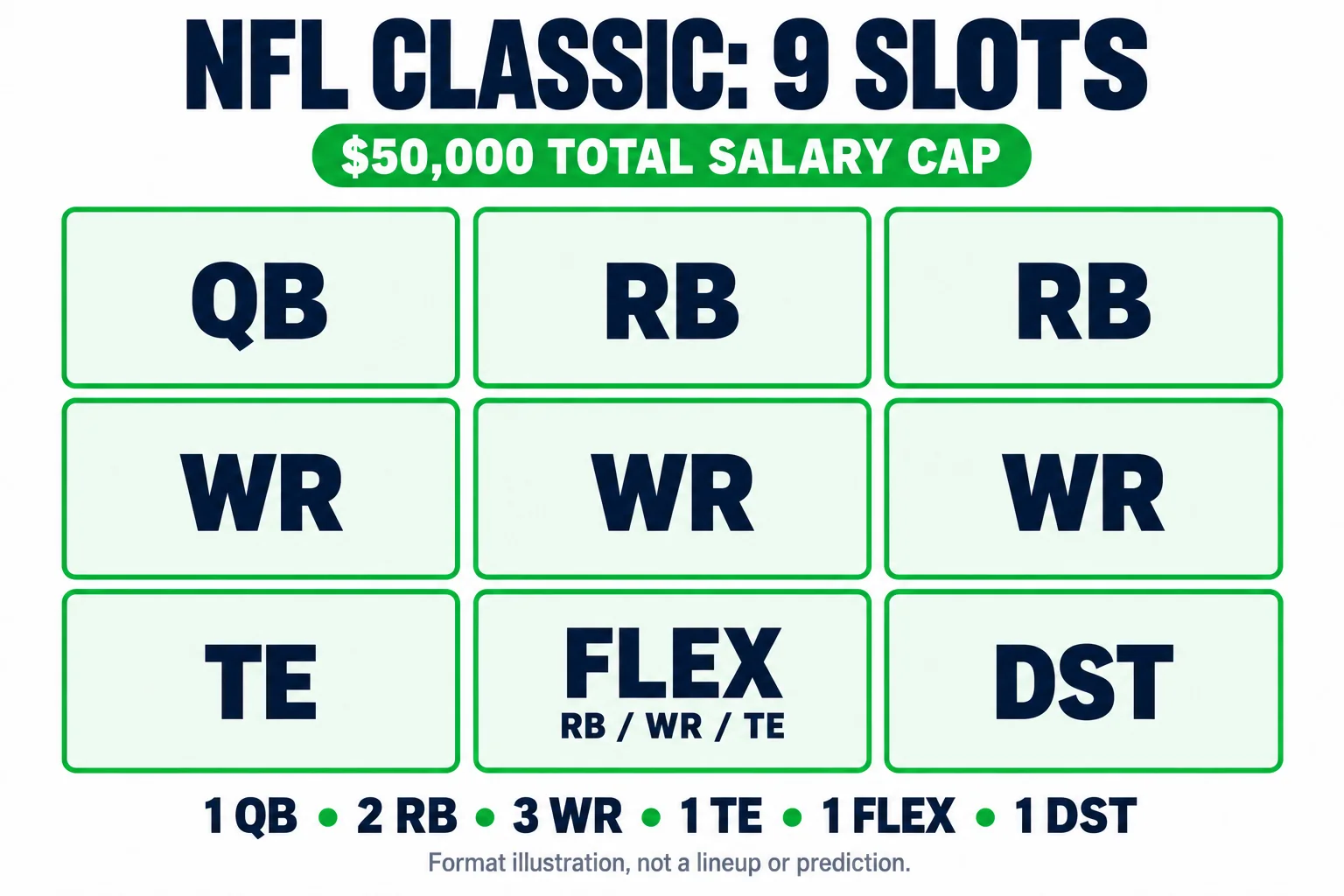
Start with the empty lineup, rather than a list of your favorite players. DraftKings' NFL Classic format guide identifies nine roster slots, while its current Classic overview confirms the $50,000 salary cap. Those are the building blocks for this player pool. Read the rules attached to your actual contest before entering, including its scoring and team requirements.
Fill nine positions before comparing star names
| Position | Slots | What to select |
|---|---|---|
| QB | 1 | One quarterback |
| RB | 2 | Two different running backs |
| WR | 3 | Three different wide receivers |
| TE | 1 | One tight end |
| FLEX | 1 | A running back, wide receiver or tight end |
| DST | 1 | One team defense and special teams unit |
The FLEX spot gives you another choice among three positions, as explained in DraftKings' FLEX guide. It is not an extra quarterback spot in this format. A player eligible at running back can help fill RB or FLEX; he cannot solve an empty WR slot. Check the eligible positions shown beside each name in the contest rather than relying on how that player was listed in your season-long league.
This matters when comparing expensive players. Adding a second premium running back might look attractive until it leaves you unable to afford three receivers you actually want to start. Work through all nine positions together. Reserve a realistic amount for the remaining slots, including DST, before deciding that a particular star fits. A defense is still one of the nine selections, even though you are choosing a unit instead of an individual.
A salary cap is a constraint, not a points prediction
Think of $50,000 as the maximum total available for the roster. It does not tell you what score that roster will produce. Two combinations with the same total salary can have very different paths to points: one might depend heavily on touchdowns, while another might rely on several players receiving steady opportunities. Spending more on a player does not settle which of those paths will happen on Sunday.
Here is a fictional budgeting example. If three selections cost a combined $22,000, you have $28,000 left for six spots, an average of about $4,666.67 per spot. That average is a planning aid. You could spend more on one remaining selection and less on another, provided the finished roster fits the cap and the required positions. These figures illustrate the arithmetic; they are not published salaries for unnamed Week 5 players.
Before committing to the expensive combination, identify the actual candidates who would complete it. If those remaining selections only make sense because you assume an injured starter will sit, your lineup depends on that news being confirmed. Compare a version that spends less at the top and gives you more room elsewhere. The useful question is whether every position has a credible role in your plan, rather than whether you used every available dollar.
Five Week 5 candidates at published DraftKings salaries
These five candidates focus on Detroit at Arizona. They give you several ways to compare spending at quarterback, running back, receiver and tight end within one matchup. They are a starting player pool, not a ranking of every available player or a recommendation to force all five into one lineup.
The salary examples below were published in DraftKings Network's October 10 Week 5 article. Check the amounts against your own DraftKings Classic contest before saving. A published article is not a live export of the contest's player pool.
| Candidate | Team | Position | Published salary |
|---|---|---|---|
| Jacoby Brissett | Arizona | QB | $5,500 |
| Jahmyr Gibbs | Detroit | RB | $9,800 |
| Amon-Ra St. Brown | Detroit | WR | $7,900 |
| Michael Wilson | Arizona | WR | $6,200 |
| Trey McBride | Arizona | TE | $6,700 |
Jacoby Brissett as the lower-cost quarterback option
Brissett is worth considering when your first priority is leaving room for other positions. Arizona's official depth chart, checked October 11, lists him first at quarterback. At the published $5,500 salary, he offers a lower-cost starting point for the combinations discussed here. That saves budget space; it does not establish that he will outscore a more expensive quarterback.
Start by asking what you need Arizona's passing game to do. If your lineup pairs Brissett with Wilson or McBride, you are looking for successful passing plays that help both selections. That quarterback-plus-pass-catcher pairing is commonly called a stack. It has a clear football explanation: a completed touchdown pass can benefit the passer and the receiver on the same play. The opposite is also possible. A stalled passing attack can disappoint both, so pairing teammates concentrates part of your lineup's risk.
I would compare a Brissett version of the lineup with a version that pays more at quarterback and less elsewhere. Keep the rest of the roster visible during that comparison. If the savings only lead you to add names you would otherwise avoid, the inexpensive quarterback has not solved the underlying problem. If they let you select a player you prefer at an otherwise weak position, there is a clearer reason to consider this route.
Jahmyr Gibbs and Amon-Ra St. Brown as premium choices
Gibbs and St. Brown are the premium options in this focused pool. They also fill different needs: Gibbs takes a running back slot, while St. Brown takes a receiver slot. Neither appears on Detroit's October 9 injury report. Still check the final game-day availability information before relying on any player; absence from Friday's report is not a substitute for the final lineup.
For a first build, compare them separately. Put Gibbs into a version that spends more at running back, then build a second version with St. Brown and a different running back allocation. That reveals which set of remaining positions you can fill more comfortably. It also keeps you from deciding the entire lineup around two famous names before seeing the trade-offs.
Using both is a larger commitment. Their published salaries total $17,700, leaving $32,300 for seven slots. There is room to construct different combinations, but those seven selections still need their own reasons to be included. Do not assume that a strong Detroit performance automatically produces equally strong fantasy results for both players. A rushing touchdown, a passing touchdown to another receiver, and a drive that ends without a touchdown distribute the benefits differently.
My practical preference is to choose the premium player whose inclusion makes the whole roster more coherent. If the supporting choices are equally appealing, compare the football assumptions behind each version. The point is to make a deliberate positional choice, rather than treating both as mandatory selections at any cost.
Michael Wilson and Trey McBride as alternative pass catchers
Wilson and McBride provide two different ways to pair a pass catcher with Brissett. The current Cardinals depth chart lists Wilson first at one receiver position and McBride first at tight end. Their salaries are relatively close, but their roster effects differ. Wilson fills a WR slot; McBride fills TE, which can save you from having to choose a separate tight end solely because he fits the remaining budget.
There is also newer news to weigh. In its October 10 report about Marvin Harrison Jr., Arizona's team site cited NFL Network reporting that Harrison would be inactive against Detroit as trade arrangements were being discussed. The article did not confirm a completed trade or its timing. Treat that reported absence as a reason to recheck the final active list, rather than inventing a precise increase in Wilson's or McBride's opportunities.
I would usually begin by comparing Brissett with one of these pass catchers. Including both means asking the Arizona passing game to support three roster spots, counting the quarterback. That can be an intentional game-based approach, but it gives one offense a bigger say in your overall result. The two receivers of passes can also compete for opportunities; a catch for one is not a catch for the other.
Finally, do the full-pool arithmetic before treating this as a core. All five listed candidates cost $36,100, leaving $13,900 for a second RB, a third WR, FLEX and DST: an average of $3,475 across those four spots. This is not a completed lineup. Without real eligible candidates you like at those remaining prices, reduce the expensive selections rather than filling gaps with unsupported guesses.
How injury news and late swap change a lineup
A Friday practice report helps you prepare, but it may leave the final decision unresolved. For example, Cincinnati's October 9 Week 5 report listed Ja'Marr Chase as questionable with a concussion despite full participation on Friday. That dated example shows why the practice column and the game-status column answer different questions. It is not an announcement that Chase will play or miss Sunday's game.
Apply the same habit to your own selections. Check the latest team update and final inactives, then reconsider the football reason for the pick. If a player is unavailable, another teammate might receive more opportunities, but the team could also change its approach or split the work. Do not assume every missing target or carry transfers directly to your preferred replacement.
Keep replacement plans inside the same contest
First confirm whether your entry supports late swap. DraftKings' late-swap overview explains that this feature varies by contest. In an eligible contest, a player remains editable until his own game starts; after that, he locks. Use the contest's Game Center and lock indicators to see which choices remain available.
The operator's lineup-edit guidance also distinguishes contests without late swap: once the first game starts, their players are no longer editable. Prepare those lineups accordingly. Do not save an uncertain selection on the assumption that every Sunday contest will let you fix it later.
For a contest with late swap, write down a replacement plan before the first games begin. The plan needs an eligible position, a salary you can afford, and a game that will still be unlocked when you need to make the change. Both the player you remove and the player you add must remain editable. You cannot wait until the late afternoon to remove a player whose early game has already started, even if he has produced no points.
Keep the alternatives within the same player pool. A player from Monday night's game cannot rescue an entry limited to Sunday afternoon games. Likewise, a cheaper receiver cannot replace an unavailable tight end in the TE slot merely because you have enough salary. A replacement must fit the actual slot, the contest's remaining salary and its team requirements. Check the finished lineup's validation before saving the change.
Positioning can preserve choices before lock. If a later-game player is eligible for FLEX, putting him there can leave you able to consider an RB, WR or TE replacement, whereas a fixed WR slot limits the position options. This is a planning consideration, not permission to move an already locked player. Work out the arrangement while the relevant selections can still be edited.
Finally, name a time when you will check again. If your uncertain player's game starts later than the opening games, set that reminder before his own lock time and leave room to make a valid change. When you cannot monitor the news, compare the uncertain selection with an option whose availability is clearer. A backup plan is useful only if you can actually carry it out.
A final checklist before saving your DFS lineup
Use this check in the contest itself, with the finished roster on screen. It is easier to catch a mistake when you can see all nine positions, the remaining salary and the included games together. A good player idea still needs to become a valid entry that reflects the latest information.
- Confirm the contest and date. Make sure you are building for the DraftKings Week 5 Sunday afternoon Classic slate discussed here. Open its listed games and compare the matchups with the Week 5 schedule. A season-long roster or a single-game entry needs a different decision process.
- Match the salaries to the actual player pool. The five amounts in this guide are dated published examples. Use the amounts displayed in your selected contest for the final calculation. If a name is unavailable there, remove it from that entry's shortlist.
- Fill every position and check the total. Review QB, both RBs, all three WRs, TE, FLEX and DST. Confirm that the finished roster costs no more than $50,000 and satisfies the contest's other requirements. Inspect the remaining positions whenever an expensive selection changes.
- Separate confirmed news from your assumptions. Check final availability for your players. Write down any selection that depends on a teammate being absent or a particular game unfolding one way. If the key assumption changes, reconsider the pick rather than simply keeping yesterday's plan.
- Confirm editing rules and a workable backup. Know whether your contest allows late swap. Where it does, keep any replacement inside the same pool, position eligibility and budget, with both relevant games still unlocked. Set a reminder before the decision expires.
- Save and review the entry you intended to use. Check that the submitted roster contains the final choices rather than an earlier draft. If you have more than one entry, review each deliberately instead of assuming a change reached all of them.
After the games, revisit the reasoning as well as the total score. Did the player participate as expected? Did the passing-game combination you chose receive the opportunities you were counting on? Was an avoidable mistake caused by an outdated injury assumption, the wrong slate or a missed lock time? Those are different lessons from a soundly prepared selection that simply had an unproductive afternoon.
The aim of this Week 5 DFS guide is to make the next choice clearer: choose a budget approach, compare the eligible players who fit it, and keep the plan current until the relevant lock. The five candidates give you examples to work through, while the contest and the latest team news determine which combinations remain usable.
Cover photo: Jahmyr Gibbs at a Michigan Dick's store grand opening on June 26, 2026, photographed by Ck18102006. Source: Wikimedia Commons; CC0 1.0 public domain dedication. Resized and converted to WebP. This is an archival appearance photograph, not Week 5 game action or evidence of game-day availability. The roster diagram is an original generated NFL Schedule educational illustration, converted to WebP.

Comments