
How these positional rankings work
Our positional leaders include Josh Allen at quarterback, Bijan Robinson at running back and Myles Garrett on the edge. These are editorial selections for a 2026 viewing guide, using the completed 2025 regular season as the statistical baseline. The assessment was checked on October 18, 2026; it is not a ranking of 2026 performance through Week 6. That distinction matters when a new season changes roles, health or opportunity. The selections below explain what earns each player the top spot in our framework, which qualities to watch and what could weaken the argument. They cover offense, defense and special teams, with positions compared against their own responsibilities. Use them to choose players and matchups to study, while checking current availability separately before a game.
The evidence cutoff and what “best” means
We prioritize three questions. Did the player produce an exceptional full-season body of work? Does the evidence connect that production to his own responsibilities? Would the underlying skills remain useful when the opponent changes? Availability belongs in that assessment because excellent snaps cannot help a team when a player cannot take them. It is a consideration, however, rather than an automatic rule that every player with more appearances ranks higher.
There is no invented numerical score behind the order. For a quarterback, decision-making and the ability to create a viable play matter. For a lineman, executing a difficult assignment matters even when a teammate finishes the play. For a defender, denying an option can be valuable without producing a turnover. The league’s tracking-data explanation describes measurements that add context to a conventional box score. Those measurements still require interpretation.
Why a ranking is different from a fantasy draft board
A fantasy manager buys scoring opportunities under a particular rule set. A coach needs someone to execute an assignment. A running back can improve a passing play by protecting the quarterback and earn no fantasy points for it. A cornerback can remove a dangerous receiver from the progression and finish with few visible statistics. Rankings that omit those jobs answer a narrower question.
Awards, peer ballots and statistical leaderboards also answer different questions. The NFL’s Top 100 uses player voting; an individual award recognizes a defined season; this article offers an editorial comparison by role. Agreement between them strengthens an argument but does not turn opinion into a league designation. Treat a close ranking as a case to examine, particularly when two players contribute in different ways.
Quarterback, running back and receiver: the offensive leaders
Our top choices at these positions reward different things: the quarterback’s range of solutions, the back’s usefulness across phases and the receiver’s ability to sustain a passing offense. They are not three versions of the same yards-and-touchdowns contest.
Quarterback: Josh Allen
Allen is our first choice at quarterback because the position is more than a passing-yardage competition. His combination of throwing and running gives an offense more ways to solve a difficult down. Buffalo’s official career table credits him with 25 passing touchdowns and 14 rushing touchdowns in the 2025 regular season. Those are separate scoring routes that a defense has to account for on the same snap.
The same table provides useful early-2026 context: through five appearances, Allen had seven passing touchdowns and eight rushing touchdowns. That illustrates the dual role; it does not establish that he leads every quarterback metric this season. The strongest counterargument to our selection is that a different framework could emphasize pure pocket efficiency more heavily. When watching Allen, ask whether his movement improves the offense’s options or merely repairs a play that broke down. Both can produce a highlight, but they imply different kinds of repeatability.
Running back: Bijan Robinson
Robinson gets our top spot because his completed-season evidence supports value as both a runner and receiver. The Falcons’ official biography records 1,478 rushing yards and 820 receiving yards in 2025, totaling 2,298 yards from scrimmage. That breadth is the foundation of the selection rather than an assumption that every future workload will be identical.
A back who remains useful when the offense changes approach is difficult to plan around. For your own assessment, watch the choice before the burst: when does he commit to the lane, and does the decision make the blocker’s work count? On passing downs, distinguish a catch manufactured by an uncovered outlet from a route that creates a favorable matchup. Christian McCaffrey’s receiving case offers a reasonable alternative approach to the position. Our preference rewards Robinson’s combined evidence without claiming there is only one defensible answer.
Wide receiver: Jaxon Smith-Njigba
Smith-Njigba is our receiver choice on the strength of the receiving workload and output shown in Seattle’s official career record: 119 receptions, 1,793 yards and 10 touchdowns in 2025. The attraction is a season-long passing contribution, not one spectacular catch. A ranking that gives more weight to contested-catch power or a longer career sample could reach a different answer.
To examine the choice, follow his route from the snap instead of waiting for the ball. Look for how he changes the defender’s leverage, where the quarterback expects him to arrive and whether the catch creates a manageable next down. Then watch a target that fails. A good route without a completion can still reveal a repeatable skill; a successful scramble-drill play may reveal a different one. Keeping those categories separate makes receiver comparisons more informative than simply counting the clips.
Tight ends and offensive linemen: value beyond the box score
These positions expose a limitation of an all-purpose ranking: the job description changes with the formation. A tight end can block next to the tackle or run a route from the slot. An offensive lineman may win an individual block while a protection fails elsewhere. Our choices are positional leaders, not claims that every member of a selected unit performed equally well.
Tight end: Trey McBride
McBride is our first choice because this framework gives considerable weight to sustained receiving value from a tight end. Arizona’s official All-Pro announcement records 126 receptions, 1,239 yards and 11 touchdowns for 2025. That supplies a much firmer case than projecting a reputation into another season. It also explains why a fan seeking a reliable receiving focal point should start here.
The qualification is important: reception totals do not settle the blocking comparison. If your definition prizes an inline blocker who also creates passing mismatches, you should examine the blocking assignments before adopting our choice. Watch whether a tight end’s presence lets the offense change between run and pass without substituting. The tactical value lies partly in what the defense has to respect, not only in the final receiving line. McBride leads our receiving-weighted assessment; that is a narrower and more useful claim than calling one player universally superior in every tight-end task.
Tackle, guard and center: Penei Sewell, Joe Thuney and Creed Humphrey
Sewell remains listed with Detroit in the current official roster record and is our tackle choice. The reason to watch a tackle is the range of blocks the role demands. On a pass, inspect the space between the blocker and quarterback; on a run, inspect the leverage that creates or closes a lane. A spectacular finish can be less valuable than keeping a dangerous defender outside the useful part of the play. Our selection rewards the established body of work rather than an unsupported 2026 pressure rate.
Thuney is our guard choice, with Chicago’s current biography providing the career and team context. Guard work often happens in traffic: a defender can threaten the inside gap while another arrives through a stunt. For a useful comparison, watch how the blocker passes one responsibility to a teammate and takes another. A clean pocket belongs partly to those exchanges. Do not assume the player nearest a sack caused it; the protection assignment may tell a different story.
Humphrey is our center choice. His official Chiefs profile anchors the selection to an actual role rather than a generic “best line” label. At center, watch the snap and the first blocking step together, then watch a combination block as one blocker releases to the next level. Those jobs impose different demands from isolated tackle pass protection. The trio’s completed-season recognition supports the baseline, while our separation of tackle, guard and center prevents one impressive unit reputation from replacing individual evaluation.
Defensive front: disruption, leverage and responsibility
Pressure from outside, pressure through the middle and a linebacker’s work behind the line are related, but they are not interchangeable. We separate them because a sack total alone cannot capture who made a defense function. These three selections reward different answers to the same offensive problem: how to prevent a play from developing as designed.
Edge defender: Myles Garrett
Garrett is our clearest first choice. The Rams’ 2026 newcomer profile records the central completed-season evidence: 23 sacks in 2025. It also confirms the team context that matters for following him now: Los Angeles acquired him from Cleveland in June 2026. A viewer relying on an older Browns-only description would be starting from the wrong roster.
The number supports the case; the more interesting viewing question is how protection reacts. Watch whether the offense assigns help, changes the launch point or gets the ball away before a rush can develop. A quick completion does not automatically mean the edge defender lost. Conversely, a sack after lengthy coverage is different from an immediate win that ruins the play. Our preference for Garrett is based on the exceptional completed-season result, with the 2026 change of surroundings making scheme and supporting cast particularly important context.
Interior defender and linebacker: Jeffery Simmons and Jack Campbell
Simmons is our interior selection. Tennessee’s official biography credits him with 11 sacks in 15 appearances in 2025. Interior disruption can force a quarterback to move before an outside rusher arrives, and that relationship is a reason to evaluate the middle independently. A smaller raw sack count than an edge defender’s is not, by itself, an inferior season.
For your own comparison, watch whether the interior player maintains the run responsibility while threatening the pocket. An aggressive upfield move can be impressive and still leave space behind it. The counterargument to a pass-rush-weighted interior ranking is therefore straightforward: how much do you value occupying blockers and protecting the linebackers? Our choice gives significant credit to creating disruption from a crowded part of the formation.
Campbell is our off-ball linebacker pick on the full-season baseline. Detroit’s May 2026 extension explanation identifies 176 tackles in 2025 and a new deal keeping him with the club through 2030. The contract supplies current team context, not independent proof of a ranking. The tackles provide evidence of workload and involvement, not a complete measure of coverage.
Watch where a tackle happens, not just who makes it. A stop near the line and a cleanup tackle after a long gain are different outcomes. Then follow a passing down on which the ball goes elsewhere. The linebacker’s positioning may have discouraged the throw, or the offense may simply have preferred another matchup. Those are the questions a strong challenge to our selection should address. This is a completed-season performance choice, rather than a claim that Campbell has the longest elite résumé at the position.
Secondary and specialists: judge the job before the numbers
A corner who discourages throws and a safety who changes assignments can disappear from the highlight reel while affecting the game. Kickers and punters have the opposite problem: one visible mistake can overwhelm months of good execution. In both cases, the fairest comparison begins with the responsibility and the opportunities.
Cornerback and safety: Patrick Surtain II and Kyle Hamilton
Surtain is our cornerback choice, with Denver’s official career record showing one interception and 12 passes defensed across 14 appearances in 2025. His established coverage résumé is central to our assessment; the interception total is not a shortcut to it. A defense does not need its best corner to lead the league in picks if opponents find another place to throw.
The counterargument is that a season-specific ranking could favor a different corner’s larger recent body of work. That is a fair challenge to our balance between the baseline and established quality. To examine it, compare assignments: outside versus slot, man versus zone, receiver quality and the help available behind the corner. A completion against a zone does not always belong solely to the defender nearest the catch. Nor should a lack of targets automatically be credited entirely to one player.
Hamilton is our safety choice. Baltimore’s 2025 All-Pro announcement supports his completed-season standing, and his current official roster profile supplies the team context for following him in 2026. We favor the value of a safety whose assessment requires more than a deep-coverage interception total.
For a practical comparison, locate the safety before the snap and after the quarterback commits. Did he remain deep, enter a run fit, cover a receiver or become part of the pressure? Evaluate the result against that assignment. Our selection emphasizes the breadth of the safety role. A list that mainly rewards center-field range might place the names differently without necessarily disagreeing about the player’s quality.
Kicker and punter: a separate kind of excellence
Will Reichard is our kicker choice on the completed-season baseline. Minnesota’s official award announcement records 33 successful field goals in 35 attempts and all 31 extra points made in 2025. Jordan Stout is our punter choice, backed by the Ravens’ first-team All-Pro announcement for that season. Neither selection should be read as an announced 2026 award.
Field-goal percentage needs distance and conditions alongside it. A shorter attempt and a difficult long kick are not equivalent opportunities. For punters, gross distance describes the kick before the return and other field-position consequences; net results better reflect where possession ends, but also involve coverage teammates. Watch whether a punt gives the coverage unit time to arrive and whether a placement near the end zone becomes a touchback. Those distinctions explain why the longest leg is not automatically the best specialist, and why one week’s missed kick should not erase the full-season comparison.
How to use the rankings when watching the 2026 season
Start with two players whose jobs interact: a tackle and edge rusher, a receiver and cornerback, or a running back and linebacker. Find their upcoming games through the NFL team schedules, then confirm the broadcast through the NFL TV schedule. Those live tools answer when to watch. This ranking gives you a specific question to investigate once the game begins.
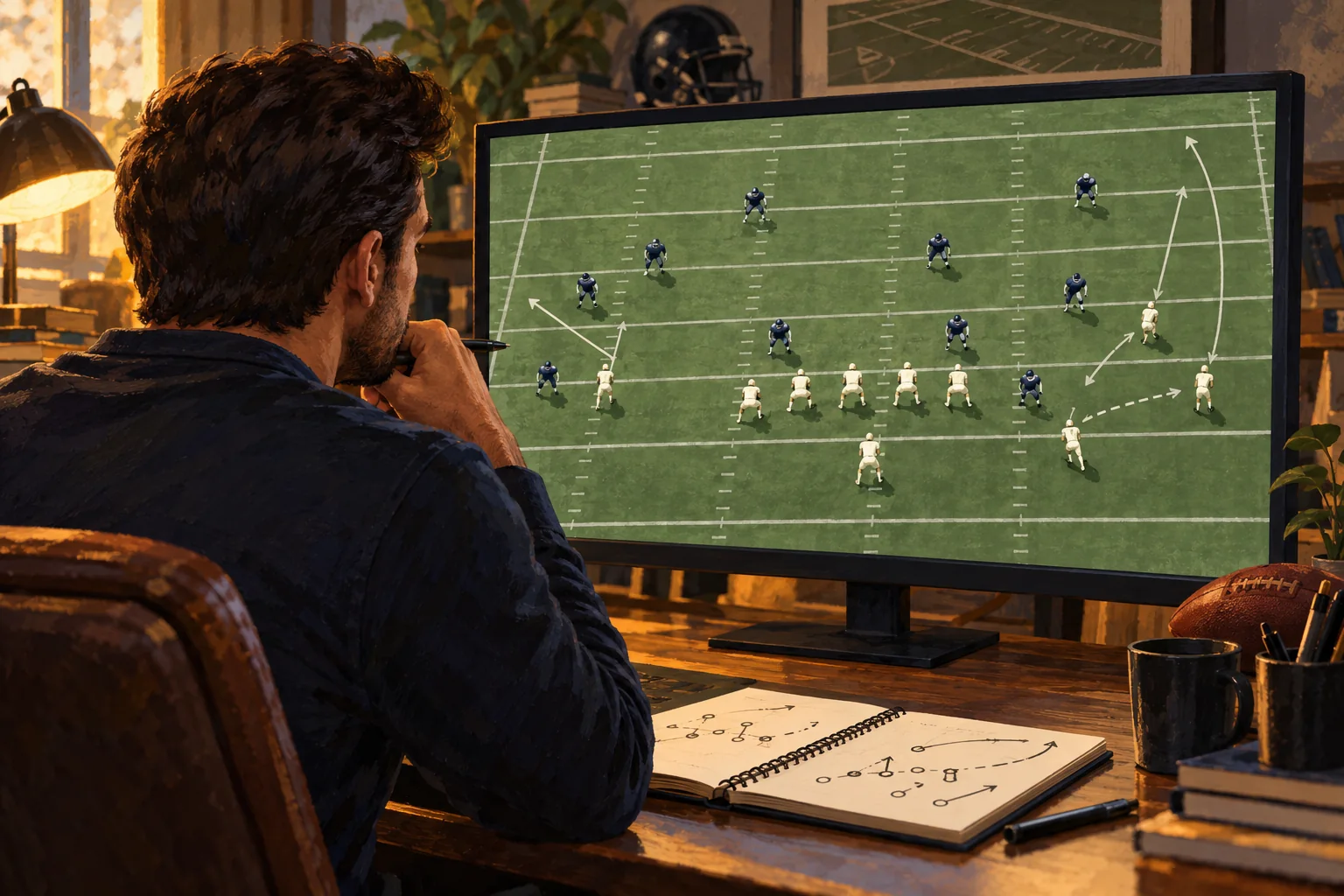
Choose a complete drive instead of only the scoring play. Write down the assignment you think the player had, what happened and what remains uncertain. For a tackle, that might mean distinguishing a controlled outside rush from a pocket collapsed through the middle. For a receiver, it might mean noting a route that drew help even though another player caught the ball. Be willing to leave an uncertain responsibility unresolved; the broadcast does not reveal the entire playbook.
If you want wider views, NFL’s Coaches Film instructions explain the NFL+ Premium route when film is available. You do not need an analytics subscription to begin, but the ordinary television camera cannot show every off-ball assignment. Avoid drawing a strong conclusion about a deep safety from a shot that never included him.
Finally, keep separate notes for ability, current form and availability. A new role, sustained changes in execution or a meaningful availability change can justify revisiting a selection. One unusual matchup may simply expose a tradeoff. The completed-2025 baseline here is a starting argument with explicit limits; the 2026 games supply the evidence that should strengthen, qualify or replace it. Before making a viewing plan around any named player, consult the current team injury report and game-day status rather than interpreting this article as a promise that he will play.
Comments