The complete 2026 NFL schedule is official, so there is no longer a live slate of games to ?leak.? The league released the full schedule on May 14, 2026, after several days of planned game announcements from the NFL, its clubs and broadcast partners. Some release-week posts were genuine news reports, some were coordinated early reveals, and others were unverified rumors that happened to circulate before the television show. Today, the useful question is not ?What just leaked?? but ?Which source confirmed this detail, and is it still current?? Use the live 2026 NFL schedule for the latest league-wide view. This guide explains how to grade an old leak, verify every part of a matchup and avoid mistaking a later flex change for evidence that the original schedule was fake.
The 2026 NFL Schedule Is Official?What ?Leaks? Means Now
The NFL announced in advance that the complete schedule would be revealed at 8 p.m. ET on Thursday, May 14. It also said broadcast partners would announce select games before that full release. NFL.com published its complete Week 1 slate at the release time, and clubs posted their own schedule videos and graphics that evening. A tracker from the morning of May 14 therefore captures a temporary snapshot, not the current authority.
The word ?leak? became a catch-all during release week, but four different kinds of information were moving through social feeds:
| Type of claim | What it means | How much to trust it | What to do now |
|---|---|---|---|
| Official early reveal | The NFL, a club or a broadcaster deliberately announced a game before the full show | Confirmed at the time, subject to later schedule procedures | Compare it with the current schedule |
| Attributed media report | An established reporter or outlet named the matchup and described how it was learned | Credible reporting, but secondary until primary confirmation | Look for the later NFL or club record |
| Unverified leak | A screenshot, list or post appeared without a traceable source | Unconfirmed, even when other entries on the list proved correct | Do not rely on it for tickets or travel |
| Later schedule update | The league changed a time, date or network after release | Official current information | Use the new assignment and note the update date |
That distinction matters because a post can be ?early? without being unauthorized, while a confident graphic can remain unconfirmed even if it looks professional. For the current state of this site?s data, check the NFL schedule data status page.
Confidence should also attach to a specific field and a specific time. A reporter may have correctly confirmed the opponents while the kickoff window was still being finalized, or a club may have announced a date before the network assignment appeared. Preserve that nuance when reviewing an old post. Marking one correct field as proof of the entire row can turn a limited, accurate report into an inaccurate travel plan.
Why Games Appeared Before the Full Schedule Release
Schedule-release week is designed as a sequence rather than a single data dump. The league?s own announcement told fans that broadcast partners would reveal selected games before May 14 and that the remaining international slate would be announced on NFL Network on May 13. Those were planned promotions with a stated source and time.
Network upfront presentations also created legitimate early news. The Associated Press reported that NBC, Fox and Prime Video presentations announced three games on the Monday before the full reveal: Lions at Bills for the Thursday night package, Cowboys at Giants for the first Sunday night game, and Eagles at Cowboys on Thanksgiving. Those reports were not anonymous screenshots. They described public presentations and were subsequently reflected in the official schedule.
The same principle applies to the current Week 1 schedule, the Thanksgiving games and the record nine-game international schedule. A network, league or club may announce a matchup for promotional reasons before the master schedule appears. Calling every such announcement a leak obscures the most important fact: the information had an accountable primary source.
A Four-Level Source Test for Any NFL Schedule Claim
When an old post says ?confirmed,? ignore the label and inspect the evidence. Use this four-level test from strongest to weakest:
Level 1: NFL, Club and Broadcaster Primary Sources
The strongest record is the NFL schedule itself, followed by an official team schedule page or a named broadcaster announcement. A club?s verified account can also be a primary source when it links to its schedule or posts the complete graphic. Confirm that the account and domain are genuine; copied images on another account do not inherit the original source?s authority.
Level 2: Attributed Reporting From an Established Outlet
A report can be useful before the league posts its page, especially when it identifies a network presentation, team announcement or named reporter. Read the story, not only the search snippet. Look for a publication time, an author, a clear attribution and an update note. Reliable reporting can still contain a detail that changes or needs clarification, so treat it as a bridge to primary confirmation.
Level 3: Screenshots Without a Traceable Origin
A cropped schedule graphic can remove the club name, timestamp, correction or ?projected? label. Reverse-search the text, inspect the earliest post you can find, and ask whether the claimed team published the same detail. Do not upgrade a screenshot merely because many accounts reposted it.
Level 4: Anonymous Posts and Copied Rumor Chains
?A friend in the building? is not verifiable evidence. Neither is a spreadsheet that contains several already-known games plus new unsupported entries. Correct guesses do not authenticate the rest of a list. Until a primary source or accountable report confirms the claim, label it unverified and keep it out of ticket, hotel and flight decisions.
How to Verify a Leaked Matchup in Five Minutes
A matchup is not one fact. It contains at least six fields: visiting team, home or designated-home team, week/date, kickoff time and time zone, venue, and television or streaming assignment. Verify each field separately with this process:
- Write down the exact claim. Save the source URL and publication time. ?Team A plays Team B? is different from ?Team A hosts Team B Sunday at 4:25 p.m. ET on a specific network.?
- Find the original post. Trace screenshots and reposts back to the NFL, club, broadcaster or named reporter. If no origin exists, the claim remains unverified.
- Check the live schedule. Search the appropriate week and compare home/away order, date, kickoff time, venue and network.
- Cross-check a team source. Use NFL schedules by team and the relevant club?s official page. Two independent displays help catch a time-zone or home-designation mistake.
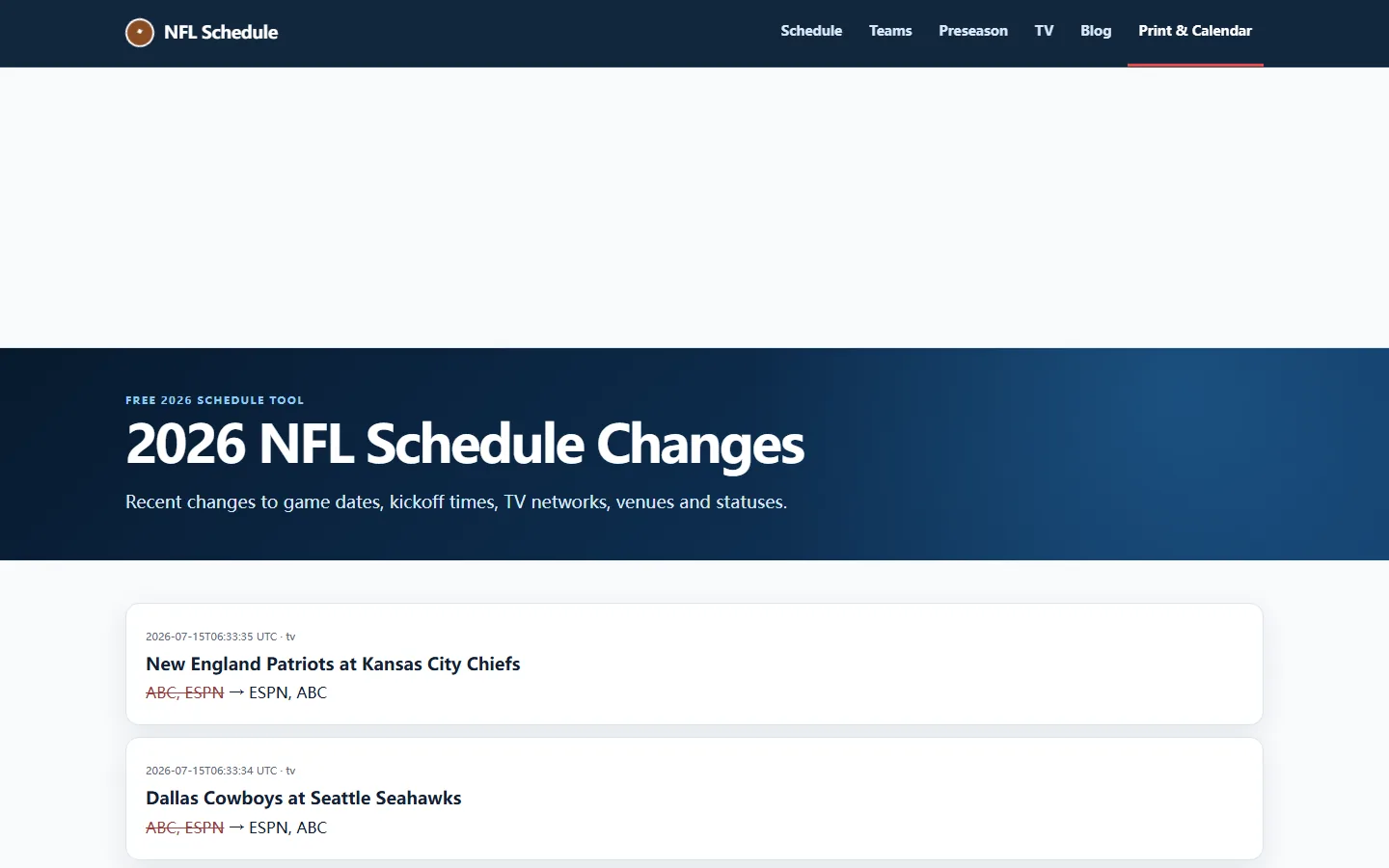
- Check for a later update. Review the NFL schedule changes tracker and the current NFL TV schedule before acting.
If the original claim and current listing differ, do not immediately call the report false. First determine whether the report was wrong on release day or whether the NFL subsequently changed a movable detail.
What Early Reports Commonly Get Wrong
Release-week errors often occur in the details surrounding a real matchup. Watch for these patterns:
- Right opponents, wrong week: known home-and-away opponents were available before the dated schedule, making it easy to attach a plausible matchup to the wrong week.
- Right game, incomplete kickoff: a date may be confirmed while the exact time or network remains TBA. A fan graphic can turn a placeholder into false certainty.
- Local time presented as ET: international and West Coast games are especially vulnerable to time-zone mistakes.
- Designated home team confused with venue geography: an international game can have an official home designation even though it is played outside that club?s stadium.
- Preseason mixed with the regular season: the 2026 NFL preseason schedule is a separate competition period and should not be inserted into the 18-week regular-season grid.
- TV package inferred instead of announced: a familiar day or kickoff window does not prove the network. Verify the current broadcast assignment.
A good tracker shows uncertainty at field level. ?Matchup confirmed; kickoff TBA? is more accurate than marking the entire row either confirmed or rumored.
A Schedule Change Is Not Evidence the Original Schedule Was Fake
The schedule released in May is official, but selected assignments are intentionally movable. Under the NFL?s published 2026 procedures, Sunday Night Football can be flexed up to twice in Weeks 5-10 and in any week from 11-17. Monday night flexing applies in Weeks 12-17, and Thursday night flexing can be used up to twice in Weeks 13-17. Sunday afternoon games can also move between the early and late windows.
Week 18 requires special care. Its Saturday, Sunday afternoon and Sunday night dates, times and networks are assigned after Week 17. A May graphic that says ?Saturday or Sunday? or ?TBD? is not incomplete reporting; it reflects the official status at that time.
To audit an apparent contradiction, preserve both timestamps. Ask, ?Was this correct when it was published?? and then, ?What is the current assignment?? The first question evaluates the report; the second supports planning. Follow the change log and use an updating NFL calendar subscription so a legitimate flex does not strand an old kickoff time on your personal calendar.
What Fans Should Use Instead of an Old Leak Tracker
Release-week trackers were useful for a few hours. Once all 272 regular-season games were published, their historical sequence stopped being the safest planning tool. Choose the live resource that matches your task:
- Use the complete 2026 NFL schedule to search the league-wide slate.
- Use team schedule pages for a single club?s home, road and bye pattern.
- Use the week pages when planning a particular weekend.
- Use the calendar tools when you want updates in your personal calendar.
- Use data status to see how the site handles confirmed, tentative and recently updated information.
Before buying a ticket or making a nonrefundable booking, perform one final check on the league or club page. The rule is simple: use rumor pages to understand what people were discussing, but use current primary data to decide what to do.
Frequently Asked Questions
Is the 2026 NFL schedule out?
Yes. The NFL released the complete schedule on May 14, 2026. Use the current schedule rather than a pre-release leak tracker.
Were all early 2026 schedule posts leaks?
No. The NFL said in advance that broadcast partners would reveal selected games, and the league scheduled a separate international-game announcement. Those were official early reveals. Other posts were attributed reports or unverified claims.
Can an officially announced game still change?
Yes, selected dates, kickoff windows and network assignments can change under flex scheduling or other league procedures. Week 18 details are assigned after Week 17. The current schedule controls planning.
Where should I check the latest kickoff time and TV channel?
Start with the live schedule, then confirm the relevant team or week page and review the schedule-change log. For viewing details, use the current TV schedule rather than a release-day screenshot.
Comments