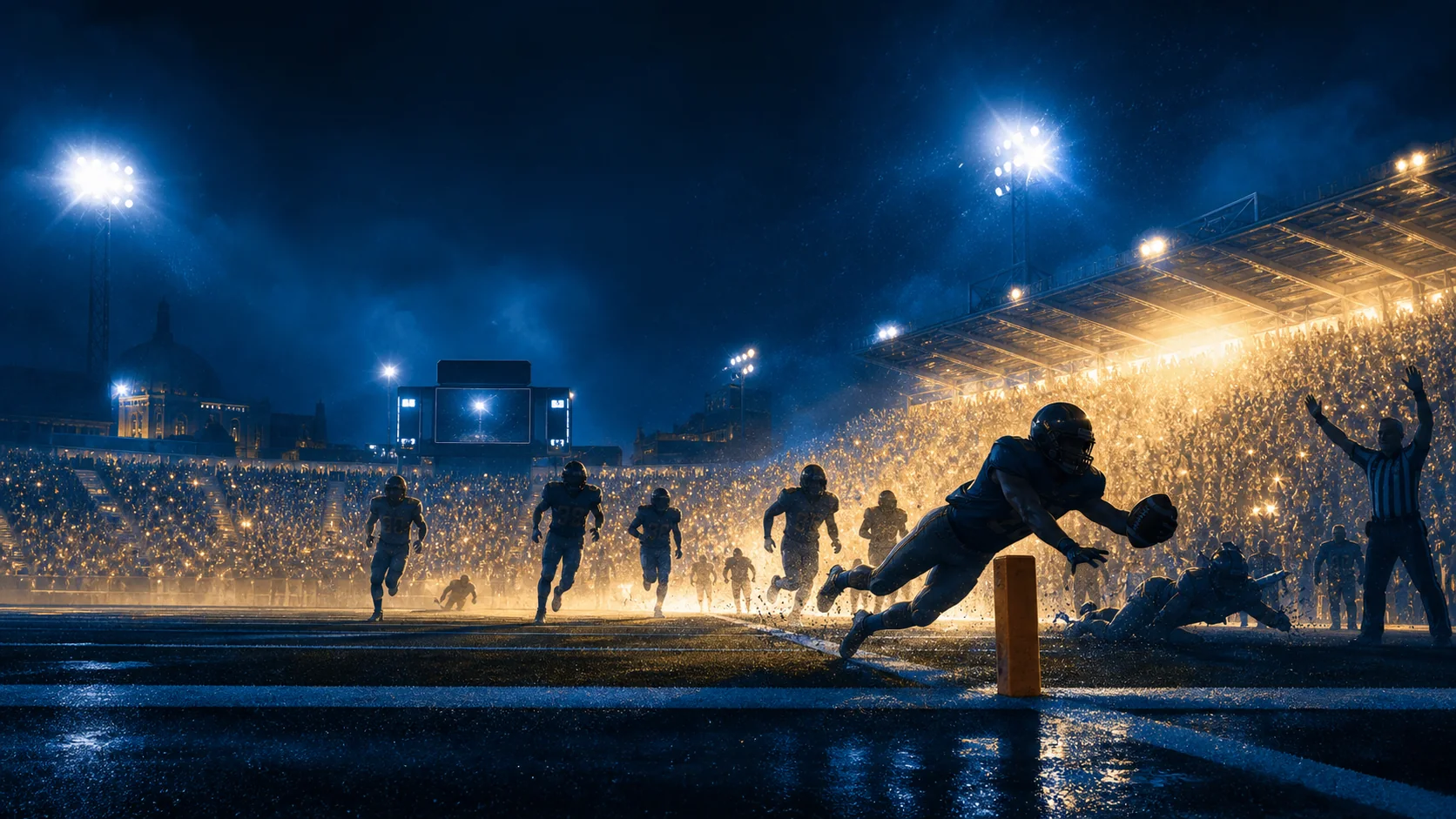
The Carolina Panthers beat the Arizona Cardinals 33-30 in the 2026 Pro Football Hall of Fame Game. Rookie quarterback Haynes King ended the exhibition with a five-yard touchdown run as the clock reached 0:00 on Thursday, August 6. The finish turned the NFL preseason opener in Canton into a genuine last-play thriller.
This recap puts the answer first, then goes deeper: every scoring turn, the decisive drive, official player and team statistics, and the roster questions the game actually changed. Just as importantly, it separates useful preseason evidence from conclusions that would be premature after one extra exhibition involving mostly reserves.
2026 Hall of Fame Game Final Score at a Glance
Carolina and Arizona were scoreless after one quarter, traded 17 points apiece in the second, and entered the fourth with the Cardinals ahead 20-17. The Panthers then scored 16 fourth-quarter points, including King?s walk-off run, to win by three. No overtime was needed because the winning touchdown occurred on the final timed play.
| Team | Q1 | Q2 | Q3 | Q4 | Final |
|---|---|---|---|---|---|
| Carolina Panthers | 0 | 17 | 0 | 16 | 33 |
| Arizona Cardinals | 0 | 17 | 3 | 10 | 30 |
- Date: Thursday, August 6, 2026
- Venue: Tom Benson Hall of Fame Stadium, Canton, Ohio
- Kickoff: 8:09 p.m. EDT
- Paid attendance: 18,116
- Game length: 2 hours, 55 minutes
The result belongs to the Hall of Fame Game portion of the preseason, not the regular-season standings. Carolina left the event 1-0 in exhibition play and Arizona 0-1, but neither club gained or lost ground in its division. Fans looking ahead can use the complete NFL preseason schedule to follow each team?s remaining tune-ups.
How Panthers vs. Cardinals Reached 30-30
The empty first-quarter scoring column gives the wrong impression of the pace that followed. Arizona opened the second quarter by finishing a 13-play, 96-yard possession with Corey Kiner?s one-yard run. Carolina answered in 3:59: John Metchie III supplied an important kickoff return and catch, AJ Dillon powered the offense into the red zone, and Dillon scored from one yard.
Carson Beck then produced the quickest touchdown drive of the half. Arizona moved 60 yards in four plays, ending with Beck?s five-yard throw to Simi Fehoko for a 14-7 lead. Haynes King entered for Carolina and responded with a 10-play, 65-yard march. His rolling 15-yard touchdown pass found Ja?seem Reed in space and tied the game again. Chad Ryland and Ryan Fitzgerald exchanged late field goals, leaving the teams even at 17 at halftime.
| Quarter/time | Scoring play | Score after play |
|---|---|---|
| Q2 14:55 | Corey Kiner 1-yard run | Arizona 7-0 |
| Q2 10:56 | AJ Dillon 1-yard run | 7-7 |
| Q2 9:38 | Simi Fehoko 5-yard catch from Carson Beck | Arizona 14-7 |
| Q2 5:54 | Ja?seem Reed 15-yard catch from Haynes King | 14-14 |
| Q2 1:46 | Chad Ryland 35-yard field goal | Arizona 17-14 |
| Q2 0:08 | Ryan Fitzgerald 33-yard field goal | 17-17 |
| Q3 4:42 | Ryland 43-yard field goal | Arizona 20-17 |
| Q4 14:20 | Anthony Tyus III 5-yard catch from King | Carolina 24-20 |
| Q4 10:19 | Ryland 35-yard field goal | Carolina 24-23 |
| Q4 6:53 | Fitzgerald 37-yard field goal | Carolina 27-23 |
| Q4 1:55 | Bryson Green 1-yard catch from Kedon Slovis | Arizona 30-27 |
Arizona?s go-ahead touchdown could have been the conclusion. Instead, it left exactly 1:55 for Carolina and King. That was enough time for a ninth Panthers possession and the only scoring play missing from the table: the touchdown at 0:00 that changed 30-27 Arizona into a 33-30 Carolina final.
The 13-Play Walk-Off Drive That Won It
Carolina took over at its own 35-yard line with 1:55 remaining, no margin for a stalled series and a rookie third-string quarterback directing the offense. The official drive chart credits the Panthers with 13 plays and 65 yards. That is a long two-minute sequence for any unit, and especially revealing for players trying to show that they can communicate, line up and execute while the available clock shrinks.
The pivotal escape came on third-and-14. King dropped back, found his targets covered and used the part of his game that had already troubled Arizona: his legs. He crossed the line to gain and continued toward the sideline, stopping the clock instead of chasing a few low-value extra yards in the middle of the field. The scramble combined improvisation with the situational awareness coaches need from a backup quarterback.
Carolina eventually reached the Arizona 5. On the final snap, King did not force the ball into coverage. He kept it, found a lane and crossed the goal line as the stadium clock hit zero. The touchdown was worth six points, moving the Panthers from a 30-27 deficit to a 33-30 lead. With the timed game over and the outcome settled, there was no routine extra-point attempt, which is why the final margin remained three.
The finish was more valuable as an evaluation rep than as a preseason win. King showed command through a multi-play pressure drive, converted the critical long-yardage situation and made the correct clock decision before finishing as a runner. It still does not prove how he would perform against a starting NFL defense or in a regular-season game plan. It does, however, give Carolina coaches a clean example of his movement skill translating when every remaining snap mattered.
Haynes King and the Panthers Quarterback Numbers
King received by far the larger evaluation window. He completed 21 of 34 attempts for 180 yards, two touchdowns and no interceptions, producing a 95.2 passer rating. His longest completion covered 21 yards, so the performance was built more on keeping possessions alive than on one inflated deep shot. He added 39 yards and the winning touchdown on three rushing attempts. Those three carries accounted for more than a quarter of Carolina?s 141 rushing yards.
| Quarterback | Comp-att | Pass yds | Pass TD | INT | Rating | Rush yds-TD |
|---|---|---|---|---|---|---|
| Haynes King | 21-34 | 180 | 2 | 0 | 95.2 | 39-1 |
| Kenny Pickett | 8-11 | 62 | 0 | 0 | 86.2 | 0-0 |
Pickett started and completed eight of 11 passes for 62 yards. His first possession ended with a sack, but he settled into the game and helped direct the 67-yard touchdown drive that Dillon finished. He did not turn the ball over, and his shorter appearance should be weighed differently from King?s 34-attempt workload.
The contrast was stylistic as much as statistical. Pickett largely operated the available structure. King created answers when structure broke down, moved launch points and forced defenders to account for a quarterback run. He also missed opportunities, including an overthrow of an open Jimmy Horn Jr. near the end zone, so this was not a flawless passing performance.
King unquestionably strengthened his case for more preseason work. Declaring him Carolina?s new No. 2 quarterback would go beyond the evidence. Coaches will combine this tape with training-camp practice, protection calls, full-field reads and the next exhibitions. The defensible takeaway is narrower: King handled extended snaps, avoided interceptions, generated three total touchdowns and delivered the night?s most demanding drive.
Carson Beck Led Arizona?s Efficient Passing Night
Arizona lost the scoreboard but produced the more efficient team passing line. Carson Beck completed 15 of 19 attempts for 188 yards, one touchdown and no interceptions. His 125.4 passer rating was supported by real chunk production: his longest completion gained 49 yards, and he repeatedly delivered on time during Arizona?s 17-point second quarter.
Beck?s touchdown was a five-yard throw to Simi Fehoko after a four-play, 60-yard drive. The rookie looked composed moving between short answers and deeper throws, an encouraging first NFL exhibition for a quarterback whose reads and timing mattered more than the final score. He was sacked once for two yards, but the pocket generally did not disrupt his rhythm.
| Quarterback | Comp-att | Pass yds | Pass TD | INT | Long | Rating |
|---|---|---|---|---|---|---|
| Carson Beck | 15-19 | 188 | 1 | 0 | 49 | 125.4 |
| Kedon Slovis | 9-10 | 106 | 1 | 0 | 27 | 144.2 |
Kedon Slovis was even more efficient in the later portion of the game, completing nine of 10 passes for 106 yards. He led the 10-play, 62-yard drive that put Arizona ahead with 1:55 remaining, finishing it with a one-yard throw to Bryson Green. The one significant negative in his passing total was a 10-yard sack; otherwise, the ball rarely hit the ground.
Together, Arizona?s quarterbacks went 24-of-29 for 294 gross passing yards, two touchdowns and no interceptions. After the two sacks, the official net passing figure was 282. Jacory Brooks supplied the largest explosive contribution with three receptions for 99 yards, including the 49-yarder. Like King?s performance, Beck?s debut earned another serious look. It did not settle a regular-season role by itself, particularly against a Carolina defense that held many established starters out.
Full Team Stats: Where Carolina Found the Winning Margin
Arizona gained more yards and held the ball almost nine minutes longer, yet Carolina created enough high-leverage advantages to win. The Panthers finished with two more first downs, converted a slightly larger share of third downs, succeeded on their only fourth-down attempt and scored touchdowns on four of six red-zone visits. Arizona reached the red zone six times as well but converted only three into touchdowns.
| Category | Panthers | Cardinals |
|---|---|---|
| First downs | 25 | 23 |
| Total net yards | 378 | 425 |
| Net rushing yards | 141 | 143 |
| Net passing yards | 237 | 282 |
| Third down | 9/14 (64.3%) | 7/12 (58.3%) |
| Fourth down | 1/1 | 0/1 |
| Red-zone touchdowns | 4/6 | 3/6 |
| Turnovers lost | 1 | 0 |
| Penalties | 5 for 20 yards | 7 for 78 yards |
| Time of possession | 25:39 | 34:21 |
The sharpest difference was discipline. Carolina gave away only 20 penalty yards; Arizona lost 78. Penalty totals do not automatically explain a three-point result, but that 58-yard gap repeatedly changed the distance and field position around meaningful downs. Carolina also turned its late possessions into touchdowns rather than settling exclusively for kicks.
There was no interception in the game. Carolina lost one fumble, while Arizona recovered both of its own. That makes the Panthers? win unusual: they lost the turnover margin and trailed in total yardage and possession, but stayed efficient on money downs and finished drives.
One data note matters for readers comparing pages. Carolina?s web game center displayed 423 Arizona yards when reviewed, while the final NFL game book lists 425. The final book is used here because its components reconcile: 143 net rushing yards plus 282 net passing yards equals 425. Small postgame display differences happen; the finalized league document is the controlling box-score source for this recap.
Rushing, Receiving and Special-Teams Standouts
Mike Davis led Carolina?s running backs in yardage despite receiving only four carries. He gained 53 yards, with a 36-yard run doing most of the damage. AJ Dillon?s sample was even smaller?three carries for 18 yards?but included the one-yard touchdown and a 13-yard gain. King?s 39 yards made the quarterback an essential part of the Panthers? 6.4-yards-per-rush team average.
Arizona spread 34 rushing attempts across its available backs. Zonovan Knight led with 60 yards on 12 carries, and Corey Kiner added 57 yards and a touchdown on 14. Neither had to rely on a single breakaway; their longest runs were 15 and 13 yards. That steadiness helped Arizona control possession for 34:21.
- Carolina receivers: Jimmy Horn Jr. caught four passes for 44 yards, John Metchie III had three for 38, and Ja?seem Reed turned two receptions into 30 yards and a touchdown.
- Arizona receivers: Jacory Brooks led the game with 99 yards on three catches, Robert Virgil caught five for 66, and Xavier Weaver added three for 31.
- Touchdown targets: Reed and Anthony Tyus III scored for Carolina; Simi Fehoko and Bryson Green scored for Arizona.
The kicking was clean on both sides. Ryan Fitzgerald made field goals from 33 and 37 yards plus all three extra points for Carolina. Chad Ryland hit from 35, 43 and 35 yards and converted all three Arizona PATs. With the final margin only three, neither team can point to a missed placekick.
Sam Martin also supplied a quieter Carolina advantage. His two punts averaged 58.5 yards with a 55.0 net, and one was downed inside the 20 after a well-covered, high-arcing kick. These are small samples against preseason coverage units, but they are meaningful individual audition snaps: distance, placement and assignment execution are visible even when the surrounding roster changes.
Four Takeaways That Matter ? and Two That Do Not Yet
- Haynes King raised the value of his next opportunity. The combination of 34 pass attempts, zero interceptions, two passing scores and a pressure drive gives Carolina more than a highlight to evaluate. His movement changed plays, while his late decisions showed that the athleticism did not eliminate clock awareness.
- Carson Beck?s process looked ready for a larger test. A 15-of-19 debut is encouraging because the completions came at multiple depths and the ball generally arrived in rhythm. The next question is how the timing holds up against more disguise, pressure and starting defenders.
- Carolina?s receiver competition remains genuinely open at the bottom of the depth chart. Metchie, Horn and Reed each produced a useful moment, but none created an unanswerable statistical gap. Routes, blocking, special teams and availability across the remaining games will matter as much as this box score.
- Arizona?s reserve passing structure functioned efficiently. Completing 24 of 29 throws without an interception suggests the quarterbacks and receivers were seeing the field similarly. It is legitimate evidence of execution, even if the opponent did not use its full defensive lineup or regular-season package.
Two tempting conclusions do not follow yet. First, Carolina?s win does not forecast a better regular-season record than Arizona?s. Exhibition staffs prioritize evaluation, protect core players and call situations they want on tape. The Panthers? own report estimated that roughly 22 players watched from the sideline, and the official game book lists many established starters who did not play for either club.
Second, Arizona conceding 33 points does not establish the quality of its starting defense. The units finishing the fourth quarter will not mirror a September lineup. Personnel groupings, communication and individual technique can be graded, but a team-level defensive verdict needs snaps with regular starters and a representative game plan.
The balanced reading is that four individual or unit-level developments earned follow-up attention, while sweeping power-ranking claims did not. Preseason tape is most valuable as a trail: identify a trait in Canton, then see whether it survives the next opponent, a different situation and stronger personnel.

Why the 2026 Hall of Fame Game Had Extra Meaning
The pairing connected directly to the 2026 Pro Football Hall of Fame class. Luke Kuechly spent his entire playing career with Carolina, while Larry Fitzgerald spent all 17 of his seasons with Arizona. Both were recognized in Canton alongside classmates Drew Brees, Roger Craig and Adam Vinatieri before the class was enshrined two days later.
For the Panthers, the trip also completed a historical loop. Carolina?s only previous Hall of Fame Game came in 1995, when the expansion franchise played the first game in its history and defeated Jacksonville 20-14. The 2026 return therefore linked the organization?s beginning to the Canton celebration of Kuechly, one of its defining players.
The Cardinals? connection reaches even further back. Then based in St. Louis, the franchise played the New York Giants in the inaugural Hall of Fame Game in 1962. That contest ended 21-21, more than a year before the Hall?s museum opened. Arizona arrived in 2026 with a 1-3-1 record from its five earlier Canton appearances.
The dramatic finish also found a substantial national audience. The Pro Football Hall of Fame reported a combined over-the-air and streaming audience of 7 million. According to the Hall, that was the largest audience for the event on NBC?s family of networks since 2017 and the highest overall Hall of Fame Game figure since 2021.
Those historical and television details do not make an exhibition result count more in the standings. They explain why this particular preseason opener carried more ceremony and attention than a normal August game. It honored two one-team icons, revisited each franchise?s Canton history and then supplied a finish strong enough to stand on its own.
2026 Hall of Fame Game FAQ
Who won the 2026 Hall of Fame Game, and what was the final score?
The Carolina Panthers defeated the Arizona Cardinals 33-30 on Thursday, August 6, 2026. Carolina scored 16 points in the fourth quarter after trailing 20-17 through three. The winning touchdown came on the final play at Tom Benson Hall of Fame Stadium in Canton, Ohio.
Who scored the winning touchdown?
Panthers quarterback Haynes King scored on a five-yard run as the clock reached 0:00. The play completed a 13-snap, 65-yard possession that began with 1:55 remaining and Carolina behind 30-27. Because the touchdown ended the game with the result decided, Carolina did not add a conventional extra-point attempt.
What were Haynes King?s stats?
King completed 21 of 34 passes for 180 yards, two touchdowns and no interceptions, a 95.2 passer rating. He also rushed three times for 39 yards and the game-winning touchdown. Ja?seem Reed and Anthony Tyus III caught his two scoring passes.
What were Carson Beck?s stats?
Beck went 15-of-19 for 188 yards, one touchdown and no interceptions. His longest completion gained 49 yards, and his official passer rating was 125.4. His five-yard touchdown throw to Simi Fehoko gave Arizona a 14-7 second-quarter lead.
Did the Hall of Fame Game count in the regular-season standings?
No. It was an extra preseason exhibition played before the standard three-week preseason schedule. The 1-0 and 0-1 records displayed with the result refer only to exhibition play. They have no effect on division standings, playoff qualification or regular-season tiebreakers.
Where can fans find the rest of the 2026 preseason schedule?
Use the 2026 NFL preseason schedule for the remaining weekly slate and the site?s NFL calendar for dates across the season. Team-specific pages for the Panthers and Cardinals provide the most direct route to each club?s next game.
Comments