
NFL player positions fall into three units: offense moves the ball, defense tries to stop it, and special teams handle kicks and returns. Each team normally uses 11 players at a time. On offense, look for the quarterback behind five offensive linemen; on defense, identify the front near the ball and the defensive backs farther away. The exact mixture changes from play to play.
This guide explains the common position names, what their jobs look like on television, and why a player listed as a linebacker can sometimes act like a defensive end. You do not need to memorize a playbook. Learn the groups, follow one matchup, and use replays to see how their jobs connect.
How many NFL positions are on the field?
An NFL team normally has 11 players on the field at a time. That is the number of people playing, not a rule requiring 11 different job titles. An offense can use several wide receivers, a defense can use several cornerbacks, and a team does not need to put a fullback on every play. The normal picture is 11 offensive players facing 11 defenders; kicking plays bring different groups into the game.
The NFL's playing rules set the player limit, while coaches choose the mixture. The familiar 53-man regular-season roster is the larger squad from which players are drawn, rather than the lineup you should try to count on television. Players rotate for different tasks. A backup can be important even when the starting lineup graphic does not show his name.
| Unit | Common abbreviations | What to look for |
|---|---|---|
| Offense | QB, RB, FB, WR, TE, C, G, T | The snap, blockers and routes |
| Defense | DT, NT, DE, EDGE, LB, CB, S | The rush, running lanes and coverage |
| Special teams | K, P, LS, returner | Kicks, returns and field position |
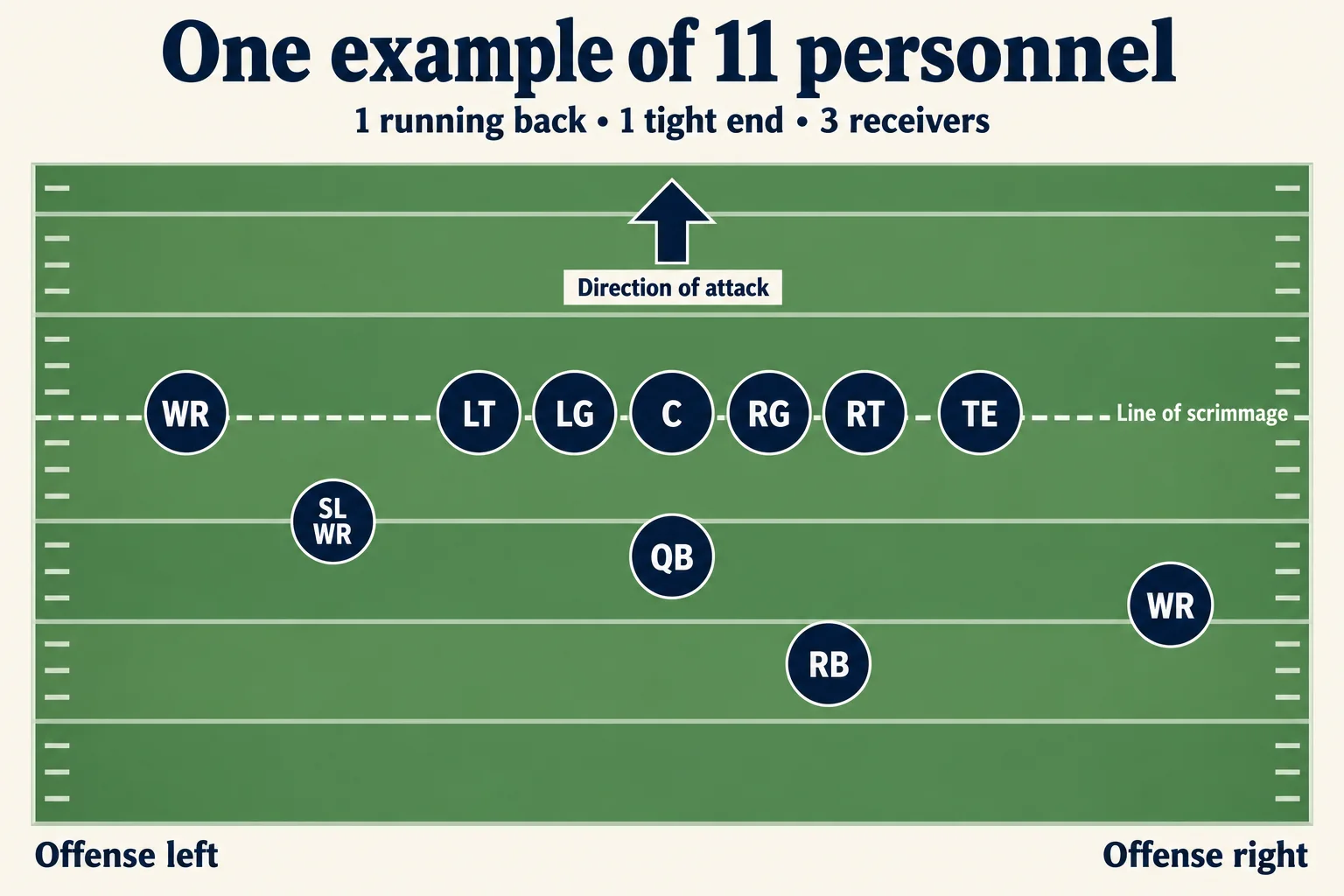
For example, five offensive linemen, one quarterback, one running back, one tight end and three wide receivers add up to 11. Replace a receiver with a second tight end and the total stays the same, but the matchups can change. The defense responds with its own substitutions.
If you are choosing a team to follow, start with the NFL team schedule directory and watch one full possession. Identify the offensive line first, then the quarterback, then the receivers outside the line. This is easier than trying to recognize every position simultaneously. Once the opposing team gets the ball, the original team's defensive unit takes over.
Offensive positions: who moves the ball and who makes space?
Start at the ball. The center controls the snap, the quarterback usually receives it, and the rest of the formation provides protection and places to send the ball. An offense succeeds when these jobs fit together. The player scoring the touchdown may be the last person in a chain of useful work.
Quarterback: making the play work
The quarterback, or QB, is the offense's main ball distributor. He can take the snap directly behind the center or stand farther back in shotgun. From there, the play may involve a handoff, a pass or a quarterback run. Before the snap, he communicates and studies how the defense is arranged. A visible adjustment does not necessarily mean the original play was wrong; it may be a planned response to what the defense shows.
Watch the first exchange rather than immediately following the receiver. A handoff fake can attract a defender and create room for a pass. On a replay, notice whether the quarterback had a clear throwing lane or whether a defender arrived quickly. A sack is the outcome of the whole play: protection, coverage and the quarterback's decisions can all matter. The broadcast angle rarely tells you every assignment.
Running back and fullback: carrying, catching and protecting
A running back, or RB, often receives handoffs and attacks a gap in the defense. He also catches passes and can stay behind to help protect the quarterback. Those are three different ways to contribute. When a back does not run a route, look for the defender he meets near the pocket; he may have prevented the play from ending before a receiver became open.
A fullback, or FB, commonly helps clear a route for another runner. Fullbacks can also carry or catch the ball. The distinction is a typical role, not a ban on handling it. Some formations have a fullback and some have none. For a viewer, follow the lead blocker on a run once: the runner's opening may make much more sense when you see who created it.
Wide receiver and tight end: routes, catches and blocks
Wide receivers, or WRs, create passing options through their routes. An outside receiver starts nearer a sideline; a slot receiver aligns inside the widest receiver. Slot describes a place in the formation rather than a separate kind of human. A receiver can move between these locations during the same game.
The tight end, or TE, combines receiving and blocking responsibilities. He may line up beside a tackle, farther outside, or off the line. An offense can use that flexibility to put a defender in a difficult matchup. Tight ends are not limited to short catches, and receivers still block when the ball goes elsewhere.
Receiving eligibility depends on the rules for numbers, reporting and alignment. A familiar receiver can be in an ineligible position if the formation covers him on the line. When an official announces that a lineman has reported eligible, that announcement also matters. The NFL rulebook explains the exceptions; a position label alone is not permission to catch every forward pass.
Offensive line: center, guards and tackles
The normal five-man line is left tackle, left guard, center, right guard, right tackle, read from the offense's perspective looking toward the defense. The center snaps the ball. Guards work on either side of him; tackles occupy the outside of that central group. A camera showing the defense's viewpoint can reverse the apparent left and right.
All five help with both running and passing plays. On a pass, their protection gives the quarterback time and space. On a run, their blocks help create a usable path. Avoid the shortcut that a left tackle only protects passes or a right tackle only blocks runs. Instead, watch the first step after the snap and where the blocker tries to position the defender. This reveals useful work that rarely appears in a rushing or receiving leaderboard.
Defensive positions: how a team stops the offense
Think of the defense in layers: players near the line, linebackers working behind or around that front, and defensive backs handling receivers and deeper space. The layers cooperate. A defender forcing a runner toward a teammate may have done his job even when the teammate receives credit for the tackle.
Defensive line and EDGE: winning at the line
Defensive tackles, or DTs, operate in the interior of the front. A nose tackle, or NT, is an interior role associated with the area around the center. Defensive ends, or DEs, work toward the ends of the front. Interior players are involved in stopping runs and disrupting passing plays; outside players also need to defend runs rather than chase the quarterback on every snap.
EDGE is a convenient label for an edge-rushing role. A player doing that job may be listed as a defensive end in one scheme and an outside linebacker in another. The label helps compare a job that crosses roster categories. It does not add an extra player to the defense or prove that someone rushes on every play.
Watch the space beside an offensive tackle. If a defender keeps the runner from escaping outside, the ball may be forced back toward help. On passing downs, watch the inside of the pocket too. Pressure through the middle can make the quarterback move even when the eventual sack comes from the edge.
Linebackers: linking the front and the coverage
A linebacker, or LB, can be involved in run defense, pass coverage and blitzes. Off-ball linebackers generally work behind the defensive front; an outside linebacker in a different system may spend much of his time near the line rushing. This is why two players with LB beside their names can have very different games.
You may hear Mike, Sam and Will. These are coaching terms often associated with middle, strong-side and weak-side linebacker responsibilities. They are useful when explaining a particular defense, but they are not a universal promise about exactly where someone will stand. The offense's alignment and the defensive call can move the job.
Follow a linebacker after the snap: does he attack the running lane, follow a receiver, hold an area or rush? The first movement tells you more than his position in the pregame graphic. A player dropping into coverage can make a throw unattractive without touching the ball, so tackle and sack totals alone leave part of the story out.
Cornerbacks and safeties: defending space and receivers
Cornerbacks, or CBs, often line up opposite receivers. In man coverage, the responsibility focuses on an assigned opponent; in zone coverage, it focuses on an area and the receivers entering it. A corner covering the slot works farther inside than a corner opposite the widest receiver. That inside job is often called the nickel position.
Safeties, or Ss, can help protect deeper space, support the run or take a specific coverage assignment. Free safety and strong safety are familiar labels, but real defenses rotate and disguise where the help is going. A safety who begins deep may move toward the line, while another player replaces him farther back.
When a receiver catches a pass, resist automatically blaming the nearest defender. The coverage could have involved a handoff between zones or help from another player. A wider replay can make that clearer. Also, a safety the player and a safety the two-point score are different meanings of the same word; any defensive player can help create the scoring play.
Special teams positions: the players behind kicks and returns
Special teams take over for kicking situations: kickoffs, punts, field goals and extra-point kicks. The players can overlap with offensive and defensive rosters, while dedicated specialists handle particular skills. A receiver playing on punt coverage has not become a defender in the team's regular defensive scheme; he is doing a different job for that play.
Kicker, punter, long snapper and holder
The kicker, or K, attempts field goals worth three points and extra-point kicks worth one. He may also handle kickoffs. The punter, or P, sends the ball away when the team chooses a punt, often on fourth down. His useful result is the opponent's next starting position, which makes placement and the return just as interesting as the distance the ball travels.
The long snapper, or LS, sends the ball back for punts and place kicks. On a field-goal attempt, the holder receives the snap, positions the ball and holds it for the kicker. That sequence needs to fit together. A missed attempt might involve the snap, the hold, protection, conditions or the kick itself. Watch a replay of the operation before treating the kicker as the only person involved.
These are specialized jobs with different demands from ordinary quarterback-center exchanges. The holder's role also does not tell you his normal roster position. Use the team's current specialist listing if you want to identify the player rather than assuming every club uses the same arrangement.
Returners, gunners and coverage players
A returner fields a kick or punt and looks for a way to improve starting field position. He may also be a wide receiver, running back or defensive back in other situations. A punt return is recorded separately from a catch on an ordinary passing play. On a punt, a returner can signal a fair catch instead of trying to advance; protecting possession can matter more than a risky extra few yards.
Punt gunners start wide and try to reach the returner or help control where the ball finishes. Opposing blockers try to delay them. Watch that matchup on a replay: a returner's available lane depends on much more than his own speed.
The current NFL dynamic kickoff uses a different arrangement and movement rules from older kickoff footage. Do not apply a punt diagram or the traditional full-speed kickoff run-up to it. The current kickoff rules are the right reference. Coverage players and return blockers still work together to determine field position, even when none of their work shows up in the offensive yardage columns.
Why formations change the lineup without changing the player limit
Personnel tells you who is playing; formation tells you where they line up. The same group can spread out on one play and stand close together on the next. That difference is useful when an analyst describes the offense without explaining the terminology.
Offensive personnel labels commonly count running backs first and tight ends second. 11 personnel means one back and one tight end, leaving three receivers alongside the usual quarterback and five linemen. 12 personnel means one back and two tight ends, leaving two receivers. The second tight end replaces a receiver in this comparison. The team still has 11 players; the label 12 does not mean twelve people on the field.
Those counts do not guarantee a run or a pass. Two tight ends might improve blocking options, but either can become a receiving threat. Three receivers can make the defense spread out, but the offense can still hand the ball off. Try to notice what the particular players make possible rather than predicting the entire call from one number.
Defensive 4-3 and 3-4 descriptions count linemen and linebackers in familiar base arrangements. Four linemen and three linebackers leave four defensive backs; three linemen and four linebackers also leave four. Nickel means five defensive backs and dime means six, with someone in another group removed. Nickel need not mean exactly three cornerbacks: a team can use another safety instead.
The NFL's formation guide illustrates these differences. Remember that nickel describes a personnel package, while man and zone describe coverage. A depth chart can list someone as a reserve, yet he may be on the field whenever the defense uses its nickel package. This is why starting labels and actual playing time do not always tell the same story.
How to follow player positions during your next game
Pick a game from the NFL games today schedule, then choose one matchup for a possession. On the live play, follow the ball so you understand the result. On the replay, follow a blocker, a receiver without the ball or a defender who made the runner change direction. You will begin to see contributions that the touchdown highlight skips.
- Before the snap, find the center and quarterback.
- Count the receivers and tight ends you can see.
- Look for defenders near the line and defenders protecting deeper space.
- After the snap, follow your chosen player and then check the result.
- Use a replay to connect the player's movement to the opening or stop.
When looking at official NFL player statistics, select the relevant season and competition type. Passing, rushing and receiving totals describe different activities, not every player's overall value. A lineman making an important block usually has no receiving gain to show for it. A defender discouraging a throw may not record an interception.
Also compare the opportunity. One game's totals do not tell you how many routes a receiver ran, how often a back stayed in protection or which coverage assignment a safety had. The numbers are a useful starting point; the play and the role provide the context.
Quick answers to common position questions
Can only the quarterback throw? No. Other offensive players can attempt a legal forward pass within the rules; quarterbacks do most ordinary passing.
Is a tackle always a defender? No. Offensive tackle is a blocking position. A tackle also describes an action that stops the ball carrier.
Does a safety have to score a safety? No. The position and the two-point score are separate terms.
Which position is best? It depends on the question. The quarterback distributes the ball, but protection, receiving, defending and kicking require different skills. Learn the job before judging the player.
Comments