
Bruce Smith leads the official NFL career sack list with 200 sacks, followed by Reggie White with 198. Sacks became an official individual statistic in 1982. Earlier players' researched totals help tell the history of pass rushing, but they belong to a separately labeled comparison.
This guide explains the career leaders, the reason for that cutoff and the half-sack credits you see in a box score. It also separates career accumulation from Myles Garrett's verified 23-sack season in 2025, then shows how to follow today's pass rushers without mixing regular-season, playoff and franchise records.
Who leads the NFL in official career sacks?
Bruce Smith holds the official NFL regular-season career sack record with 200.0. Reggie White finished second with 198.0. The official individual record covers sacks recorded from 1982 onward, so that scope must stay attached to any comparison with earlier defensive greats.
The five highest completed career totals provide a clear starting point:
| Rank | Player | Official career sacks |
|---|---|---|
| 1 | Bruce Smith | 200.0 |
| 2 | Reggie White | 198.0 |
| 3 | Kevin Greene | 160.0 |
| 4 | Julius Peppers | 159.5 |
| 5 | Chris Doleman | 150.5 |
Smith's and Doleman's Hall of Fame career profiles and the Panthers' account of Peppers' place in the record book document these totals. This is a career regular-season comparison checked on October 11, 2026, rather than a current-season sack race.
Smith's lead over White is two sacks, while Greene and Peppers are separated by half a sack. Decimal totals are normal because two defenders can share credit on one play. A half-sack difference has the same meaning on a career leaderboard as it does in Sunday's box score.
A player's league career number can also differ from his best-known team's record. The Bills' Smith profile lists 171 sacks with Buffalo. His later Washington seasons added 29, bringing his NFL total to 200. Team changes do not reset a league career record.
That distinction is useful when a broadcast celebrates a franchise milestone. Passing a club legend can be a major achievement while leaving the player below that legend's whole-career NFL total. Our NFL team directory helps you follow the clubs involved; use the statistical label to identify which record the broadcast is discussing.
The career list rewards repeated production over a long span. It does not automatically identify the strongest single season, the best playoff run or the defender who created the most disruption without finishing the tackle. Those questions need their own measures.
Why the 1982 cutoff changes historical sack lists
The NFL began keeping sacks as an official individual statistic in 1982. A career list using that rule cannot show the full production of someone who retired before the cutoff. An empty entry for an earlier defender does not mean he never brought down a passer. It means that particular official statistical category does not cover his playing years.
This matters when comparing the great pass rushers of different generations. A modern table can be accurate within its stated scope and still leave out an important part of football history. The right first question is whether the table includes only official totals or also earlier sacks reconstructed by researchers. Its answer should appear beside the numbers.
What reconstructed sack totals can tell us
Deacon Jones is a useful example. His career preceded the official category. The Hall of Fame's account of his career attributes a total of 173.5 sacks to research by historian John Turney. That number helps describe Jones's impact and explains why expanded historical lists place him among the great pass rushers.
It should be labeled a reconstructed total rather than silently inserted into a table headed official sacks since 1982. Those labels let fans compare the figures without pretending that every season was recorded under the same system. They also explain why a historical article and an official career leaderboard can display different names near the top.
There is no need to dismiss either comparison. Use the official list when answering the league record question. Use clearly identified historical research when discussing earlier generations. If a table combines both, look for notes explaining which seasons and players were added. A number without that context tells you less than it first appears to.
How to handle players whose careers cross the cutoff
Lawrence Taylor shows how the distinction affects one player's career. The Giants list 132.5 official sacks and separately explain that he had 9.5 as a rookie in 1981, before sacks became official. Adding the earlier figure produces 142.0. Both totals describe Taylor, but they answer different statistical questions.
When a broadcast graphic shows 132.5 and another history page shows 142.0, check the treatment of 1981 before assuming someone made an arithmetic error. This is also separate from adding playoff games: a pre-1982 regular-season adjustment and a postseason addition are two different changes to the scope. Keep the date boundary and the competition boundary visible whenever you compare records.
What a half sack means in the box score
A player finishes a game with 1.5 sacks because sack credit can be shared. Under the NFL's statistical guide, two defenders judged equally responsible for the same sack divide the credit. Each receives 0.5. The defense still has one sack on that play.
For a simple hypothetical season, imagine a defender records three solo sacks and shares another equally with a teammate. His personal total is 3.5, while those four plays produce four team sacks. The teammate's half completes the shared play's credit. There is no half of a football play and no extra team sack created by listing two names.
That is why career records often include decimals such as 159.5 or 150.5. The decimal is meaningful, not a formatting mistake to round away. If two players have 100.0 and 100.5, they are not tied merely because a graphic displays whole numbers. Keep the half when reading a milestone or calculating how much another defender needs to catch a record.
The key idea behind sack scoring is stopping a potential passer at or behind the statistical line of scrimmage during an apparent passing attempt. The guide addresses plays beyond a conventional tackle, including a passer forced out by imminent contact. Simply seeing a quarterback on the ground does not explain every scoring decision. The intention and sequence of the play matter.
A sack is different from a pressure or a rushing tackle
A loss on a designed quarterback run is different from a loss while trying to pass. The same defender can make both kinds of plays, but they belong in different statistical categories. When a replay shows the quarterback keeping the ball, look at what the offense was attempting rather than assuming every stop behind the line adds to the sack column.
Pressures describe a broader range of disruption; they are not interchangeable with sacks. The NFL's Next Gen Stats pressure explanation is useful when a broadcast introduces tracking statistics. A hurried throw can be important to the defense without producing a sack. Conversely, the career sack leaderboard counts the credited sacks, not every play on which a blocker struggled.
For watching a game, separate the outcome from the threat. A rusher may force a quick incompletion, occupy protection or make the passer move, while a teammate gets the eventual sack. Those observations help explain the rush, but they do not let a viewer assign unofficial extra sacks. Use the box score for the record and the replay for how the defense created the play.
Career sack records and single-season records are separate
The career record rewards production accumulated across a player's entire regular-season career. The single-season record measures one season. Bruce Smith's 200 sacks and a record-breaking season by another defender can both lead their respective categories. A headline about the season record should not be read as someone passing Smith's career total.
These comparisons are useful for different reasons. Career totals help show sustained production and staying power. A season total describes a concentrated run of success. Neither number on its own tells you how many pass-rush opportunities a defender had, how opponents protected against him or how his role changed from year to year.
The time frame should be visible in a conversation about a record. Ask whether the number covers a game, a season, a franchise career or a league career. Then ask whether postseason games are included. A franchise can celebrate a team record while the league record remains intact, just as a playoff achievement can stand separately from regular-season statistics.
Myles Garrett's 23-sack season in 2025
Myles Garrett set the official NFL single-season sack record with 23.0 in the 2025 regular season. He surpassed the 22.5 achieved by Michael Strahan in 2001 and T.J. Watt in 2021. The Hall of Fame's record display identifies those totals and preserves equipment from Garrett's record-setting play.
The decisive sack came against Cincinnati on January 4, 2026. That calendar date can cause confusion: it was the conclusion of the 2025 season, so the record belongs in a 2025 season table. NFL season names do not change automatically on New Year's Day.
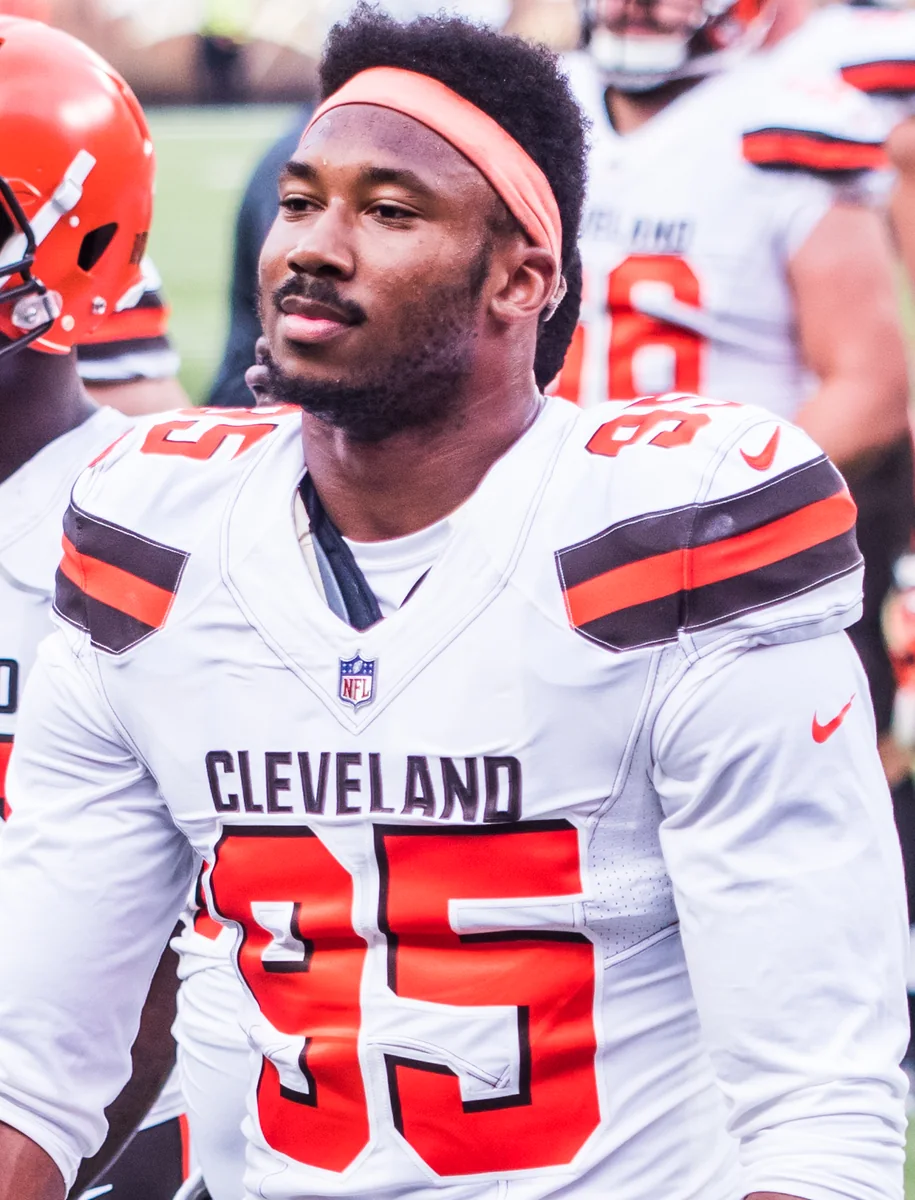

The half-sack margin matters here. Moving from 22.5 to 23.0 is enough to hold the record outright rather than share it. A rounded table showing all three players at 23 would obscure the achievement. Read the decimal before deciding whether a record was tied or broken.
For an earlier season discussed in a historical list, return to the 1982 distinction. A reconstructed pre-1982 total belongs with its historical label, while Garrett's achievement leads the official category. Keeping those descriptions clear allows fans to recognize an older pass rusher's peak without rewriting what a contemporary record announcement actually means.
Why position and pass-rush opportunity matter
The sack leaderboard includes players with different jobs. A defensive end attacking from the edge, an outside linebacker used as a rusher and a defensive tackle working inside can all earn sack credit. Their route to the passer and their other responsibilities can differ considerably. A position abbreviation alone does not describe every snap.
John Randle illustrates why an interior defender belongs in a discussion of great pass rushers. The Hall of Fame lists the defensive tackle with 137.5 career sacks. Looking only for players labeled defensive end would miss that production. At the same time, combining every linebacker into one comparison can put frequent rushers beside players who spend much more time in coverage.
When a broadcast calls someone an edge rusher, think about where and how he attacks rather than insisting that every team's roster must use the same abbreviation. Teams can label a player differently while giving him a similar pass-rush assignment. For a specific club, begin with its roster and watch the alignment in the game. Our NFL teams page can help you find the team you want to follow.
Opportunity is another useful question. Two defenders can appear in the same number of games and still have different numbers of chances to rush a passer. One may rotate on passing downs, another may have broader run responsibilities, and their opponents may throw at different rates. Games played is helpful context, but it does not equal pass-rush snaps.
A sack total therefore works best alongside an understanding of the player's assignment. If you add a rate statistic, read its denominator. Sacks per game and sacks per pass-rush opportunity answer different questions. A table sorted by one should not be described as a ranking by the other, and a smaller sample deserves care before declaring a new player better than a long-established star.
Finally, watch how the whole defense creates the chance. Good coverage can make a passer hold the ball; one rusher can attract protection while another arrives. Those patterns explain why the replay is valuable even after you know who received credit. They add context to an official sack without requiring you to change the credited player's total.
Following active sack leaders without mixing the numbers
Active players can climb the career list during the season, so a saved article is a dated reference rather than a live scoreboard. On October 11, 2026, the Cowboys' career table for Von Miller displayed 138.5 sacks. Use the career total when comparing him with retired players; the current-season row answers a different question.
Team changes make the distinction especially useful. Miller's earlier sacks remain part of his league career after joining Dallas. Garrett's move to the Rams likewise does not erase his Cleveland production or alter which franchise he represented during his record season. The Rams' 2026 newcomer profile explains his arrival. A historical Browns photograph should be read with its date, rather than used to infer his current team.
Before a milestone game, read the player's official career page and check the latest completed game in the log. Choose regular-season statistics for a comparison with this article's table. If a broadcast uses a combined regular-season and postseason figure, keep that label attached instead of transferring the number into a regular-season ranking.
Next, find when his team plays on the NFL games today schedule. Watch for the final credited total after the game rather than relying exclusively on an instant graphic during the play. A shared sack can change the arithmetic of a milestone, and the final box score is the practical place to confirm the result.
Quick answers about NFL sack records
Who has the most official career sacks? Bruce Smith, with 200 regular-season sacks. Reggie White follows with 198. The table near the top of this guide lists the leading five completed career totals within that official category.
Who holds the official single-season record? Myles Garrett, with 23.0 in the 2025 regular season. It is a season record, separate from Smith's career mark. The previous shared mark was 22.5.
Why do old lists give Deacon Jones a different place? His reconstructed total describes a career before sacks became official in 1982. Look for that label before comparing his number with the official leaderboard.
Do half sacks count toward career records? Yes. They are credited shares of sacks and remain in the total. Do not round a player's decimal away when checking a tie or a record chase.
Are playoff sacks included here? No. This guide's career and season figures are regular-season figures. A separate postseason list can recognize playoff production without changing the scope of these records.
Comments