
To compare NFL all-time records by position, choose the right statistic first: passing for quarterbacks, rushing for running backs, receiving for wide receivers and tight ends, defensive categories for defenders, and separate kicking or return records for specialists. Then decide whether you mean a career, a season or one game. This guide uses familiar record holders to explain those choices, including why a receiving list can contain tight ends and why offensive linemen need a different comparison.
Choose the record category before comparing players
NFL records are organized by the statistic and its time frame, not by one universal score for each position. A quarterback's passing total, a safety's interceptions and a kicker's points describe different work. Start by choosing the category you want to compare, then use a position filter when the question specifically requires one.
| Position or role | Useful starting categories | Important distinction |
|---|---|---|
| Quarterback | Passing yards, passing touchdowns, rushing | Passing and rushing remain separate |
| Running back | Rushing yards, rushing touchdowns, scrimmage production | Receiving gains are not rushing gains |
| Wide receiver or tight end | Receptions, receiving yards, receiving touchdowns | All receivers and one position are different filters |
| Defender | Sacks, interceptions and other defensive categories | Different assignments create different opportunities |
| Kicker or returner | Points, field goals, punt or kickoff returns | Scoring and return types need clear labels |
| Offensive lineman | Games, starts, durability and defined blocking measures | Rushing and passing yards do not capture his usual job |
Next choose career, season or single game. These are three different achievements, so a player can own one record without leading the other two. The record-holder examples below use regular-season figures and were reviewed on October 11, 2026. Postseason and combined totals need their own labels.
Finally, distinguish a total from a rate. More yards is different from more yards per attempt, and a tiny sample is different from a full career. If a table ranks an average, read its qualifying minimum before calling the first row an all-time record. A statistical category's definition matters as much as its number.
Quarterback records: passing yards and touchdowns
Tom Brady's regular-season career records are 89,214 passing yards and 649 touchdown passes. His NFL career statistics provide the totals. These accumulated figures are different from the best passing production in one season or one game.
For the season category, Peyton Manning's 2013 Denver campaign produced 5,477 passing yards and 55 touchdown passes. The Broncos' record book identifies both as NFL records. Manning's peak season and Brady's career totals can therefore be the correct answers to different passing-record questions.
The single-game yardage example is different again: Norm Van Brocklin passed for 554 yards for the Rams against the New York Yanks in 1951. The Hall of Fame's account identifies the record and the opponent. It should not be confused with a New York Giants game just because the historic team name is unfamiliar.
When reading a graphic, look for career, season or game before comparing its figure with a number you remember. Also keep touchdown passes distinct from touchdowns personally scored. Throwing the scoring pass is its own statistical credit; it does not add six individual scoring points to the passer's ordinary points total.
Keep quarterback rushing in its own category
A quarterback's rushing gains do not increase his passing-yard total. A dual-threat performance can be impressive in both columns, but adding them creates a combined measure that must be labeled. It is not an ordinary passing record.
The same care applies to averages. Passing yards per attempt and rushing yards per carry use different plays as their denominator. Read each category separately before arguing that one player's combined production proves he leads every quarterback statistic. A career record identifies an achievement, while a broader discussion of quarterback play can consider several achievements together.
Running back records: career, season and single-game rushing
A rushing record needs a time frame as well as a player name. Career yards tell you how much a runner accumulated across his seasons; a season record measures one year's output; a game record captures one afternoon. All three belong in a running back discussion, but putting their numbers in one ranked column would make the comparison meaningless.
| Regular-season category | Record example | What the number measures |
|---|---|---|
| Career rushing yards | Emmitt Smith: 18,355 | Production across his NFL career |
| Season rushing yards | Eric Dickerson: 2,105 in 1984 | Production during one Rams season |
| Single-game rushing yards | Adrian Peterson: 296 in 2007 | Production in one Vikings game |
Emmitt Smith and Eric Dickerson answer different questions
The Hall of Fame lists Smith's career rushing total as 18,355 yards. That total rewards sustained production over years. It does not mean Smith also owns the largest individual season. Dickerson ran for 2,105 yards for the Rams in 1984, establishing the season benchmark in a 16-game campaign.
If you are following a runner's season-long chase, Dickerson's number is the relevant target. If the broadcast is discussing a veteran's place on the career list, use Smith's total. Games played and workload add useful context, but they do not change which column the milestone belongs in. A runner's receiving yards also remain separate: yards from scrimmage combine rushing and receiving, whereas a rushing record counts the ground production alone.
What a single-game rushing record measures
Peterson's 296-yard game came against the San Diego Chargers on November 4, 2007. Use that opponent name when describing the historical game, even though the franchise later moved to Los Angeles. A single-game chase starts with the runner's rushing total in that game's box score; it does not include his receiving yards or the team's other rushers.
One huge game can be memorable without deciding a career comparison. For a fan watching the fourth quarter, however, that narrow category is exactly what matters: how many rushing yards this player has gained today and how far he is from the single-game mark.
Wide receiver and tight end records share receiving categories
Receiving yards describe the result of completed passes, rather than a position reserved for wide receivers. Tight ends and running backs can accumulate them too. If a leaderboard says “receiving yards” without a position restriction, expect players from more than one offensive role.
Jerry Rice's career receiving total is 22,895 yards. That is the career benchmark, while Calvin Johnson's 1,964 yards in 2012 provide the single-season benchmark. Johnson's big year does not replace Rice atop the career category. When a receiver approaches a milestone, first establish whether the graphic on television is counting his current season or his entire career.
Catches, receiving yards and receiving touchdowns also describe different outcomes. A player with many short catches can lead in receptions without leading in yards. A high yardage total does not automatically mean the same player leads in touchdown catches. Choose the column that matches the question before discussing the record.
Use a tight end filter for a tight end record
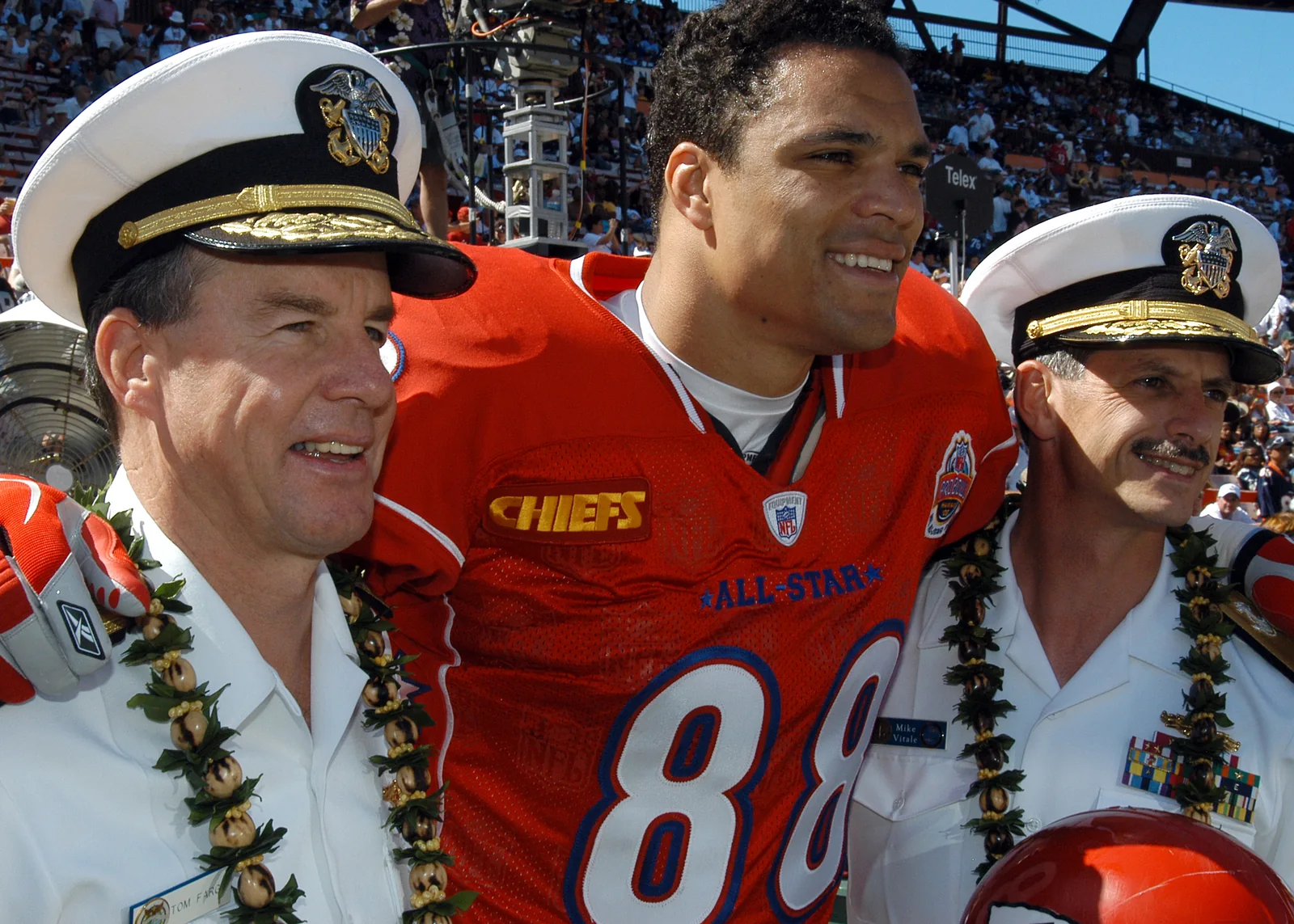
Tony Gonzalez finished with 15,127 regular-season receiving yards, a useful career benchmark for tight ends. A tight end comparison excludes wide receivers such as Rice. The position filter changes the group you are comparing; it does not create a different kind of receiving yard.
Check how a statistics service labels hybrid players before comparing two lists. A broad receiving table and a TE-only table can legitimately show different leaders because they answer different questions. For a tight end's full football contribution, receiving totals are only one part of the discussion: the chart does not by itself measure his blocking or tell you how his offense used him.
Defensive records: sacks and interceptions
There is no single counting statistic that ranks every defensive job fairly. A pass rusher and a safety have different opportunities. Bruce Smith's 200 career sacks are the official career sack benchmark. Paul Krause's 81 career interceptions lead the interception category. They are separate achievements, rather than competing scores on one defensive leaderboard.
Krause played safety. His place atop the overall interception list does not make him the answer to a question specifically about cornerbacks. Likewise, a sack list restricted to defensive tackles uses a different comparison group from an unrestricted list of pass rushers. Look at the position label before treating the top name as the leader for a narrower role.
An interception total is a count of passes intercepted, rather than a complete coverage grade. It cannot tell you by itself how often a defender was targeted or how his assignments changed. Use the record to describe the achievement it actually measures; keep broader judgments about defensive performance separate.
Remember the 1982 boundary for official sacks
The NFL began treating individual sacks as an official statistic in 1982. The Hall of Fame explains that boundary in its account of Deacon Jones, whose career preceded the official category. Historical sack totals reconstructed from older games can help describe earlier pass rushers, but they must be labeled accordingly.
If two lists disagree, check whether one includes reconstructed sacks from before 1982. A player missing from the official list may have played before the category was recorded; that absence does not mean he never brought down a quarterback. For a milestone graphic, compare official totals with official totals, or clearly identify the historical series you are using.
Kicker and returner records need precise labels
A scoring record and a field-goal record are different categories. Adam Vinatieri finished with 2,673 career regular-season points. His Hall of Fame statistics also list 599 made field goals. The points total includes his extra-point kicks as well as field goals, so those two numbers should never be substituted for each other.
Under the NFL's scoring definitions, a field goal is worth three points and an extra-point kick is worth one. For a kicker nearing a milestone, decide whether you are following points scored, field goals made, extra points made or kicking distance. Each has its own comparison. A career volume record also differs from field-goal percentage: percentage requires the number of attempts, and any eligibility minimum used by that leaderboard.
Return records need an equally careful label. Devin Hester had 14 career regular-season punt-return touchdowns. Those scores belong in the punt-return category, rather than the kickoff-return column. Return yardage measures distance accumulated; return touchdowns count trips to the end zone. A large yardage total does not automatically identify the touchdown leader.
Keep the game type visible too. A memorable Super Bowl return belongs to postseason statistics, while a regular-season career table excludes that game. Combining them silently can make a perfectly familiar highlight produce an incorrect record total.
Punters have their own columns, including punt distance and averages. A player's longest punt is a single event; an average describes his collection of punts. Before comparing averages, read the column definition and attempt requirements. “Special teams record” alone is too broad to tell a fan which achievement is actually being chased.
Offensive linemen need a different statistical comparison
Centers, guards and tackles usually create the conditions for teammates to accumulate offensive yards. The NFL's position descriptions explain their blocking and protection responsibilities. A career passing or rushing table is therefore a poor place to judge an offensive lineman's contribution. His absence from the leading yardage rows reflects the category, rather than a lack of importance.
Participation and durability offer clearer counting milestones. The Hall of Fame credits Browns tackle Joe Thomas with 10,363 consecutive offensive snaps, describing the streak as widely believed to be an NFL record. That wording matters: it is a remarkable documented streak, rather than an invitation to invent a fully standardized historical leaderboard for every snap played by every lineman.
A snap count measures participation. It does not mean every snap produced a successful block, and a long starting streak does not automatically settle which tackle was the best pass protector. Games, starts and snaps can describe availability; evaluating protection or run blocking also requires attention to the player's assignments and the plays themselves.
If you use a grading service, read its definition and coverage period before making an all-time claim. A grade from recent seasons should not be treated as a career record stretching back to the league's earliest years. The same caution applies to any chart that counts pressures allowed or assigns responsibility for sacks.
For fans discussing a lineman's milestone, the clearest wording names the achievement directly: consecutive snaps, starts or games played. Leave the larger performance debate open to the additional evidence it needs. A precise durability claim is more useful than assigning a fictional “career blocking yards” total.
How to check a record before a milestone game
Start with the exact claim you want to follow. “Career regular-season receiving yards by a tight end” gives you a usable search and comparison. “Best NFL record” leaves the position, statistic and time frame unanswered. Write down those details before comparing a player's current total with a historical mark.
Next, open the player's official statistics and read the table heading. The NFL's player statistics pages separate categories and show team-by-season rows. A whole-career total can include more than one franchise. A club record uses only the production credited to that club, so it may have a different leader.
For an active chase, check the date of the total and whether the latest game has been included. Then use NFL team schedules to locate the player's next matchup, or check today's kickoff times and TV channels when you want to watch. Those schedule pages help you find the game; the record comparison still comes from the appropriate statistics category.
Quick answers about NFL records by position
Is there one all-time NFL record for each position? No. Quarterbacks have separate passing and rushing categories, while receivers can be compared by catches, yards or touchdowns. A useful record claim always names the statistic and time frame.
Do the career examples here include playoff games? No. The numerical career, season and game benchmarks in this guide use regular-season statistics. Postseason records belong in a separate comparison unless a total is explicitly labeled as combined.
Why can a tight end appear on an all-time receiving list? Receiving is a statistical category, not a wide-receiver-only position. Use a TE filter when your question is specifically about tight ends.
Does holding a record make a player the best ever? The record establishes leadership in that category. A broader comparison also depends on the player's role, era, opportunities and the other evidence you choose to discuss.
Cover photograph: Emmitt Smith's Hall of Fame bust, photographed in 2013, by Erik Drost, CC BY 2.0. Resized and converted to WebP.
Comments