
Jerry Rice leads the NFL in career receiving yards with 22,895, ahead of Larry Fitzgerald's 17,492. These are regular-season totals; playoff receiving yards belong to a separate record. Rice's long lead comes from high production sustained across many seasons, rather than one unusually large game.
The rankings below use completed regular seasons through 2025. Active players keep adding to their records in 2026, so their current career profiles can differ from a completed-season snapshot. This guide explains the leading careers, how receiving yards differ from catches and touchdowns, and which numbers to check when following a receiver's next milestone.
NFL career receiving yards: the top ten
This table covers NFL regular-season career receiving yards through the 2025 season. It combines a player's production across his NFL teams and excludes postseason games. The leaders' completed career totals are recorded in the Texans' comparison of the top ten pass-catchers; Rice's and Fitzgerald's figures also appear in their official Hall of Fame profiles.
| Rank | Player | Position | Career receiving yards |
|---|---|---|---|
| 1 | Jerry Rice | WR | 22,895 |
| 2 | Larry Fitzgerald | WR | 17,492 |
| 3 | Terrell Owens | WR | 15,934 |
| 4 | Randy Moss | WR | 15,292 |
| 5 | Isaac Bruce | WR | 15,208 |
| 6 | Tony Gonzalez | TE | 15,127 |
| 7 | Tim Brown | WR | 14,934 |
| 8 | Steve Smith Sr. | WR | 14,731 |
| 9 | Marvin Harrison | WR | 14,580 |
| 10 | Reggie Wayne | WR | 14,345 |
WR means wide receiver; TE means tight end. Gonzalez's place among the wide receivers is particularly useful for new fans: receiving yards measure the result of catching passes, rather than a category reserved for one position. Running backs can accumulate receiving yards too, even when running the ball is their main job.
Rice's margin over Fitzgerald is 5,403 yards. That gap is larger than several strong seasons added together. It explains why a receiver can pass famous names on the list and still remain a long way from first place.
The numbers are league career totals, so they should not be compared directly with a single team's receiving record. A receiver who changed clubs retains everything he gained throughout his career; the franchise record counts only what he did for that club. Fitzgerald's entire NFL career was with Arizona, while other players on the table produced for several teams.
Keep the question narrow when reading the order. It tells you who accumulated the most receiving yardage, not who had the most catches, the most scoring receptions or the strongest one-year peak. Those separate views can change the order substantially and make players' different strengths easier to appreciate.
Why Jerry Rice's career lead is so large
Rice combined a long career with repeated high-output seasons. His Hall of Fame profile records 20 seasons and 14 seasons with at least 1,000 receiving yards. He also led the league in receiving yardage six times. Longevity explains the number of opportunities; those repeated league-leading seasons show what he did with them.
Think of a career record as a stack of season totals. A brilliant peak adds one large layer. Staying productive over the next several years keeps the stack growing while other careers slow down or finish. Rice's record requires both parts of that story, so it cannot be reduced to simply playing for a long time.
Consistency matters to fans because a receiver's opportunities can fluctuate sharply. A quarterback change, an injury or a different role can affect how often the ball comes his way. Maintaining a useful role through those changes helps explain why some stars remain on the career list long after their most memorable season.
That does not mean every year has to equal the peak. A productive later season still adds to the same career total. For someone chasing a large gap, the question is whether enough strong seasons remain, rather than whether one spectacular performance could close it.
Production after leaving San Francisco
Rice is closely associated with the 49ers, but his career total also includes Oakland and Seattle. His first two Raiders seasons produced 1,139 receiving yards in 2001 and 1,211 in 2002. Together, those two seasons added 2,350 yards after his San Francisco career had ended.
The Raiders' historical profile describes his Oakland years and separates them from his league career achievements. This is an easy place to understand the difference between an NFL record and a franchise record: the later yards extend Rice's NFL total, while they do not extend his 49ers-only total.
When watching highlights, keep the uniform and season in mind. A montage can mix several teams and competitions while a statistical page measures only one of them. Checking the year-by-year table lets you connect a familiar play to the correct part of the player's career.
Use our NFL team directory when you want to follow the current clubs connected to those careers. The schedule gives you the next game to watch; the historical table tells you whose records today's receivers are chasing.
Receiving yards, catches and touchdowns measure different things
A reception counts a completed catch. Receiving yards describe the gain credited on that passing play. A receiving touchdown records a scoring catch. A player can contribute heavily in one category without leading all three, which is why changing the column can change the leaderboard.
Gonzalez is a simple historical example. He sits sixth in the yardage table, while the Hall of Fame's through-2025 receptions list places him third. His position does not change; the question changes from accumulated yards to accumulated catches.
A target is another distinct measure: the ball was directed toward the receiver, but it may not have been caught. Checking targets alongside receptions can help you understand opportunity. Avoid treating every uncompleted target as solely the receiver's mistake; placement, coverage and the circumstances of the throw matter.
Air yards and yards after the catch
Yards after the catch, or YAC, are the yards gained after the receiver catches the ball. They help distinguish the catch point from what the receiver does next.
Here is a clean hypothetical play with no penalty, fumble or lateral. The offense starts at its own 20-yard line. The receiver catches the pass at the 28, then advances to the 35. He gains 15 receiving yards: eight from the line of scrimmage to the catch point, plus seven after the catch.
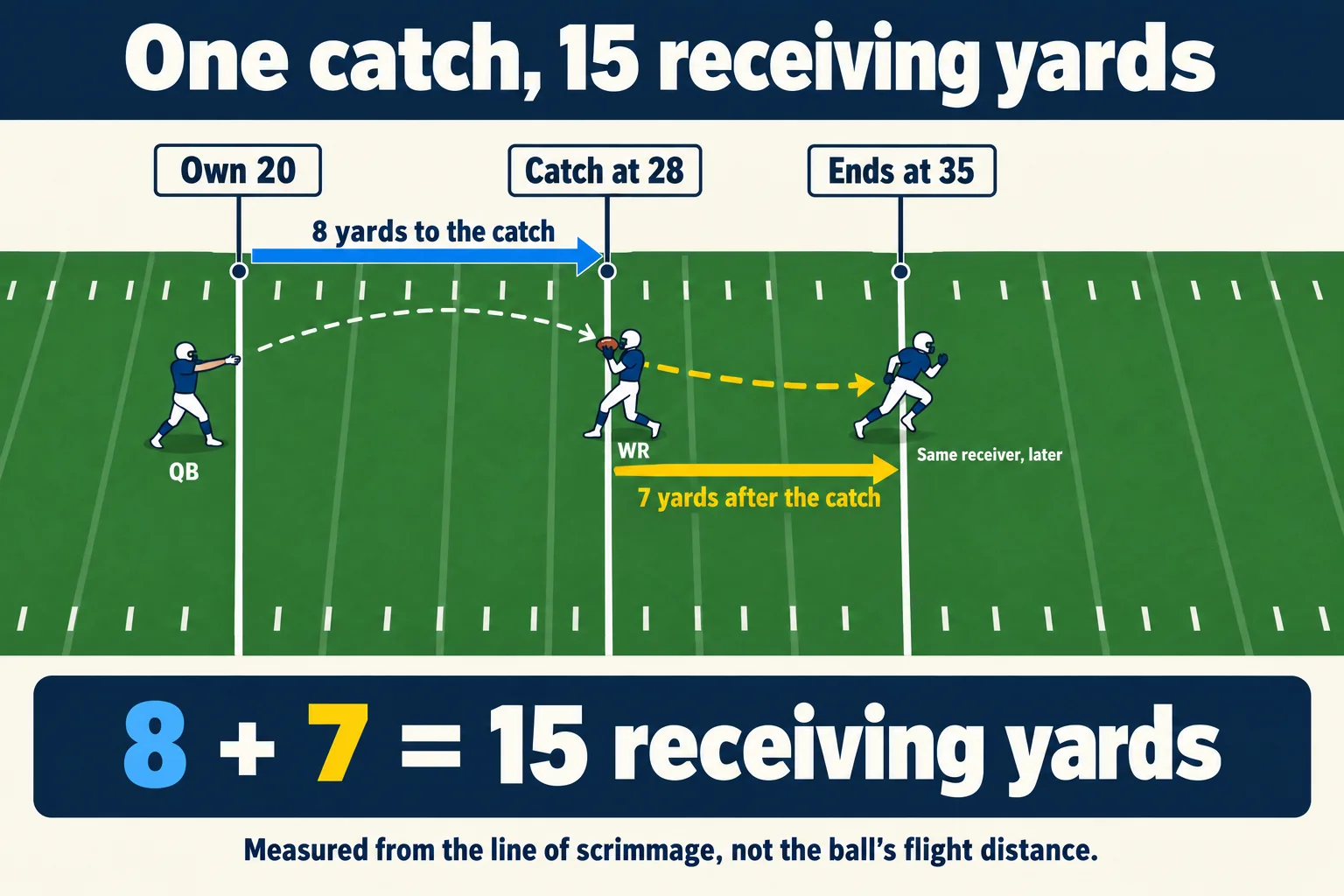
The credited gain is measured from the line of scrimmage. It is not simply the distance the football travels from the quarterback's hand, which may be several yards behind that line. When watching a short pass turn into a large gain, follow the receiver after the catch as well as the throw.
Reading yards per catch without missing the receiver's job
Yards per catch divides receiving yards by receptions. In a hypothetical comparison, 1,200 yards on 100 catches gives 12.0 yards per catch; the same yardage on 60 catches gives 20.0. The second receiver gained more per completed catch, but that does not automatically tell you which player better served his offense.
A deep route and a short third-down option ask for different work. A short catch that moves the chains can be exactly what the offense needed, while an explosive gain may create a scoring chance from far away. Read the average with the route mix, first downs and workload in mind. That turns a statistical abbreviation into something you can recognize during the next game.
Playoff receiving records need their own comparison
Rice finished with 2,245 postseason receiving yards, a separate total from his 22,895 regular-season yards. The Raiders' historical profile records that completed playoff figure. Adding them gives 25,140 combined yards, but a combined number must be labeled and compared with another player's combined number.
A useful playoff comparison shows why the selected column matters again:
| Player | Career playoff receiving yards | Career playoff receptions |
|---|---|---|
| Jerry Rice | 2,245 | 151 |
| Travis Kelce | 2,078 | 178 |
These figures were checked against the Raiders' Rice profile and the Chiefs' Kelce biography on October 11, 2026. Kelce has more postseason catches in this comparison, while Rice has more postseason yards. A headline about a reception record should not be read as a claim that the yardage record changed too.
Career playoff production depends partly on the team's opportunities. Qualifying for the postseason makes another game possible; advancing makes additional games possible. A first-round bye removes an early game from that year's workload. Great individual performances matter, but the number of games cannot be separated completely from the team's path.
A single postseason is another category again. Fitzgerald's 2008 playoff run produced 546 receiving yards over four games, as recorded in his Hall of Fame profile. That concentrated run illustrates a postseason peak, whereas Rice's career playoff total sums his opportunities over many years.
Season labels can also look confusing because the playoffs occur after the calendar changes. Games in January and February can belong to the season that began the previous autumn. Check the football season label, not only the date printed on the game.
Our NFL playoff bracket guide explains how the tournament progresses. Use that format alongside the statistical scope, and you can distinguish a career record, one postseason's production and a single Super Bowl performance without mixing their totals.
A great season is different from a career record
A season leaderboard shows who gained the most receiving yards during one campaign. The career leaderboard adds those campaigns together. A receiver can have an extraordinary peak and finish outside the career top ten because the length and shape of his career differ from the players above him.
The same distinction applies to a streak or a selected date range. A claim about the most yards in a player's first five seasons describes those five seasons, rather than his eventual career standing. Before comparing a graphic with this table, read the small print about the interval.
Calvin Johnson's 2012 benchmark
Calvin Johnson's 2012 Detroit season produced 1,964 receiving yards on 122 catches in 16 games. The Lions' 2012 statistics record those numbers. That season is one of the clearest examples of how a receiver's peak can stand apart from his career accumulation.
Johnson finished his nine-season career with 11,619 receiving yards, according to his Hall of Fame profile. That puts his career total below the top ten shown here, even though his 2012 season became a major NFL receiving benchmark. The two statements are compatible: they measure different spans.
Dividing his 1,964 yards by 16 gives 122.75, or about 122.8 yards per game. The average helps describe the pace he actually maintained. It does not tell us what he would have produced with a different schedule or what another receiver will gain in the next matchup.
The season also included five receiving touchdowns. A large yardage total and a smaller scoring total can coexist because gaining field position and finishing a drive are separate events. A catch that sets up a short rushing score still adds receiving yardage, but that later rushing touchdown is credited to the runner.
When following a season-record chase, check games played, remaining opportunities and the current total. Then keep any forecast clearly labeled. A pace graphic is a useful conversation starter; the record changes only when completed plays add enough actual yardage to the official total.
Following active receivers and choosing the right leaderboard
Established active pass-catchers such as Mike Evans, Travis Kelce and Davante Adams provide several different milestone stories. This is a watch list, rather than a complete ranking of every active player. Their current profiles are the place to check the next step in those careers.
Evans' NFL profile showed 13,265 career receiving yards on October 11, 2026. Kelce's Chiefs career table showed 13,248 that day, compared with 13,002 through 2025. That 246-yard difference comes from his 2026 regular-season production. These dated examples should not be mistaken for continuously updating figures.
Be especially careful with the prose underneath a statistical table. A biography may describe a milestone at the start of the season while the table already includes newer games. The Rams' Adams profile, for example, contains a current career table alongside earlier career summaries. Match the cutoff before using either in a comparison.
How to check a milestone before kickoff
- Find the official player career page and select the receiving category.
- Confirm that the total covers regular-season NFL games, rather than the latest season or one franchise.
- Read the career total and the latest completed-game row, noting the date checked.
- Subtract that total from the next historical target to find the remaining yards.
- Recheck after the game using the final statistics, rather than assuming a broadcast's early running total is final.
Check availability and the current team before setting up a watch party. A familiar veteran may have changed clubs, and being on a roster does not guarantee he will play that week's game. Our NFL games today schedule helps you find the matchup to watch once you know the relevant club.
The remaining-yard calculation is a gap, not a promise about when the player will pass it. A receiver's workload can change with the matchup, quarterback and injury situation. Enjoy the chase while keeping the difference between an opportunity and a completed achievement clear.
Quick answers about career receiving yards
Who leads the NFL in all-time receiving yards? Jerry Rice, with 22,895 regular-season receiving yards.
Do playoff yards count in that career record? They are tracked separately. A combined total is valid only when clearly labeled.
Can tight ends appear on the receiving-yard list? Yes. Gonzalez appears sixth in the through-2025 top ten; the category includes receiving production across positions.
Does a receiver's rushing yardage go into receiving yards? No. A handoff's rushing gain belongs in rushing statistics, even if the ball carrier usually plays wide receiver.
Comments