
Tom Brady leads the NFL in career regular-season passing yards with 89,214 and passing touchdowns with 649. Drew Brees is second in both categories. Those figures exclude playoff games: postseason passing has its own record book, and combining the two without a label changes the question.
This guide separates career, single-season and single-game records, explains why yardage and touchdown rankings differ, and shows how to follow active quarterbacks moving up the lists. The main yardage table uses a clearly labeled start-of-2026 baseline; in-season updates are discussed separately so an older snapshot is not presented as a live total.
Who leads the NFL in career passing yards?
Tom Brady is the NFL's career regular-season passing leader with 89,214 yards. Drew Brees is second with 80,358. The difference is 8,856 yards, a useful reminder that the top position reflects an enormous amount of production over many seasons rather than one exceptional game.
The table below is a start-of-2026-season baseline, covering career regular-season statistics through the end of 2025. It is not a live in-game leaderboard. Aaron Rodgers and Matthew Stafford can add yards during 2026, so their displayed totals should be read with that cutoff. The Hall of Fame's career list supplies the ranking baseline; Ryan finished with 62,792 yards in his official NFL statistics.
| Rank at start of 2026 | Quarterback | Career passing yards |
|---|---|---|
| 1 | Tom Brady | 89,214 |
| 2 | Drew Brees | 80,358 |
| 3 | Peyton Manning | 71,940 |
| 4 | Brett Favre | 71,838 |
| 5 | Aaron Rodgers | 66,274 |
| 6 | Matthew Stafford | 64,516 |
| 7 | Ben Roethlisberger | 64,088 |
| 8 | Philip Rivers | 63,984 |
| 9 | Matt Ryan | 62,792 |
| 10 | Dan Marino | 61,361 |
Changing teams does not restart a player's career total. A quarterback's yards with different franchises belong together in the career column, while each franchise can maintain a separate team record. Consequently, being a club's all-time leader and being the league's all-time leader are different accomplishments.
A top-ten appearance also should not be read as a complete ranking of quarterback quality. Playing time, durability and the number of passes in an offense affect how quickly a total grows. A player with a shorter career can have an outstanding peak without accumulating the same career volume.
What counts as a passing yard?
Passing yardage follows the gain on a completed forward pass, including the receiver's advance after the catch. In a simple example, a catch five yards beyond the line followed by a ten-yard run produces fifteen passing yards for the passer and fifteen receiving yards for the catcher. It is not fifteen extra yards for each player added to the team's gain.
A quarterback's rushing yards are a separate category. Incomplete passes add no passing gain. NFL sack yardage is also treated differently in individual and team displays: a passer's individual passing-yard total is not reduced by sack losses, while team net passing accounts for those losses. Before comparing a career player table with a team box score, check whether the latter says net yards.
Career passing touchdown leaders: why the order changes
Brady's 649 regular-season touchdown passes lead the category. Brees finished with 571, leaving a gap of 78. The top group at the start of 2026 shows why sorting by touchdowns produces a different order from sorting by yards.
| Rank at start of 2026 | Quarterback | Career touchdown passes |
|---|---|---|
| 1 | Tom Brady | 649 |
| 2 | Drew Brees | 571 |
| 3 | Peyton Manning | 539 |
| 4 | Aaron Rodgers | 527 |
| 5 | Brett Favre | 508 |
These are regular-season career figures through 2025, following the Hall of Fame's touchdown-pass list. Rodgers ranks ahead of Favre here, while Favre is ahead of him in the yardage baseline. Different columns answer different questions, even when many of the same names appear near the top.
Passing touchdowns and total touchdowns are different
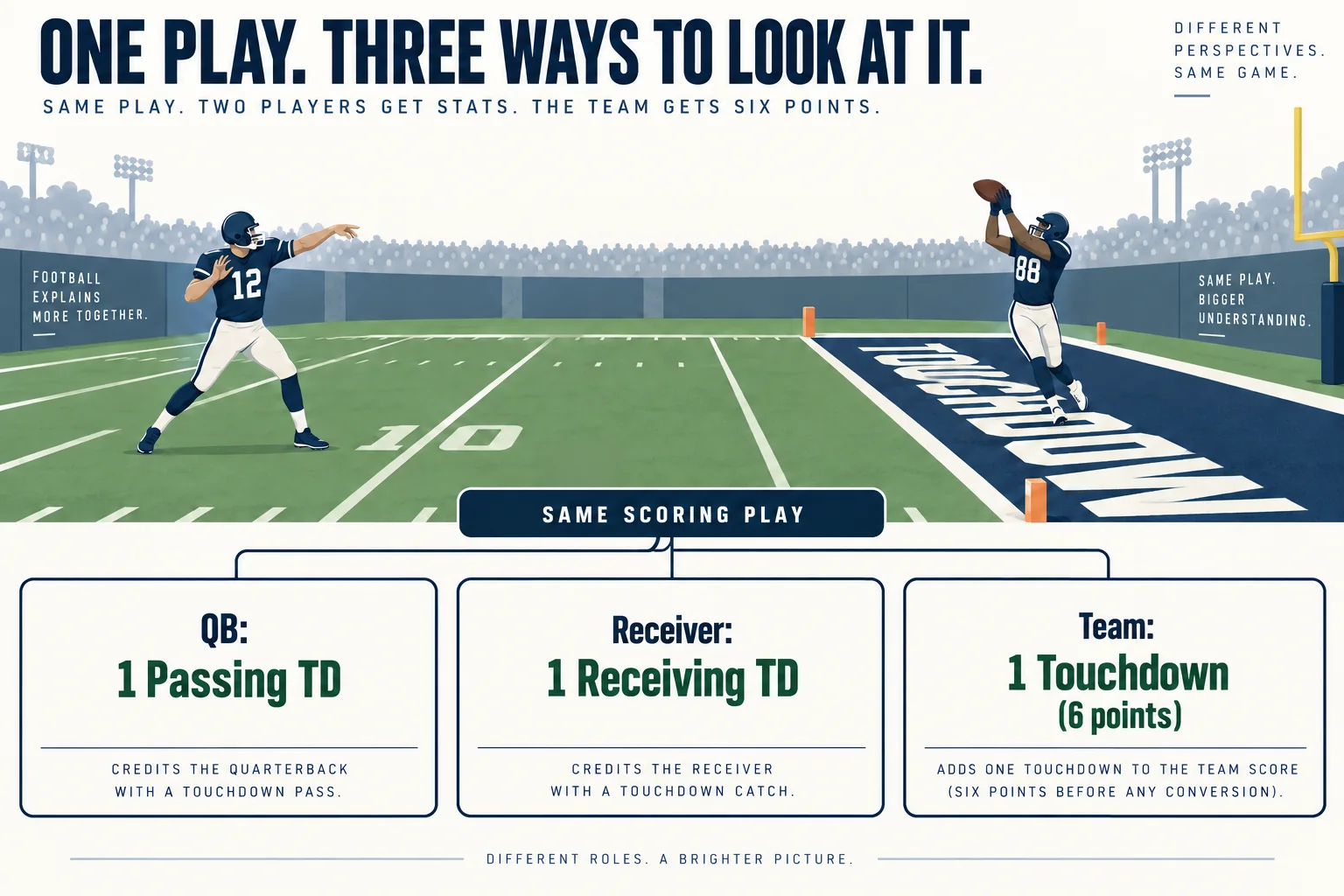
Imagine a quarterback completing a pass that a receiver takes into the end zone. The passer gets one touchdown pass and the receiver gets one receiving touchdown. Their team has scored one touchdown worth six points before the conversion attempt. The two player credits describe contributions to the same score, rather than two separate touchdowns for the team.
If the quarterback instead runs into the end zone, that is a rushing touchdown. It does not increase his passing-touchdown career total. This distinction is especially useful for fans comparing a mobile quarterback with a passer whose team finishes most scoring drives through the air.
Also check the heading on a total-touchdowns leaderboard. Lists of touchdown scorers and lists of touchdown passes can use different categories. Reading only the word touchdowns can lead to an incorrect comparison between quarterbacks, receivers and running backs.
What the leaders show about volume and efficiency
A career touchdown total measures accumulated scoring passes. Touchdown percentage asks how frequently a pass attempt becomes a touchdown. For an invented example, thirty touchdowns from six hundred attempts is five percent, while thirty from five hundred is six percent. The total is identical but the rate differs. Neither imaginary line is a claimed season for a real player.
Use both volume and rate when assessing a career. Then ask about opportunities: how often did the offense throw, how often did it reach scoring range, and how often did it choose a run near the goal line? Those questions help explain a total without turning it into an automatic verdict about who played best.
Why playoff passing records belong in a separate table
Brady's postseason record is a separate achievement: 13,400 passing yards and 88 touchdown passes, compiled in 48 playoff starts. His Patriots Hall of Fame biography records those completed career figures. Super Bowl games are included in postseason statistics, while preseason games belong to neither the regular-season career table nor the playoff table.
| Brady's competition scope | Passing yards | Touchdown passes |
|---|---|---|
| Regular season | 89,214 | 649 |
| Postseason | 13,400 | 88 |
| Combined, explicitly labeled | 102,614 | 737 |
The combined row is simple addition, not a replacement for the conventional regular-season records. It can answer a fan's question about all meaningful games in a career, but it must not be compared with another player's regular-season-only number. Otherwise the comparison gives one player extra games without telling the reader.
Postseason opportunities also depend on the team's success. A quarterback needs his team to qualify, advance and keep winning to build a large playoff total. A first-round bye reduces the number of games available in that particular postseason, even though earning it is usually a good result for the team. These differences are part of the record's context.
Consider two questions separately: how well did the quarterback perform when given a playoff opportunity, and how much postseason production did he accumulate? Total yards address the second question directly. Per-game and per-attempt measures help with the first, but the opponent, protection and situation still matter.
If you want to understand how those opportunities arise, use our NFL playoff bracket and format guide. It explains the tournament structure rather than mixing playoff statistics into a regular-season leaderboard.
Career, season and single-game records answer different questions
A career leaderboard rewards sustained production across many years. A season record measures a concentrated run of performance. A single-game record captures one extraordinary afternoon or night. The same quarterback can appear on several lists, but the lists do not describe the same achievement.
For a useful football conversation, decide which question you are asking first. Are you comparing longevity, the strongest complete season, or the highest passing total in one game? That choice keeps a career accumulation record from becoming an automatic answer to every debate about quarterback play.
The season records that put career totals in perspective
Peyton Manning's 2013 Denver season produced 5,477 passing yards and 55 touchdown passes in 16 games. Those figures appear in the Broncos' 2013 individual passing statistics. They are his individual numbers, rather than the team's passing total with its other quarterback included.
Dividing 5,477 by 16 gives approximately 342.3 passing yards per game. That calculation describes his actual season; multiplying that average by a different schedule length would describe a hypothetical season. It would not create a new official record, nor show what Manning necessarily would have done in an extra game.
Today's regular season gives each team 17 scheduled games. When comparing a modern season with an older one, check games played as well as the total. A player may miss games, leave an outing early or sit late in the season. Scheduled opportunities and actual participation are two different things.
Also look at whether the quarterback needed unusually high passing volume. Yardage can rise when an offense consistently moves the ball, but it can also rise when a team trails and must throw repeatedly. The total tells you what was gained through the air; attempts, turnovers and the score help explain how it happened.
Single-game records and the danger of comparing one afternoon
Norm Van Brocklin passed for 554 yards against the New York Yanks on September 28, 1951. The Pro Football Hall of Fame's account identifies that performance as the NFL single-game passing yardage record. It is a reminder that an older player can hold a peak record even when modern quarterbacks dominate career accumulation lists.
One game is especially sensitive to its circumstances. In a hypothetical comeback, a quarterback might keep throwing through the fourth quarter; another offense with a comfortable lead might spend that quarter running out the clock. Neither situation makes the recorded yards imaginary, but it changes the opportunity to add more.
Use the single-game list to find remarkable performances, then examine that game's attempts, scoring drives and opponent. Use the career list when you want the wider story. Moving between those views makes the records more interesting without asking one number to settle every comparison.
How to follow active quarterbacks climbing the career lists
Aaron Rodgers and Matthew Stafford are the active quarterbacks near the top of the through-2025 yardage table. Their careers continue beyond that snapshot, so a current player page can show a different number without either table being incorrectly added.
For example, Rodgers' NFL career page showed 67,273 passing yards when checked on October 11, 2026. That is 999 yards above the 66,274 in the completed-season table. This dated example illustrates the update; it does not turn the entire historical table into an October live ranking.
To check the next milestone yourself, open the quarterback's career page, find the Passing table and read its TOTAL row. Do not accidentally take the rushing total or the latest single-season row. Then confirm whether the page is showing regular-season or postseason statistics. A game log can help establish which completed games have entered the total.
Team changes do not reset an NFL career record. Stafford's official career table includes his years with Detroit and Los Angeles. A Rams-only franchise list answers a different question from the league-wide career list. The same distinction matters whenever a familiar quarterback changes uniforms late in his career.
For a milestone watch, subtract the player's current verified total from the target. That gives the remaining yards, rather than a predicted date. Dividing the gap by an average can provide a rough scenario, but injuries, byes, game plans and playing time can all change the pace. A projected crossing should stay a projection until the actual game statistics confirm it.
Our NFL team directory helps you find the club you want to follow, and the NFL games today schedule shows when to watch. During the broadcast, look for a milestone graphic's scope and cutoff. A team record, a regular-season career record and a combined playoff-plus-regular-season figure can all sound similar when announced quickly.
How to compare great quarterbacks without losing the context
Start with equal terms: the same competition, the same statistic and a clearly stated cutoff. Then ask what you want the comparison to reveal. Career yards are a strong description of accumulated passing production, but choosing the greatest quarterback involves more questions than choosing the largest yardage total.
A practical viewing checklist keeps those questions manageable:
- Opportunity: How many seasons, games and attempts did the quarterback have?
- Efficiency: What happened per attempt, and how often did drives end in scores or turnovers?
- Role: Was the offense built around frequent passing, or did it depend more heavily on the running game?
- Environment: Who provided protection, caught the passes and called the plays?
- Era: How did the player compare with quarterbacks facing the same league conditions?
The NFL's Next Gen Stats explanation notes the difficulty of separating quarterback play from teammates and play-calling. That is a useful reason to watch the play as well as read the box score.
In a hypothetical comparison, two passers might finish with the same yardage after very different numbers of attempts. The lower-volume passer gained more yards per attempt, but that alone cannot tell you which offense faced tougher third downs or protected a late lead more effectively. The next useful step is to inspect those situations, rather than inventing an answer from the total.
Historical comparisons work better when you also look sideways at a player's contemporaries. Leading a league by a wide margin in a lower-volume passing environment tells a different story from posting a similar raw number in an environment where many quarterbacks approach it. Career tables are the starting point for that investigation, not the full investigation itself.
Quick answers about NFL passing records
Who has the most NFL career passing yards? Tom Brady, with 89,214 in regular-season games. The conventional career record does not include his postseason yardage.
Who has the most career touchdown passes? Brady also leads the regular-season list with 649. Passing touchdowns are separate from a quarterback's rushing touchdowns.
Do sacks reduce a quarterback's career passing yards? Sack losses are not deducted from individual passing yardage. They affect team net passing yardage, so a team's total and its quarterback's individual total can differ.
Are passing yards the distance the ball traveled in the air? No. A completed pass can include yards the receiver gains after the catch. Air-distance and air-yard measures describe different parts of the play.
Why does an active quarterback have different totals on different pages? Check the cutoff and competition first. A completed-season table, a current career profile and a postseason table each have their own scope. Matching those labels usually resolves the apparent disagreement.
Comments