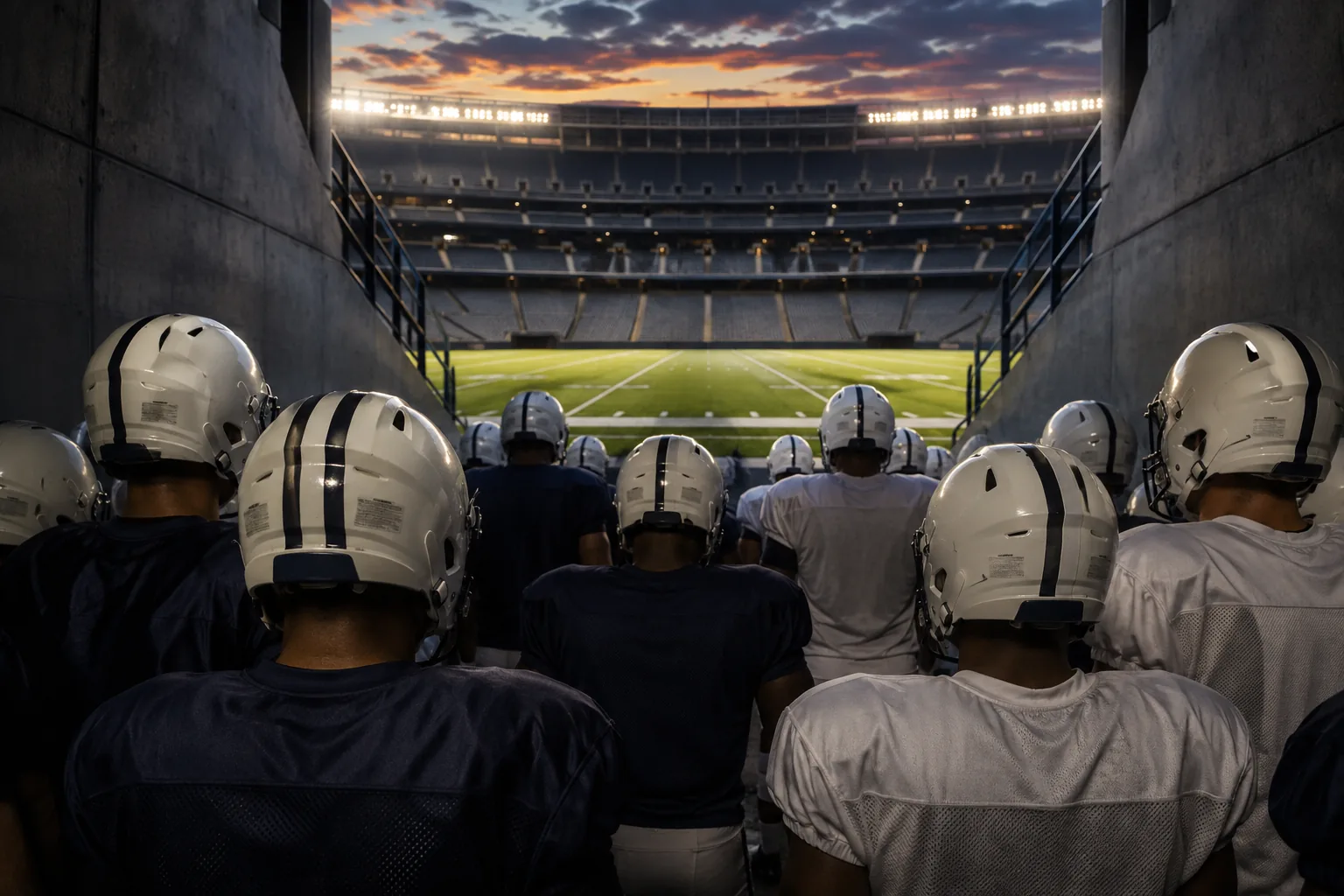
No, NFL preseason games do not count toward the regular-season standings. A team can go 3-0 in August and still begin Week 1 at 0-0. Preseason wins cannot improve playoff position, settle a division race, or enter a regular-season tiebreaker. The games do create a separate preseason record, and every snap can matter enormously to a player fighting for a roster spot, but that is different from counting in the championship season. This guide separates those meanings so you can read an August box score correctly. For current dates and results, use the NFL preseason schedule; for the first games that affect the official standings, go to the NFL Week 1 schedule.
Do NFL Preseason Games Count in the Standings?
NFL preseason games are exhibitions played before the regular season. The score is official for that exhibition, so a team really can win, lose or tie a preseason game. However, the result is stored in a separate preseason record. When the regular season opens, all 32 clubs start at 0-0 regardless of what happened in August.
This separation matters because the NFL's competitive standings are built from the 17 regular-season games each club plays. Division titles, wild-card places and playoff seeding come from that regular-season record. If clubs finish with the same won-lost-tied percentage, the league applies its published postseason tiebreaking procedures, beginning with measures such as head-to-head and division or conference results where applicable. A preseason result is not one of those measures.
| What the preseason game affects | What it does not affect |
|---|---|
| A separate preseason W-L-T record | The regular-season W-L-T record |
| The game's final score and box score | Division rank or a division championship |
| Coaches' evaluation film and depth-chart decisions | Wild-card qualification or playoff seeding |
| Player preparation and roster competition | Regular-season strength of victory or other playoff tiebreakers |
That is the cleanest way to understand the phrase ?the games do not count.? It means they do not count in the standings that lead to the playoffs. It does not mean the rules disappear, the score is imaginary, or teams learn nothing from the game. Preseason and regular season are simply two different accounting periods with different competitive purposes.
Why Do Websites Show NFL Preseason Standings?
Websites show preseason standings because W-L-T is a convenient way to summarize exhibition results. NFL.com itself lets readers select the preseason view and displays wins, losses, ties, winning percentage, points for, points against and streak. Statistical archives do the same. Those columns accurately describe what happened; they just do not determine anything beyond the preseason.
Think of the table as a scoreboard index, not a race for a trophy. It can answer whether a club finished August unbeaten, how many points it allowed, or whether it tied a game. It cannot name a preseason division champion, award a playoff berth or give a club an advantage when the regular season starts. There is no official preseason playoff and no preseason result carries forward into September.
The modern format makes that distinction especially clear. In 2026, 30 teams were scheduled for three preseason games. Arizona and Carolina played a fourth because they also appeared in the Aug. 6 Hall of Fame Game, which the league lists separately from Preseason Weeks 1-3. A table can therefore show some clubs with more games played than others. That would be unsuitable for deciding a championship, but it is perfectly sensible for recording exhibitions.
Winning percentage in a preseason table is normally read the familiar way: wins divided by decisions, with a tie treated as half a win and half a loss when a percentage is displayed. Yet even a perfect percentage is only a description of August outcomes. On the morning of the regular-season opener, the team with the best preseason line and the team with the worst one both have the same official regular-season record: 0-0.
What Happens When an NFL Preseason Game Ends Tied?
A preseason game tied after four quarters ends as a tie; the NFL does not play preseason overtime. The league eliminated overtime from exhibitions in 2021. That change reduced unnecessary extra snaps in games whose results cannot affect playoff qualification, while allowing the W-L-T line to record exactly what happened.
This is one place where an old explanation can mislead a new fan. Before the 2021 change, NFL rulebooks did provide an overtime period for preseason games. The current 2026 rule is different: Rule 16 begins its overtime procedure for tied regular-season and postseason games, not preseason games. A tied regular-season game proceeds to a 10-minute overtime period and can still finish tied if the score remains level when that period ends. A preseason game stops at the end of regulation.
Neither team receives a hidden advantage from that preseason tie. The ?T? may appear in a preseason table and affect the percentage shown in that particular table, but it does not follow either club into Week 1. Coaches still keep the full film and can grade every snap; the league simply has no competitive reason to force a winner.
Do NFL Preseason Stats Count Toward Player Records?
Preseason statistics do not count toward a player's official regular-season or career totals. A quarterback's August passing yards can appear in a preseason box score, but those yards will not increase the career passing total shown for the regular season. The same separation applies to touchdowns, sacks, interceptions, rushing yards and other familiar categories.
The apparent contradiction disappears once you distinguish ?recorded? from ?counted.? The NFL records the game, publishes a box score and can collect detailed tracking data. Coaches can grade the tape snap by snap. Historical references may preserve an exhibition result. But the league's record books separate preseason results and standings from regular-season individual statistics and career leaders.
- Box score: The player's production is recorded under the preseason game.
- Regular-season leaderboard: The production is excluded because the game has a PRE rather than REG season type.
- Career total: The exhibition production does not add to the official regular-season career number. Postseason statistics are also commonly displayed in their own separate category.
- Evaluation file: The snap still becomes evidence that coaches and scouts can use when making a roster or role decision.
The same category discipline helps with awards and fantasy football. An August performance does not put a player ahead in the regular-season rushing race or build an MVP case. Standard seasonal fantasy competition begins with games that count in the fantasy league's schedule, generally NFL Week 1, so preseason box-score points are research rather than banked points. Commissioners of unusual custom leagues should still check their own settings instead of assuming every platform works identically.
Contract incentives require a similar caveat. Many performance clauses are written around regular-season production, playing time or honors, but the actual contract language controls. It is safer to say that a preseason stat is excluded from official NFL season totals than to declare that no privately negotiated provision could ever refer to a preseason event.
Why Preseason Games Still Matter to NFL Teams and Players
A game can be irrelevant to the standings and still change a career. In 2026, clubs moved from expanded 90-man rosters to an initial 53-player roster immediately after the final preseason weekend. That compression makes live snaps scarce evidence for coaches deciding who can fill a role, who belongs on the practice squad and which released player from another club might be an upgrade.
The evaluation is more specific than ?he scored, so he made the team.? A staff wants to know whether an offensive lineman executed the correct protection, a defensive back recognized a route combination, or a receiver contributed when he did not get the ball. Special teams are especially important near the bottom of a roster. Former NFL executive Scott Pioli has explained that core kickoff, punt and field-goal contributors often occupy the final five to ten spots. A reserve receiver's coverage tackle may therefore tell decision-makers more than a late touchdown.
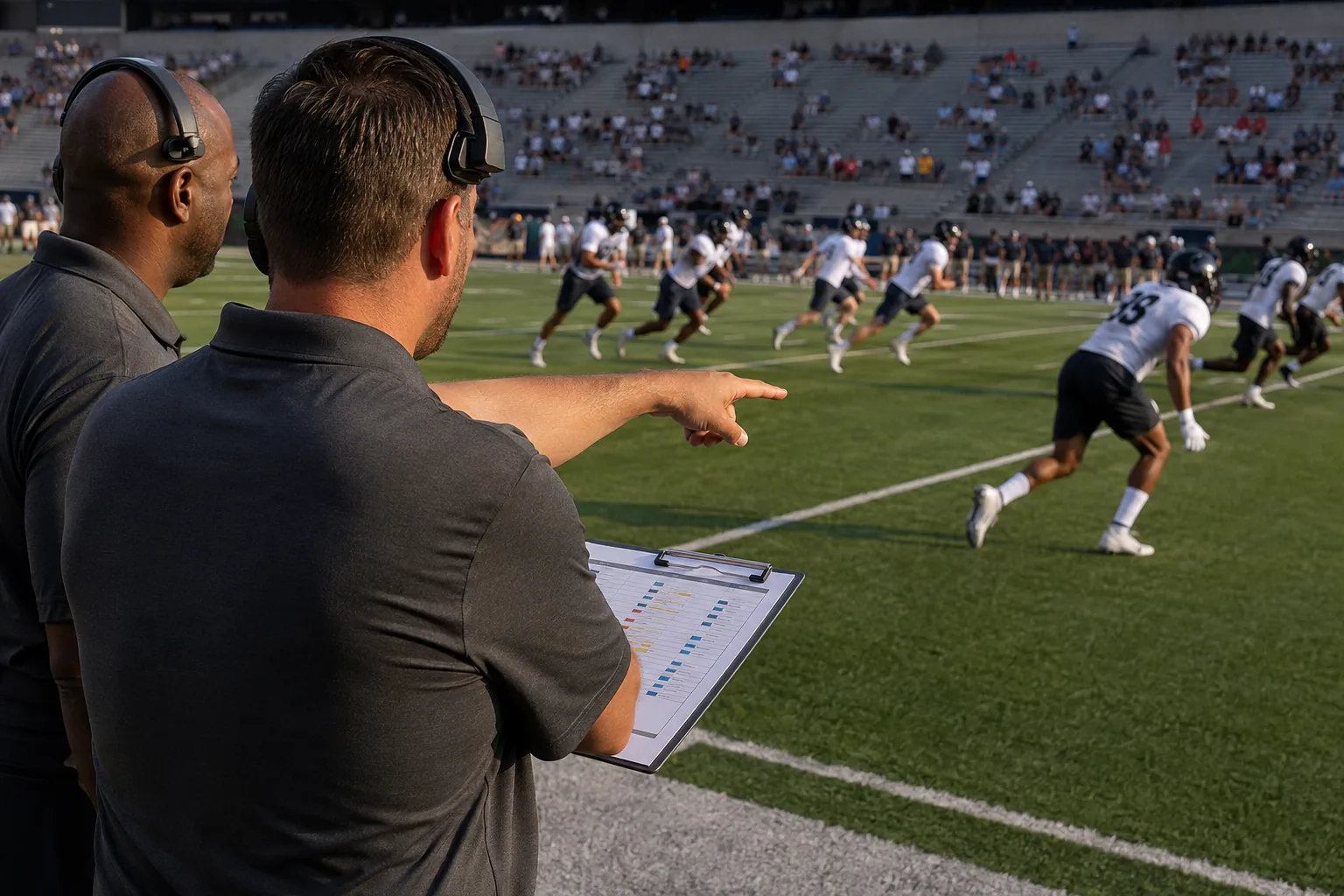
Why starters and roster-bubble players get different treatment
A proven starter has little to gain from another long exhibition appearance and plenty to lose through injury. A rookie, new acquisition or roster-bubble player needs competitive reps against unfamiliar personnel. This is why a fan may see the first-team quarterback for one series, if at all, while third-string players finish the game. Playing time reflects the question a staff needs answered; it is not a reliable ranking of how urgently each team wants the final score.
Joint practices add another layer. NFL.com reported that 28 teams scheduled joint work during the 2026 preseason, giving staffs controlled, opponent-based reps before games. Those sessions can help starters prepare while preseason games allocate more time to unsettled jobs. The public box score captures only the game, not the full evaluation week.
Why the playbook can look plain
Teams also have little incentive to reveal their best Week 1 designs in an exhibition. Official team analysis has described limited preseason game-planning and an emphasis on seeing technique in one-on-one or situational work. A simple call may deliberately test whether a player can win an assignment without schematic help. That makes the film valuable to the evaluator even when the offense looks less creative than it will in September.
So the precise answer is: the result does not count toward the season, but the performance can count toward a job. Use the NFL team schedule directory to place each exhibition in a club's wider preparation timeline.
Does a Winning Preseason Record Predict Regular-Season Success?
A winning preseason record is a poor stand-alone forecast of regular-season success. The problem is not only the small number of games. Teams use different players for different amounts of time, test narrow objectives and often protect important starters or schemes. The two sides may be trying to answer entirely different personnel questions while the scoreboard treats every point equally.
Research supports the caution. A Colorado State University summary of a study covering the 2002-2010 seasons reported that neither preseason winning percentage nor a win in the third preseason game predicted regular-season winning percentage. The researchers contrasted that period with older data from 1970-1991, a useful warning against assuming that findings from the four-game, starter-heavy past automatically describe today's format.
Player-level data tells a similar story. A PFF study found small preseason samples generally less predictive than comparable regular-season work. In its resampling analysis, regular-season samples beat preseason samples every time for blocking and route-running, and in 96% of comparisons for passing. A 2026 PFF review also found that among 45 rookies who earned grades of at least 80.0 in the 2025 preseason, only one later reached a regular-season grade of at least 70.0 while playing 250 or more snaps.
Those findings do not mean you should ignore every August rep. They mean the claim must match the evidence. A 3-0 team record says little about how the first units will perform for 17 games. A reserve tackle repeatedly handling NFL-caliber speed, a rookie processing assignments correctly, or a coverage unit avoiding the same mistake may be useful evidence?especially when it agrees with practice and prior film.
The sensible conclusion is ?weak forecast,? not ?zero information.? Treat preseason wins as entertainment and a record of the exhibitions. Treat repeatable, role-specific performance as one input among many. Do not turn either a perfect August or a winless one into a playoff prediction.
How to Read Preseason Scores Without Overreacting
The final score is the least contextual number in a preseason box score. It combines snaps from starters, backups and roster-bubble players, even though those groups may never play together during the regular season. Before declaring a team improved or doomed, work through five questions.
- Who was on the field? Separate first-unit possessions from later work. A late comeback against deep reserves does not tell you how the starting offense performed, and a starting defense's short shutout should not be credited to every player who finished the game.
- Who was the opponent? A clean rep against a proven starter carries different information from the same rep against someone at the bottom of a 90-man roster. NFL front-office guidance specifically warns that preseason competition levels are inconsistent.
- Did the player execute the assignment? Watch beyond the ball. Protection calls, route depth, gap discipline, tackling angles and special-teams lanes can matter even when the play gains no yards. A receiver may run the correct clear-out route without receiving a target.
- Was the skill repeatable? One long gain can come from a missed tackle or busted coverage. Several correct reads or technically sound reps against different looks are stronger evidence. Also note penalties and mistakes erased from the headline stat line.
- What decision is the team making? Connect the performance to a real question: backup quarterback, final receiver, return specialist, swing tackle or coverage player. A productive night matters most when it demonstrates the exact skill required for an open role.
Imagine two reserve running backs. One finishes with more yards after breaking a single poorly defended run late in the fourth quarter. The other repeatedly identifies pressure, protects the quarterback and contributes on kickoff coverage. The box score favors the first player, but the second may have answered more of the questions attached to the final active-roster spot.
Availability is another essential line of context. A player who leaves the game may create a depth problem even if the team wins comfortably, while a healthy starter held out by design has not ?lost? a competition merely because his replacement accumulated statistics. Confirm absences and roles through team reporting rather than guessing from a blank stat line.
Finally, check whether the schedule or displayed data is current before building an argument around it. Kickoff details and result feeds can be corrected, and the site's NFL schedule data status page explains freshness. The goal is not to drain the fun from August football. It is to enjoy the score while drawing conclusions from the evidence that actually matches the question.
NFL Preseason Rules FAQ
Do preseason wins help a team make the playoffs?
No. Preseason wins do not improve a club's regular-season winning percentage, division position, wild-card chances or playoff seed. They also do not enter the league's postseason tiebreaking sequence. Every team begins the regular season at 0-0.
Does the Hall of Fame Game count?
It counts as an additional preseason exhibition for the two participating teams. Its score and statistics are recorded in the preseason category, but its result does not affect the regular-season standings. In 2026, Arizona and Carolina each had that extra game in addition to the three standard preseason weeks.
Does a preseason win count on a coach's record?
It can be described as a win in that coach's separate preseason record, but it should not be added to the official regular-season career W-L total. When comparing coaches, check the category: regular season, postseason and preseason answer different questions.
Are preseason games real NFL games?
Yes?in the ordinary sense that NFL clubs play in NFL stadiums under league rules, with officials, recorded scores and player-conduct enforcement. ?Exhibition? describes the game's competitive classification; it does not mean a scrimmage with no rules or consequences. Injuries, roster evaluations, penalties and league discipline are real even though the standings impact is not.
What is the first NFL game that counts in 2026?
The first regular-season game is New England at Seattle in the NFL Kickoff Game on Wednesday, Sept. 9, 2026. That is when those teams begin building the record that determines their standings and playoff path. Other clubs begin as their Week 1 games are played; the current Week 1 schedule is the safest place to confirm dates and kickoff details.
The one-line rule to remember is simple: preseason scores count for the preseason record, while regular-season scores count for the road to the playoffs. Watch August to understand players and roles; start the standings clock with Week 1.
Comments